Home → News → 20/5T double beam bridge crane design
20/5T double beam bridge crane design
Abstract and Overview
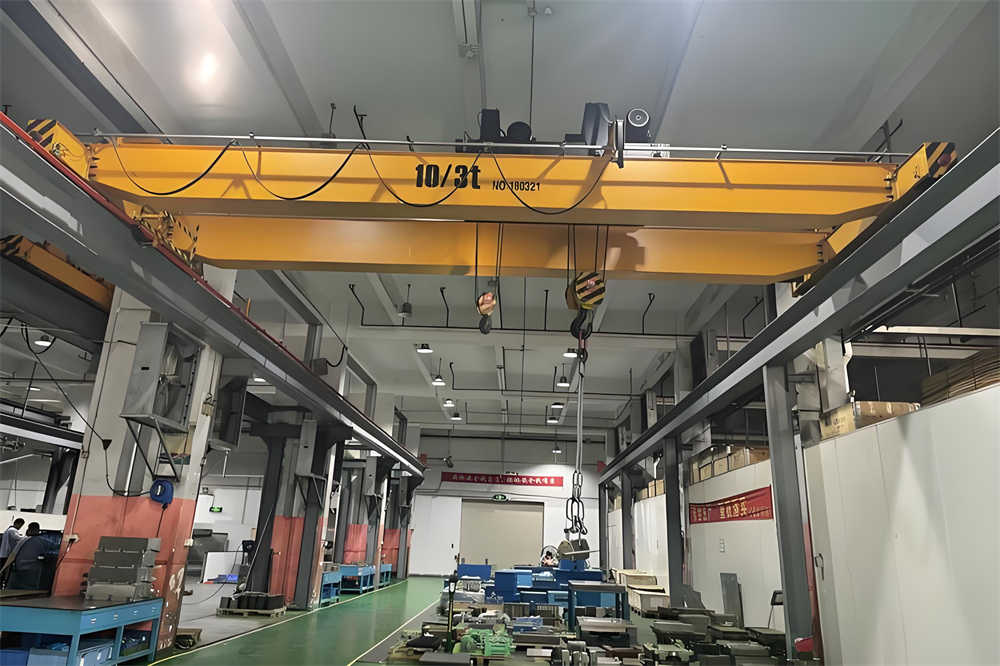
The 20/5T double-beam bridge crane is a material handling equipment widely used in the industrial field. It is mainly composed of a lifting mechanism, a trolley running mechanism, a trolley frame and safety protection measures. The bridge spans the tracks on both sides of the workshop, and the trolley moves on the bridge beam track, so that the hook can reach every corner of the workshop to achieve the lifting and translation of objects. This type of crane has the advantages of wide adaptability, large lifting weight range, simple operation, and convenient installation and disassembly. It is widely used in factory production, mines, ports, stations, construction sites, power stations and other fields.
This design plan will provide a complete 20/5T double-beam bridge crane design content, including the design and calculation of core components such as the main and auxiliary lifting mechanisms, running mechanisms, and bridge structures. The design follows national standards such as GB/T3811-2008 “Crane Design Specifications” and GB/T14405-93 “General Bridge Crane” to ensure the safety, reliability and economy of the equipment.
Design parameters and technical requirements
Main technical parameters
Rated lifting capacity: main hook 20T, auxiliary hook 5T (main and auxiliary hooks work in coordination)
Span range: 18.5m-25.5m (according to the search results, there are 18.5m, 23m, 25.5m and other specifications available)
Working level: A5 (intermediate working system)
Lifting height: usually 12m-20m (can be adjusted according to actual needs)
Lifting speed: main hook 3-5m/min, auxiliary hook 8-12m/min
This design strictly follows the following national standards and industry specifications:
GB/T3 811-2008 “Crane Design Specifications”
GB/T14405-93 “General Bridge Crane”
GB6067-85 “Safety Regulations for Lifting Machinery” (Note: Updated to GB6067.1-2010)
GB5905-86 “Lifting Machinery Test Specifications and Procedures”
GB8918-88 “High-quality Steel Wire Rope”
GB3323-87 “Radiography and Quality Classification of Steel Fusion Welded Butt Joints”
Working Environment Conditions
Indoor/Outdoor: Double-beam bridge cranes are divided into indoor and outdoor types. The highest and lowest temperatures of the working environment should be indicated when ordering
Ambient temperature: -20℃~+40℃ (customizable for special environments)
Relative humidity: ≤85%
Altitude: ≤1000m
Wind pressure: Not considered indoors, outdoor design based on maximum non-working wind pressure of 800N/m²
Overall design scheme
Structural composition
The 20/5T double-beam bridge crane is mainly composed of the following parts:
Bridge structure: a frame structure consisting of two main beams and two end beams, and the main beam adopts a box-shaped double-beam design
Lifting mechanism: including the main lifting mechanism (20T) and the auxiliary lifting mechanism (5T)
Trolley running mechanism: drives the trolley to move along the main beam track
Trolley running mechanism: drives the entire crane to move along the factory track
Electrical control system: including electrical equipment such as motors, control cabinets, resistors, limit switches, etc.
Safety devices: including overload limiters, height limiters, travel limiters, buffers, etc.
Design features
European design style: The steel structure design adopts European design standards and styles, with compact structure and light weight
Modular design: easy to transport, install and maintain
High reliability: key components such as wire ropes, motors, brakes, etc. are selected from high-quality products
Safety protection: equipped with multiple safety protection devices to ensure safe operation
Humanized operation: the driver’s cab design conforms to ergonomics and is comfortable to operate
Main component design
Bridge design
The bridge is the main load-bearing structure of the crane, consisting of the main beam and the end beam. This design adopts a box-shaped double-beam structure, which has the advantages of high rigidity, high strength, and mature manufacturing technology.
Main beam design:
Section form: off-track box beam
Material: Q235B or Q345B steel plate welding
Main dimensions: Depending on the span, the height is about 1.2-1.8m and the width is about 0.8-1.2m
Upper camber: preset according to 0.9/1000-1.4/1000 of the span L
Connected or welded with the main beam by high-strength bolts
Built-in trolley running mechanism
Equipped with buffer and limit switch collision block
Lifting mechanism design
The lifting mechanism is the core component of the crane. This design adopts a separate drive mode, and the main and auxiliary lifting mechanisms are set independently.
Main lifting mechanism (20T):
Wire rope selection:
Multi-layer non-rotating wire rope GB8918-2006
Diameter: ≥18mm
Structure: such as 34×7+FC
Safety factor: ≥5.6
Pulley block:
Ratio: 4 or 5
Pulley diameter: ≥20 times the wire rope diameter
Material: ZG270-500
Drum:
Diameter: ≥20 times the wire rope diameter
Length: calculated according to the lifting height and wire rope diameter
Material: HT200 or Q235B
Rope groove: standard groove or deep groove
Motor:
Model: YZR series motor for metallurgical hoisting
Power: about 30-45kW (calculated according to speed)
Speed: about 750rpm
Reducer:
Model: QJRS or QJR series crane dedicated reducer
Transmission ratio: calculated according to speed and motor speed
Brake:
Model: YWZ5 or YPZ2 series hydraulic push rod brake
Braking torque: ≥1.5 times rated torque
Auxiliary lifting mechanism (5T):
The design principle is the same as the main lifting, the parameters are reduced accordingly, and the motor power is about 11-15kW.
Trolley running mechanism design
The trolley running mechanism drives the trolley to move along the main beam track. This design adopts a separate drive method.
Main components:
Motor: YZR series, power about 2×2.2kW
Reducer: QJRS series crane-specific reducer
Wheel set:
Wheel diameter: φ350-φ400mm
Material: ZG340-640
Bearing: spherical roller bearing
Brake: electric hydraulic brake
Coupling: gear coupling or elastic pin coupling
Design of trolley running mechanism
The trolley running mechanism drives the entire crane to move along the factory track. This design adopts separate drive mode.
Main components:
Motor: YZR series, power about 2×7.5kW
Reducer: QJRS series crane-specific reducer
Wheel set:
Wheel diameter: φ600-φ700mm
Material: ZG340-640
Bearing: spherical roller bearing
Brake: electric hydraulic brake
Coupling: gear coupling
Electrical control system design
The electrical control system is the nerve center of the crane. This design adopts traditional relay-contactor control or frequency conversion control.
Main components:
Power supply introduction: using safety busbar or cable drum
Control cabinet: including main isolating switch, circuit breaker, contactor, relay, etc.
Resistor: used for motor starting and speed regulation
Master controller: used for control of various mechanisms
Limit protection:
Lifting height limiter
Travel limiter
Overload limiter
Lighting and signal: driver’s cab lighting, underbridge lighting, alarm bell, etc.
Safety protection design
To ensure the safe and reliable operation of the crane, this design is equipped with multiple safety protection devices:
Overload limiter: automatically cuts off the lifting power when the load exceeds the rated lifting weight
Height limiter: prevents the hook from rising beyond the limit position
Travel limiter: prevents the trolley and the trolley from running beyond the track range
Buffer: set at both ends of the trolley and the trolley to absorb collision energy
Windproof device: outdoor cranes are equipped with track clamps, anchoring devices, etc.
Emergency power off switch: cuts off the main power in an emergency
Electrical protection: short circuit protection, overcurrent protection, zero voltage protection, etc.
Manufacturing process requirements
Welding process:
Main weld quality level shall not be lower than the level II requirement in GB3323-87
Welders must be certified before taking up their posts
Important welds must undergo non-destructive testing
Machining process:
Wheel tread quenching hardness HB300-380
Axis parts quenching and tempering treatment
Gear accuracy shall not be lower than level 8
Assembly process:
Wheel vertical deflection ≤L/400
Wheel horizontal deflection ≤L/1000
Wheel position difference under the same end beam ≤2mm
Anti-corrosion treatment:
Surface sandblasting Sa2.5 level
Primer + intermediate paint + Topcoat, total dry film thickness ≥ 200μm
Testing and acceptance
The following tests are required before the crane leaves the factory:
No-load test:
All mechanisms operate normally
Limit switch operates reliably
Brake braking is effective
Static load test:
1.25 times rated load test
Main beam deflection ≤ L/800
No permanent deformation
Dynamic load test:
1.1 times rated load test
All mechanisms move flexibly and reliably
Acceptance standards:
Meet the requirements of GB/T14405-93 and GB6067
Provide product certificates, instruction manuals and other technical documents
Contact our crane specialists
Send us a message and we will get back to you as soon as possible.