As an indispensable key equipment of large hydropower stations, the installation and construction technology of hydropower station bridge cranes is directly related to the operating efficiency and safety performance of hydropower stations. This technical solution aims to elaborate the whole process of hydropower station bridge cranes from preparation to installation, commissioning and acceptance. Through a scientific and reasonable installation process, it is ensured that the crane can be accurately positioned and stably operated, while meeting the needs of efficient operation and long-term use. During the installation process, we will strictly follow the technical specifications, pay attention to details, and strive to create a safe and reliable crane system to provide a solid guarantee for the smooth operation of the hydropower station.
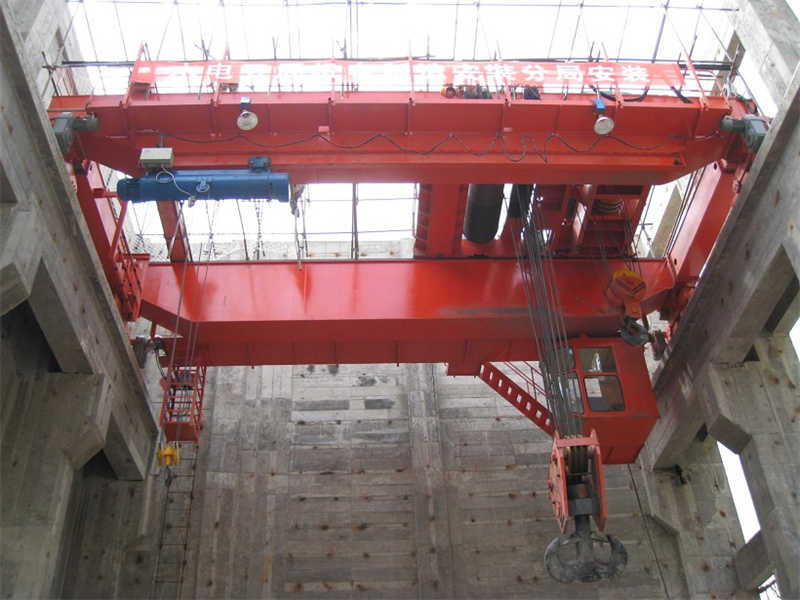
Before starting to install the hydropower station bridge crane, a series of detailed and careful preparations need to be carried out to ensure the smooth progress of the entire installation process and the safe and reliable operation of the final equipment. Accurate selection of the installation location and assessment of the bearing capacity of the foundation are crucial steps. The technicians need to accurately calculate the installation location of the bridge crane according to the specific layout of the hydropower station, the requirements of the working area and the performance parameters of the crane, and conduct detailed geological surveys and bearing capacity tests on its foundation structure to ensure that the foundation has sufficient strength and stability to withstand the load pressure of the crane during long-term operation, and avoid safety hazards such as tilting and settlement caused by foundation problems.
The preparation of construction drawings and technical documents is crucial. Designers need to provide detailed and complete construction drawings and technical documents, including but not limited to the structural layout diagram of the bridge crane, the electrical control system diagram, the basic construction diagram and related equipment parameters, installation guides, operation manuals, etc., to ensure that all information is accurate so that construction personnel can clearly understand the equipment structure, working principle and installation requirements, and provide strong technical support for subsequent construction.
It is an essential link to form a construction team with rich experience and professional skills and conduct systematic and comprehensive training for team members. Team members should have solid professional knowledge, be proficient in the installation process and technical requirements of bridge cranes, and understand relevant national safety regulations and operating procedures. Through training, the safety awareness, operation skills and emergency handling capabilities of team members can be improved, ensuring that they can strictly follow the specifications during the installation process, effectively preventing the occurrence of safety accidents, and improving work efficiency and quality.
The preparation of construction equipment and tools is also an important part of the preparation work. According to the construction plan and the actual situation on site, prepare all kinds of construction equipment and tools required in advance, such as cranes, hoists, welding machines, cables, etc., and conduct comprehensive inspections and maintenance of these equipment to ensure that they can operate normally during the installation process and meet construction needs. At the same time, it is also necessary to reasonably plan the equipment transportation and access routes according to the site conditions to ensure the smooth progress of the construction process.
The installation of bridge crane track is the cornerstone of the stability and safety of the entire crane equipment operation. Its installation process involves multiple delicate steps and technical requirements. Ensuring the precise execution of each link is crucial to ensure the efficient and safe operation of the crane.
In the early preparation stage of track installation, the inspection and pretreatment of track materials are an indispensable part. First of all, according to the bridge structure and crane load requirements, accurately calculate and select track materials of appropriate specifications and models to ensure that their physical and chemical properties meet the relevant national standards and design requirements. During the track cutting process, the track length is accurately cut in strict accordance with the design drawings, and each section of track is marked for accurate identification and positioning during the installation process. A comprehensive inspection of the incoming track materials is carried out, including but not limited to dimensional accuracy, surface quality, strength testing, etc., and only when all meet the standards can they be put into use.
During the actual installation, determine and mark the track centerline and elevation reference point, which is the skeleton of the entire track installation work. Using professional measuring equipment and instruments, repeatedly verify and adjust the straightness and horizontality of the track to ensure that the track is laid straight and flat on the bridge without distortion or tilt, so as to meet the geometric accuracy required by the design.
When the track is officially laid, bolt connection is a key step in fixing the track. Strictly follow the construction specifications, drill and tap first, then accurately implant the foundation bolts, and use special tools to ensure that the bolts are tightened and there is no risk of loosening. During the bolt tightening process, it is also necessary to pay attention to timely adjustment of the track to keep it stable in the vertical and horizontal directions to avoid deformation or damage to the track due to stress concentration.
After the initial installation of the track is completed, fine adjustment work is carried out, which usually includes reviewing and correcting the geometric dimensions of the track. Through professional measuring methods and equipment, the position, height and inclination of the track are constantly fine-tuned until all indicators meet the design standards. The final acceptance stage is particularly critical, not only a comprehensive inspection of the quality of the track installation, but also an important step to ensure the safety and reliability of the crane after it is put into operation. Only when all items of track installation have passed the acceptance smoothly, can the commissioning and trial operation procedures of the crane be officially started, thus ensuring the smooth completion and long-term stable operation of the entire project.
The installation of the main structure of the bridge crane is one of the core steps in the overall installation process of the crane. Its accuracy and safety are crucial to ensure the efficient and stable operation of the crane. When implementing the installation of the main structure of the bridge crane, the first task is to ensure that the erection of the main beam and the end beam is rigorous and standardized, and the structural stability is fully verified. As the main component for bearing heavy objects, the main beam must remain straight and undamaged, while the end beam is responsible for transferring the load and ensuring the lateral stability of the entire bridge frame. The connection between the two must be tight and gapless to meet the requirements of strength and stiffness.
Specific to the connection method, high-strength bolt connection or welding is usually used to achieve the fixation between the main beam and the end beam. High-strength bolt connection is popular for its adjustability and reusability, while welding can provide a stronger connection effect, especially for occasions with extremely high requirements for structural integrity. No matter which method is chosen, it is necessary to strictly follow the relevant specifications and process requirements to ensure that the connection is firm and reliable, and to make appropriate adjustments and corrections within the design allowable range to eliminate deformation caused by manufacturing errors or transportation.
The installation of the sports car and the lifting mechanism is also an indispensable part of the installation of the main structure of the bridge crane. As a component that carries the crane trolley and enables it to move on the main beam, the installation accuracy of the running wheel directly affects the operating efficiency and safety of the crane. During the installation process, it must be precisely positioned and fixed in strict accordance with the construction drawings to ensure that all components such as the drive device, brake system, and walking wheel set are installed in place and run flexibly without jamming. At the same time, attention should be paid to details such as lubrication and sealing to reduce friction and wear and prevent accidents.
In addition, the installation of cables and electrical equipment is equally important. As an important medium for power supply and signal transmission, the laying of cables must be neat and orderly to avoid twisting, pulling, and excessive bending to reduce electromagnetic interference and ensure the stability of power supply. Electrical equipment includes various electronic and electrical components such as motors, controllers, and sensors. Their wiring must be strictly operated in accordance with the instructions and specifications to ensure that the wiring is correct and provide a reliable power supply for the crane’s electrical system.
The installation of safety devices and accessories is the key to ensuring the safety of crane operation. First of all, the installation of safety limiters and overload protection devices is crucial. These devices must be installed at key parts of the crane to ensure timely response during the operation of the crane to prevent overloading or exceeding the operating range. If these devices are not installed correctly, it may cause the crane to malfunction during operation, resulting in safety accidents.
The installation of emergency stop buttons and lighting facilities is equally important. These facilities must facilitate operators to take quick measures in an emergency. If these facilities are not installed correctly, it may cause operators to fail to take timely measures in an emergency, thereby increasing the risk of safety accidents.
For the installation of protective devices and other accessories, they need to be customized according to the actual situation of the crane. These devices must ensure the safety of operators and prevent them from being injured at work. If these devices are not installed correctly, it may put operators in danger, thereby increasing the risk of safety accidents.
After completing the installation of safety devices and accessories, safety device function testing is required. This is an important step to ensure the safe operation of the crane. By testing whether the functions of each safety device are normal through simulated operation, potential safety hazards can be discovered and resolved in time. If these devices do not function properly, it may cause the crane to malfunction during operation, resulting in safety accidents.
Installation quality inspection and debugging is an important part of ensuring the quality of crane installation. This stage covers several key steps, starting with the structural integrity and connection firmness inspection. In this step, the technicians will carefully verify whether the various components of the crane have been accurately installed to the predetermined position, including but not limited to the main structural parts such as the bridge, boom, platform, cab, and various key connection parts such as connecting bolts, pins, and hydraulic systems. Through professional testing tools and methods, confirm that all structural parts are free of deformation and damage, and the connections are tight and not loose, so as to ensure the stability and safety of the overall structure of the crane.
Next is the crane function test and debugging link. At this stage, the technicians will simulate the actual working environment of the crane and conduct a comprehensive inspection of the various functions of the crane. This includes but is not limited to the normal operation of the lifting mechanism, that is, the hook can be lifted and lowered smoothly and has reliable limit protection at the extreme position; performance testing of the operating mechanism, such as the smooth operation of the trolley and the accuracy of the trolley track following; the accuracy of the action of the variable-length mechanism, such as the telescopic boom, the sensitivity of the lifting action, and the extreme position control. By simulating various action cycles under actual working conditions, it is confirmed that the crane can accurately complete the action conversion when performing various operation tasks, avoiding operational errors or safety accidents caused by functional defects.
Adjustment of centering and driving stability is also an important part of installation quality inspection and debugging. Technicians will use professional measuring instruments and equipment to adjust the centering performance of the crane to ensure that it can maintain a horizontal state during work without tilting or twisting. At the same time, the driving stability of the crane will be finely adjusted to enable it to maintain a stable travel state during operation, avoiding adverse effects caused by factors such as vibration and impact load, thereby extending the service life of the equipment and ensuring operation safety.
The last step is the insulation test and debugging of the electrical system. Technicians will conduct a comprehensive inspection of the electrical system of the crane, paying special attention to the insulation resistance test, and confirm that the insulation performance of all electrical components such as cables, terminals, motors, etc. meets the requirements of national and industry specifications. Through strict insulation testing, fires, short circuits and other safety accidents caused by electrical faults can be effectively prevented, ensuring that the electrical system of the crane is safe and reliable during operation.
System acceptance is an important milestone in the crane installation project, marking the successful completion of the installation work. This link involves comprehensive and detailed testing and inspection of each system of the crane to ensure that its various performance indicators meet the design requirements and national standards. This includes but is not limited to the stability of the mechanical transmission system, the reliability of the electrical control system, the sensitivity of the safety protection device, and the working efficiency of the whole machine. Only when all systems perform well can the crane be ensured to operate safely and efficiently in the future.
Operation and maintenance training is an important way to improve the skill level of operators. The training content should cover the operation methods of the crane, common faults and treatment measures, and daily maintenance requirements. Through systematic training, operators can not only master the various functions of the crane, but also discover and solve potential problems in time, effectively extending the service life of the equipment. At the same time, the organization of training records is also very important, which not only helps to improve the professional skills of operators, but also provides valuable reference information for subsequent equipment management and maintenance.
For the installation and construction technical plan of the hydropower station bridge crane, in addition to the above-mentioned key links, it is also necessary to pay attention to overall planning and detail control. For example, make full preparations before installation, including understanding equipment performance parameters, making detailed installation plans, checking the on-site environment, etc.; during the installation of the bridge crane track, ensure the flatness, straightness and relative position accuracy of the track; when installing the main structure of the bridge crane, pay attention to the connection and fixation of each component; in the installation of safety devices and accessories, ensure the completeness and reliability of various safety devices and accessories; in the installation quality inspection and commissioning stage, strict testing and verification should be carried out; in terms of system acceptance and operation training, not only should the acceptance work be done well, but also the operators should be systematically trained.
Through the above meticulous preparation, standardized construction and strict acceptance, as well as systematic training, it can ensure that the installation quality of the hydropower station bridge crane meets the design requirements and provide solid guarantee for the smooth operation of the hydropower station. At the same time, this also reflects the high attention to equipment performance and operator skills, which helps to improve the operating efficiency and safety of the entire hydropower station.
Contact our crane specialists
Send us a message and we will get back to you as soon as possible.