As an indispensable heavy equipment in modern industry, the manufacturing process and inspection procedures of general bridge cranes are directly related to the performance, safety and service life of the equipment. From the careful selection of raw materials to the strict control of each process, every step contains the persistent pursuit of exquisite craftsmanship. The manufacturing process covers the refined production from the main beam, end beam to the trolley. Each link must follow the established standards and processes to ensure the stability of the structure and the maximization of the load-bearing capacity. The inspection procedures are the key line of defense to ensure the quality of the crane. From the structure to the machinery to the electrical system, the all-round and multi-level inspection ensures the reliability and safety of the equipment. This article will deeply explore the manufacturing process and inspection procedures of general bridge cranes, revealing the technical secrets and quality assurance behind them.
Bridge cranes, as an important material handling equipment, play an indispensable role in industrial production. The quality of its manufacturing process is directly related to the performance, safety and service life of the crane. Therefore, in-depth understanding and mastery of the manufacturing process of bridge cranes is crucial to ensure product quality.
The manufacturing process of bridge crane is a complex and sophisticated system engineering, covering the whole process from material preparation to finished product inspection. This process requires not only a high degree of technical proficiency, but also strict compliance with established process specifications and standards. Through scientific and reasonable manufacturing processes, the overall performance of the crane can be significantly improved, the service life can be extended, and the failure rate can be reduced, thereby ensuring the safety and efficiency of production operations.
In terms of material selection, the main components of bridge cranes such as main beams, end beams, trolley frames, etc. must all use high-strength, corrosion-resistant, and wear-resistant high-quality steel. The selection of these materials must not only meet the load-bearing requirements of the crane, but also consider its long-term stability and reliability. In addition, for cables and electrical components required for the electrical system, relevant national standards and regulations should also be followed to ensure the safe and reliable operation of the electrical system.
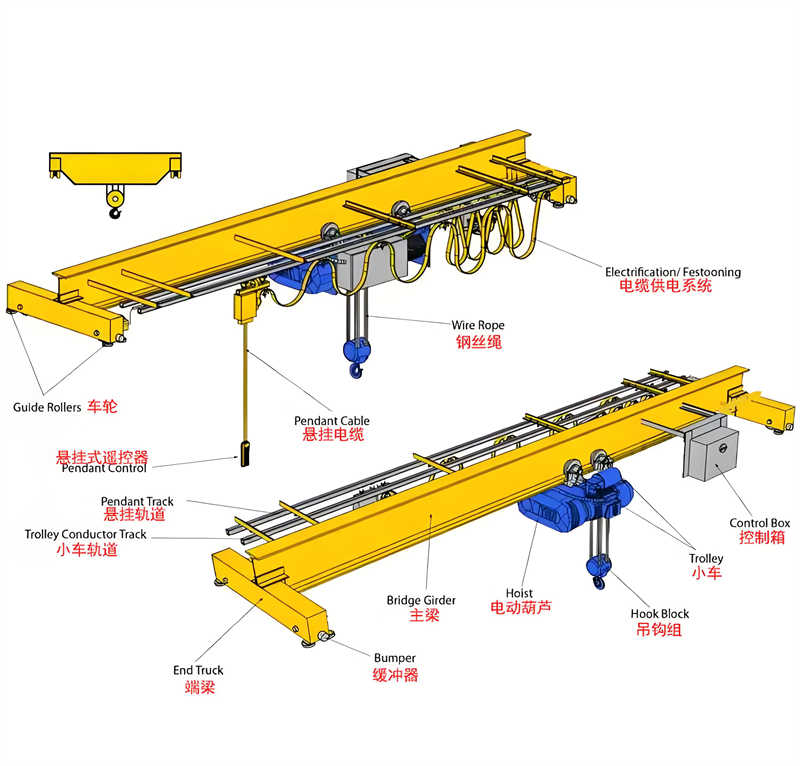
Table: Material selection table for key components of bridge crane
| Key Components | Material Type | Material properties | Selection criteria |
| Main beam | High-strength steel | High strength, corrosion resistance, wear resistance | Meet the load-bearing requirements and ensure long-term stability and reliability |
| End beam | High-quality steel | High strength, corrosion resistance, wear resistance | Same as main beam selection standard |
| Trolley frame | High strength alloy steel | High strength, light weight, corrosion resistance | Bear the weight of the trolley and the hoisting load to ensure smooth operation |
| Cable | Abrasion and heat resistant cables | Wear resistance, high temperature resistance, good insulation performance | Comply with relevant national standards and regulations to ensure safe and reliable operation of the electrical system |
| Electrical components | Industrial grade electrical components | High reliability, long life, and resistance to environmental interference | Comply with relevant national standards and regulations to ensure stable performance of the electrical system |
Table: Supplementary information table for material selection of bridge crane
| Material Category | Considerations | Example | Remark |
| Steel | Strength, toughness, corrosion resistance | Q345, Q420 and other high-strength steel | Choose the right steel material based on the stress conditions of the components and the use environment |
| Alloy steel | Strength, hardness, corrosion resistance | Stainless steel, aluminum alloy, etc. | Components such as small car frames may require lightweight, high-strength materials |
| Cable | Wear resistance, high temperature resistance, insulation | PVC insulated cables, cross-linked polyethylene insulated cables, etc. | Choose the right cable based on electrical system requirements and working environment |
| Electrical components | Reliability, lifespan, environmental adaptability | Contactors, relays, circuit breakers, etc. | Choose well-known brands and high-quality electrical components to ensure stable operation of the electrical system |
| Connectors | Strength, corrosion resistance, fastness | High strength bolts, nuts, etc. | Ensure that all components are firmly connected |
In the manufacturing process, quality control is the key link to ensure the performance of the crane. From the entry of raw materials to the exit of finished products, every link needs to be strictly inspected and monitored. By adopting advanced testing equipment and means, real-time monitoring and recording of key processes can be carried out to promptly discover and correct possible quality problems, so as to ensure that the overall quality of the crane meets the design requirements. In addition, a series of process specifications and standards must be followed during the manufacturing process, including specific requirements for welding, assembly, commissioning and other links. The formulation of these specifications and standards is intended to ensure that the manufacturing process of the crane meets industry requirements and technical standards, thereby ensuring the quality and safety of the product.
As an important material handling equipment, the manufacturing process of the bridge crane is crucial to ensuring product quality. By deeply understanding and mastering the manufacturing process of the bridge crane, the performance, safety and service life of the crane can be improved. In the manufacturing process, it is necessary to strictly abide by the principles and standards of material selection, strengthen the implementation of quality control measures; at the same time, attention should be paid to technological innovation and talent training; and continuously promote the sustainable development and progress of my country’s bridge crane manufacturing industry.
As the core component of the bridge crane, the design, manufacturing and installation accuracy of the main beam directly affects the safety, reliability, load-bearing capacity and stability of the whole machine performance. Therefore, the control of the main beam manufacturing process is a key link in the manufacturing process of the bridge crane.
At the beginning of the main beam production, it is very important to strictly control the quality of the materials. It is necessary to select steel that meets the relevant national standards and has excellent mechanical properties, such as high-strength low-alloy structural steel. Each batch of steel entering the factory must undergo strict chemical composition analysis, including but not limited to the content of elements such as carbon, silicon, manganese, sulfur, phosphorus, and the test of mechanical properties such as tensile strength, yield strength, and elongation to ensure that the material meets the requirements of the design drawings.
In the material cutting link, advanced modern cutting equipment, such as CNC flame cutting machine, plasma cutting machine or high-precision band sawing machine, is used to accurately cut materials according to the main beam structure design drawings to ensure the size accuracy and shape accuracy of various components such as webs, flange plates, and connecting plates. At the same time, it is also necessary to reserve the welding heat affected zone and deformation control zone to deal with the thermal deformation problems that may occur during the welding process.
The welding process is crucial to ensure the strength and stability of the main beam structure. Before welding, the weld needs to be preheated. The preheating temperature depends on the type and thickness of the steel, usually between 200℃-300℃. Preheating can effectively reduce welding stress and reduce the possibility of cracks in the weld.
During the welding process, automatic or semi-automatic welding methods are used to strictly control welding parameters, including welding current, voltage, speed, and welding sequence. For example, too large a current may cause the weld to burn through or overheat, and too small a current may cause the weld to not be fully melted; too high or too low a voltage will affect the stability of the arc; too fast a welding speed may cause the weld quality to deteriorate, and too slow a speed may cause the heat affected zone to be too large, increasing the risk of deformation. In addition, a certain welding sequence principle should be followed, first welding the key parts, then welding the secondary parts, to reduce welding deformation.
After all welding work is completed, a comprehensive weld quality inspection is carried out, including but not limited to X-ray or ultrasonic flaw detection, to confirm that there are no defects such as cracks, lack of fusion, and lack of penetration inside the weld. At the same time, the appearance of the weld is carefully checked to ensure that it is flat and smooth and meets the design requirements.
The assembly stage is the process of accurately splicing the processed components together according to the design drawings. During this process, it is necessary to ensure that the relative positions between the components are accurate and correct, and use special fixtures to fix and position each component. After the assembly is completed, the main beam is corrected as a whole and locally. Use advanced measuring instruments and equipment (such as laser trackers, theodolites, etc.) to accurately measure and adjust the straightness, levelness and key dimensions of the main beam. At the same time, it is also necessary to pay attention to controlling the assembly stress to avoid deformation problems caused by the assembly process.
The end beam, as an indispensable supporting component of the bridge crane, bears the weight and operating load of the entire crane. Its design, manufacturing and assembly process play a vital role in the entire crane manufacturing process. The precise and rigorous end beam manufacturing and assembly process can not only ensure the stable operation of the crane, but also effectively improve the safety and service life of the overall equipment.
When selecting end beam materials, high-strength and high-durability steels are usually given priority, such as high-quality carbon structural steels such as Q235B or Q345B, to ensure that the materials have good mechanical properties and fatigue resistance. These materials can not only withstand the heavy pressure and friction during daily use, but also maintain stable structural integrity in long-term high-intensity work. In the processing link, each component is precisely machined, including but not limited to cutting, drilling, milling, grinding and other processes. Strict dimensional control is the basis for ensuring the accuracy of the end beam. Through advanced measuring equipment and rigorous testing processes, ensure that the geometric dimensions, shape accuracy and matching degree of the assembly interface of the end beam meet the design requirements.
The assembly process of the end beam includes component docking, welding, correction and other links. Component docking requires operators to have rich experience and skills to ensure the accurate docking and positioning of each component. Welding is a key link in the end beam assembly process, and welding parameters, including welding current, voltage, speed, etc., should be strictly controlled to ensure the quality of the weld. The correction link uses professional correction equipment and methods to perform overall and partial corrections on the end beam. During the assembly process, a series of measures should be taken to ensure quality. First, formulate a detailed assembly sequence and process route to ensure the smooth progress of the assembly process. Secondly, strengthen quality control during welding, and adopt effective welding parameters and process measures to ensure the quality of the weld. Finally, carry out necessary subsequent processes such as heat treatment and surface treatment to improve the durability and aesthetics of the end beam.
In terms of quality inspection and acceptance, the end beam is comprehensively inspected and tested. Specifically, the appearance inspection is to evaluate the surface quality of the end beam to see if there are any flaws, deformations or welding defects; the dimension measurement is to confirm whether the actual size of the end beam meets the requirements of the design drawings; the weld flaw detection is used to detect whether there are potential defects such as cracks and incomplete penetration inside the weld. In addition, it may also include mechanical property tests, durability tests and other aspects. Through these strict inspection and acceptance procedures, it is aimed to ensure that the quality of the end beam meets the design requirements and standard specifications, providing a strong guarantee for the overall performance of the crane.
As the main structure of the bridge crane, the design, manufacturing and assembly quality of the bridge frame directly affect the performance and service life of the bridge crane. Therefore, the combined assembly process of the bridge frame needs to be highly valued.
The combined assembly of the main beam and the end beam is one of the core steps in bridge frame manufacturing. During the assembly process, high-precision measuring instruments are required to accurately dock and position each component to ensure that the straightness, horizontality and verticality of the bridge frame meet the design requirements. At the same time, the stiffness and stability of the bridge frame need to be verified to ensure that it can remain stable and safe during use.
The installation and debugging of the walking mechanism is a key link in the operation of the bridge crane. During the installation process, professional tools and equipment are required to ensure the accurate docking and positioning of the walking mechanism and the bridge frame. During debugging, the running speed, braking performance, etc. of the walking mechanism need to be fully tested to ensure its smooth and reliable operation. In addition, the walking mechanism needs to be inspected and maintained regularly to ensure its long-term stable operation.
In addition to the main beam and end beam, many other accessories need to be installed on the bridge, such as buffers, limiters, etc. When installing these accessories, they need to be positioned and fixed in strict accordance with the design requirements, and their functions need to be checked to ensure that they can function normally and ensure the safety of personnel. At the same time, the accessories should be inspected and maintained regularly to ensure their long-term stable operation.
As an important part of the bridge crane, the manufacturing process of the trolley also needs to be delicate and rigorous. The manufacturing process of the trolley includes material preparation, cutting, welding, correction and other links. During the manufacturing process, it is necessary to ensure that the strength and rigidity of the trolley frame meet the design requirements. During assembly, ensure the accurate docking and positioning of each component to ensure the overall performance of the trolley frame. A series of tests and acceptances are also required to ensure that the performance of the trolley meets the design requirements and provide strong guarantees for the overall performance of the crane.
The manufacturing and assembly of the trolley frame includes material preparation, cutting, welding, correction and other links. During the manufacturing process, it is necessary to ensure that the strength and rigidity of the trolley frame meet the design requirements. During assembly, ensure the accurate docking and positioning of each component to ensure the overall performance of the trolley frame. A series of tests and acceptances are also required to ensure that the performance of the trolley meets the design requirements and provide strong guarantees for the overall performance of the crane.
The installation of the trolley travel and lifting mechanism is the key to ensuring the normal operation of the trolley. During the installation process, it is necessary to ensure that the walking mechanism and the lifting mechanism are accurately docked and positioned with the trolley frame. These mechanisms must also be debugged and tested to ensure that they run smoothly and reliably. At the same time, a series of tests and acceptances must be carried out to ensure that the performance of the trolley meets the design requirements and provide strong guarantees for the overall performance of the crane.
The trolley performance test and acceptance work includes load tests, operation tests and other aspects. Through strict load tests, the operating performance of the trolley when carrying goods of different weights is tested to ensure that it has sufficient load-bearing capacity and no abnormal deformation or vibration. Operation tests must also be carried out to evaluate the running stability and reliability of the trolley through repeated starting, stopping and speed changes. Other functions of the trolley must also be tested, such as the effectiveness of the limit switch and the stability of the braking system. Through these rigorous testing and acceptance procedures, it can be ensured that the performance of the trolley meets the design requirements and provides strong guarantees for the overall performance of the crane.
The electrical system is the core component of the bridge crane, which is responsible for controlling, protecting and monitoring the operation of the entire crane. Therefore, the installation process of the electrical system is crucial to ensure the safe, reliable and efficient operation of the crane.
During the selection process, it is necessary to fully consider the use requirements of the crane, such as lifting weight, running speed, working frequency, etc. At the same time, it is also necessary to consider the impact of the working environment on the electrical equipment, such as temperature, humidity, dust, etc. Selecting suitable electrical equipment is the basis for ensuring the normal operation of the electrical system. During installation, it must be carried out strictly in accordance with the equipment manual and electrical design drawings. Ensure that the installation position of the electrical equipment is accurate and firmly fixed to facilitate the normal operation of the equipment and future maintenance. Also pay attention to the wiring and debugging of the equipment. Correct wiring is the key to ensuring the normal operation of the electrical system, and debugging can promptly discover and solve problems with the equipment to ensure that the equipment can function normally.
During the wiring process, relevant national standards and regulations must be followed. The direction of the cable should be reasonable, and cross-over and entanglement should be avoided as much as possible. The fixing should also be firm and reliable to prevent the cable from loosening or damage. When wiring, the accuracy and firmness of the wiring are the key. Correct wiring can ensure the normal operation of the electrical system and avoid problems such as poor contact or short circuit.
Debugging and testing are important means to ensure the normal operation of the electrical system. During the debugging process, the various functions of the electrical system should be fully tested. For example, the control function should be tested to ensure that the various actions of the crane are accurate; the protection function should be tested to ensure that the equipment can stop running in time under abnormal conditions; the monitoring function should be tested to ensure that the equipment operation status can be displayed and recorded in real time. These measures jointly ensure the safety and reliability of the electrical system.
In order to ensure the structural stability, operational safety and performance reliability of bridge cranes during long-term use, a set of rigorous and detailed inspection procedures must be formulated. This set of procedures not only plays a decisive role in the quality control of bridge cranes, but also effectively prevents various safety accidents caused by equipment aging, damage or improper operation.
The main goal of the inspection procedure is to conduct comprehensive and detailed inspection and evaluation of each component and system of the bridge crane to ensure that its various performance indicators meet the relevant national standards, industry specifications and enterprise design requirements, and meet actual use needs. The specific inspection scope should include but is not limited to the following:
The inspection cycle for bridge cranes should be scientifically and reasonably formulated according to their frequency of use, working environment, equipment condition and relevant national laws and regulations. For cranes with high-intensity use or harsh environments, the inspection cycle should be appropriately shortened, and for cranes with less use or better environment, the inspection interval can be appropriately extended. When formulating a specific inspection plan, full consideration should be given to the busy and non-busy periods of equipment use to minimize the impact of inspection on production. At the same time, it is also necessary to clarify the specific time arrangement, location selection (such as apron, maintenance channel, etc.), inspection content refinement and specific requirements for each inspection, so that the inspection work can be carried out in an orderly manner and achieve the expected results.
Structural part inspection plays a vital role in the safety performance and service life of the crane. Through the careful inspection of each key part of the crane, it can be ensured that it can maintain sufficient strength and stability under various working conditions, effectively prevent the occurrence of safety accidents, and extend the service life.
As the main load-bearing structure of the crane, the condition of the main beam and end beam directly affects the performance of the entire crane. The inspector needs to conduct a comprehensive inspection of the main beam and end beam, including but not limited to the inspection of weld quality, the testing of material properties, and the measurement of geometric dimensions. Through these inspection methods, it is ensured that the strength and rigidity of the main beam and end beam meet the design requirements and can withstand the pressure under various working conditions.
Crane frame and boom are important working parts of the crane, responsible for supporting and moving loads. During the inspection process, the frame and boom also need to be comprehensively and carefully inspected. Mainly check the weld quality, material properties, deformation, etc. Through these tests, ensure that the strength and stability of the crane frame and boom meet the use requirements, and ensure that there will be no structural failure and other problems during the lifting process.
As the basic component of the crane, the track welding quality is directly related to the stability and safety of the crane operation. During the inspection process, the quality of the track weld needs to be fully inspected. The inspectors will use professional equipment and technical means to check the internal structure and surface quality of the weld to ensure that there are no defects inside and the surface is flat and smooth. Such inspections can effectively prevent accidents such as track deformation and breakage caused by welding quality problems and ensure the safe operation of the crane.
Table: Orbital welding quality inspection standards
| Inspection items | Inspection content | Inspection methods | Eligibility criteria |
| Internal quality of weld | Check whether there are defects such as cracks, slag inclusions, and lack of fusion inside the weld | X-ray testing or ultrasonic testing | No defects |
| Weld surface quality | Check whether the weld surface is flat and smooth, without undercut, weld bump, dent and other defects | Visual inspection | Smooth and flawless |
| Weld size | Check whether the width, height, and excess height of the weld meet the design requirements | Measuring tools measuring | Meet the design requirements |
| Welding materials | Check whether the welding materials meet the design requirements and are free of rust, oil, etc. | Visual inspection and chemical composition analysis | Meet the design requirements, no rust, no oil stains |
Table: Overview of inspection of key crane components
| Part Name | Inspection content | Purpose of inspection |
| Main beam and end beam | Weld quality, material properties, geometric dimensions | Ensure strength and rigidity meet design requirements |
| Crane frame and boom | Weld quality, material properties, deformation | Ensure strength and stability to meet usage requirements |
| Track | Weld quality (internal and surface) | Ensure the smooth and safe operation of the crane |
The mechanical part inspection occupies a vital position in the overall maintenance and safety assurance system of the crane. The main goal of this link is to ensure that the crane exhibits smooth power transmission, precise position control and reliable mechanical strength during operation. Transmission mechanism and operating mechanism inspection
As the core working part of the crane, the transmission mechanism covers a series of sophisticated and complex mechanical components such as gears, bearings, chains, etc., which jointly undertake the task of effectively transmitting the input power and converting it into the required form of motion. During the inspection, firstly, the wear condition of the gear tooth surface is carefully checked to confirm that there is no excessive wear, peeling or cracking, so as to ensure the gear meshing accuracy and transmission efficiency; at the same time, the lubrication state of the bearing is highly valued, and the clearance size is measured by professional instruments to evaluate the degree of wear, and the necessary grease is supplemented or replaced to maintain the low friction operation of the bearing; in addition, the wear inspection of the chain should not be ignored, and the tightness of the fit between each link, as well as the wear of the pin and sleeve, are checked to ensure the strength and stability of the chain in the entire drive and operating system. The above rigorous inspection procedures are aimed at ensuring the smooth and reliable operation of the transmission mechanism and the operating mechanism as a whole, and effectively preventing failures and accidents caused by component failure.
The brake device and balancer are key components to ensure the safe and reliable operation of the crane. The braking performance of the brake device is directly related to the safety of the crane and can function normally. The balancer can reduce the workload of the operator and improve work efficiency. During the inspection process, the brake device and balancer need to be fully inspected. First, the braking performance of the brake device is tested, including the measurement of parameters such as braking distance and braking deceleration. Through the measurement of these parameters, it can be evaluated whether the braking performance of the brake device meets the requirements. If the braking performance does not meet the requirements, it needs to be adjusted or replaced. Secondly, the balance performance of the balancer is tested. The balance performance test of the balancer includes static balance and dynamic balance tests. Through these tests, it can be evaluated whether the performance of the balancer meets the requirements. If the balance performance does not meet the requirements, it needs to be adjusted or replaced. During the inspection process, it is also necessary to pay attention to the wear of the brake device and balancer. If excessive wear is found, the relevant parts need to be replaced in time to ensure the safety and reliability of the crane. Through regular inspection and maintenance, the service life of the crane can be extended and its safety and reliability can be improved.
The electrical part inspection plays a vital role in the overall maintenance and safe operation of the crane. This link not only involves the performance testing of core components such as motors, control systems, signal systems and safety devices, but also is a key means to ensure that the crane operates accurately and safely according to the set procedures and parameters.
In the inspection of the motor and control system, the operating status of the motor is first carefully observed and inspected, including but not limited to whether the key operating parameters such as the motor’s temperature, vibration amplitude, noise level and speed are within the normal range. At the same time, the insulation performance of the motor is strictly tested to prevent electrical failures caused by insulation aging or damage.
For the control system, it is necessary to conduct a comprehensive inspection of various controllers, relays, contactors and other components to confirm whether their logical control functions are normal, whether there are problems such as poor contact and malfunction. By simulating operation tests under various working conditions, the response speed, stability and effectiveness of the interlocking protection function of the control system are verified to ensure that the crane can achieve precise motion control and effective safety protection during operation.
As an important communication bridge between the crane and the operator, the accuracy of the signal system directly affects the safety and efficiency of the operation. During the inspection, it is necessary to conduct a comprehensive test on various indicator lights, alarm devices, display screens and other signal equipment to confirm that the display content is clear and easy to understand, the instructions are accurate and timely, and the sound prompts are eye-catching, so as to ensure that the operator can obtain comprehensive information in time and make correct judgments.
Safety devices are the last line of defense to ensure the safe operation of the crane. During the inspection, focus on checking the working status of various safety components such as limit switches, emergency stop buttons, overload protectors, etc., and verify their sensitivity and reliability through actual operation to ensure that the power supply can be quickly cut off or the corresponding protection measures can be activated in case of abnormal situations to prevent accidents from occurring or expanding.
In order to ensure the effectiveness and traceability of inspection work, a complete inspection record and reporting system needs to be established. This helps to ensure that the quality and safety of the product are effectively guaranteed, and also helps to improve the efficiency and accuracy of the inspection work.
Inspection records should record the time, location, content, results and other information of the inspection in detail and accurately. In the recording process, it is necessary to ensure the accuracy and completeness of the information to avoid omissions or errors. In addition, it is necessary to record and describe the problems found during the inspection process to provide a basis for subsequent processing and improvement.
The inspection report is a summary and achievement of the inspection work. When preparing the inspection report, it is necessary to comprehensively sort out and summarize the inspection process, results, problems and other aspects. After the preparation is completed, strict review and approval work is required to ensure its accuracy and reliability. Auditors need to carefully review the content of the report to ensure the authenticity and objectivity of the report. Approval personnel need to make a final approval of the report to ensure the feasibility and effectiveness of the report.
For problems and hidden dangers found during the inspection process, timely processing and rectification work is required. During the process, it is necessary to clarify the rectification measures and time nodes, and to identify the responsible persons for rectification to ensure the smooth progress of rectification work. At the same time, it is also necessary to promptly feedback the inspection results and rectification status to the relevant departments and personnel to provide reference and basis for subsequent use and maintenance. Through a complete inspection record and reporting system, the quality and safety of the product can be effectively guaranteed. At the same time, it also helps to improve the efficiency and accuracy of inspection work.
Contact our crane specialists
Send us a message and we will get back to you as soon as possible.