As an important hoisting equipment in industrial production, the safety and technical inspection of electric double-beam bridge crane is directly related to production safety and operating efficiency. In order to ensure the safe and reliable operation of the crane, it is necessary to conduct a comprehensive inspection from multiple aspects such as technical data, metal structure, safety device, electrical system, hoisting equipment and working environment. The following are several key points of the safety and technical inspection of electric double-beam bridge crane.
The first link of the safety and technical inspection is a comprehensive review of the technical data and qualifications of the crane. The manufacturer should provide a valid qualification certificate and product factory certificate, which is the basic basis for ensuring that the equipment is legally sourced and of reliable quality. The user needs to check whether the basic parameters such as crane model, rated lifting weight, lifting height, span, working level, etc. meet the design requirements and use conditions.
The acceptance standard requires checking whether the installation unit has the corresponding qualifications and whether the installation process meets the requirements of GB/T 5972-2016 “Rules for Periodic Inspection of Hoisting Machinery”. At the same time, the user should prepare the operation manual and safety signs of the crane to ensure that the operator is familiar with the equipment usage, safety precautions and emergency procedures. All technical data should be archived in full for easy reference during daily and regular inspections.
The metal structure is the skeleton of the crane, and its integrity directly affects the safety of the entire machine. During the inspection, it is necessary to focus on the main load-bearing components to ensure that there are no cracks, open welds, deformation or severe corrosion. The quality of the weld is the focus of the inspection. All welds must not have cracks and open welds, especially in key areas such as the connection between the main beam and the end beam and the load-bearing parts of the trolley track.
The loosening of the connecting parts may cause major accidents. All mechanical connection parts must be checked to ensure that fasteners such as bolts and rivets are not loose. For the track system, the gap between the track joints is required to be no more than 2mm, and the deviation between the actual center of the track and the actual center of the beam is no more than 10mm. The trolley and car tracks should be flat and free of deformation, and the track pressure plate should be firmly fixed to ensure the smooth operation of the crane.
The corrosion of the metal structure section also needs to be evaluated. If the corrosion of the main load-bearing component section exceeds 10% of the original thickness, it should be scrapped. For cranes with a long service life, fatigue cracks and stress concentration areas of the metal structure need to be specially checked, and non-destructive testing should be carried out when necessary.
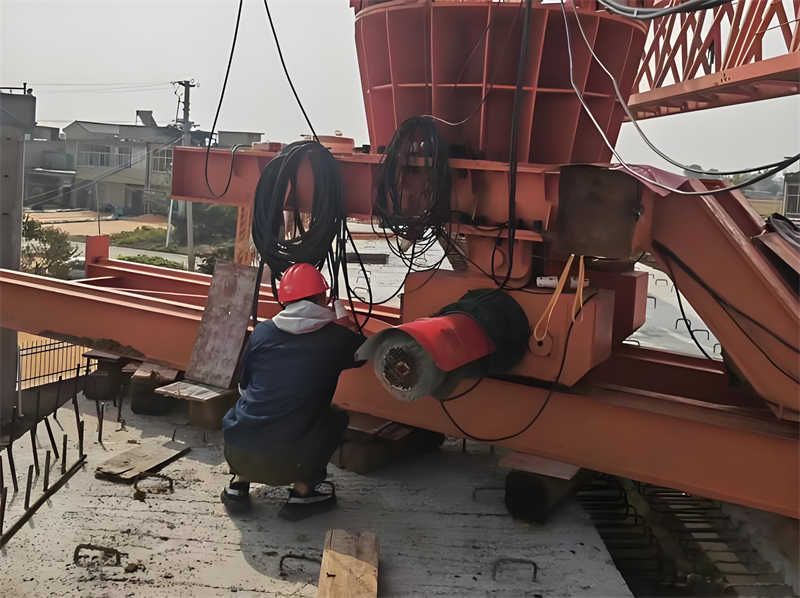
Safety devices are the guarantee system for the safe operation of cranes, and the performance of each limiter and interlocking mechanism must be ensured to be normal. The lifting height limiter and travel limit switch are key devices to prevent overwinding and overtravel, and their accuracy and reliability of action need to be tested. Each safety device should be able to stop the relevant action immediately after being triggered to avoid accidents.
The inspection of the brake system is particularly important, and the electromagnetic brake must meet the following requirements: the mechanical linkage system is flexible and free of jamming, and the moving parts are well lubricated; the electromagnetic coil is firmly wired, and the brake armature can be normally attracted and released; the coil resistance to ground should not be less than 5MΩ; all fixing bolts are tightened without looseness; the pressure between the brake shoe and the brake wheel is appropriate, and the contact area is not less than 70%. The brake must not be cracked, loose or severely worn, the clearance on both sides should be the same, the braking force should be sufficient, and the wear should be less than 50% of the original thickness.
The overload protection device is an important safety barrier to prevent crane overload operation. The accuracy of its alarm and cut-off functions should be verified during inspection. When the load reaches 90% of the rated lifting capacity, a prompt alarm should be issued; when the rated lifting capacity is exceeded, the lifting power source should be automatically cut off and an alarm should be issued. In addition, it is also necessary to check whether safety facilities such as windproof and anti-skid devices, buffers, and emergency stop switches are complete and effective.
Electrical system safety is the basis for reliable operation of the crane. Check whether all electrical connections are safe and reliable, without exposure, aging or short circuit risks. Electrical equipment such as motors, controllers, resistors, etc. should work normally without abnormal heating or noise. The cable insulation performance is good, the busbar contact is reliable, and the collector wear is within the allowable range.
As a key load-bearing component, the wire rope needs to be strictly checked for its condition. The wire rope is required to have no broken wires, wear or kinking, the number of safety circles shall not be less than 2 circles, and the diameter ratio of the drum to the wire rope shall meet the standard requirements. The fixed end of the wire rope should be firm and reliable, and the number and spacing of the rope clips shall meet the specifications. When the wire rope has cage-like distortion, the rope diameter is severely reduced locally, or the number of broken wires reaches the scrap standard, it must be replaced immediately.
The hook device is a component that is directly hoisted, and its safety is crucial. The increase in the hook opening should not exceed 15% of the original size, and the torsional deformation should be controlled within 10%. The wear of the plate hook bushing should not exceed 50% of the original size, the wear of the mandrel should not exceed 5%, and there should be no peeling, burrs or welding marks. The hook rotates flexibly, and the anti-unhooking device is intact and effective to avoid unhooking accidents during the lifting process.
Working environment safety is a prerequisite for the use of cranes. Check the working environment around the crane to ensure that there are no obstacles and safety risks, and ensure sufficient operating space and safe distance. The ground in the working area should be flat and clean, with sufficient bearing capacity to support the weight of the lifting machinery and load. Evaluate whether weather conditions, such as wind speed and temperature, meet the safety operation standards, especially when working outdoors, pay more attention to the influence of environmental factors.
Operation test is a necessary link to verify the performance and safety of the crane. After installation or overhaul, no-load and full-load tests must be carried out. The no-load test checks whether the operation of each mechanism is normal and whether the limit device is effective; the full-load test verifies the load-bearing capacity and braking performance of the crane. During the test, it should be observed whether there is abnormal vibration, noise or heating, whether the movement of each mechanism is smooth, and whether the control system is sensitive and reliable.
Daily inspection is as important as regular maintenance, and a daily inspection, monthly inspection and annual inspection system should be established. Daily inspection focuses include brake performance, wire rope status, safety device effectiveness, etc.; monthly inspection can increase detailed inspection of electrical systems and metal structures; annual inspection should be comprehensive and thorough, and if necessary, it should be conducted by professional inspection agencies. Through systematic inspection and maintenance, hidden dangers can be effectively eliminated, equipment accidents can be reduced, and equipment operation rate can be improved.
Through comprehensive inspections in the above five aspects, it can be ensured that the electric double-beam bridge crane is in good working condition, providing strong guarantees for safe production. Problems found during the inspection process must be rectified in a timely manner, and it is strictly forbidden to operate equipment with illness, so as to ensure that “no safety, no production”. At the same time, operators should operate strictly in accordance with the regulations, maintenance personnel should maintain according to standards, and management personnel should supervise according to the system, so as to jointly build a long-term mechanism for the safe use of lifting machinery.
Contact our crane specialists
Send us a message and we will get back to you as soon as possible.