Home → News → Customized design of 32-ton double-girder bridge crane
Customized design of 32-ton double-girder bridge crane
Design Overview
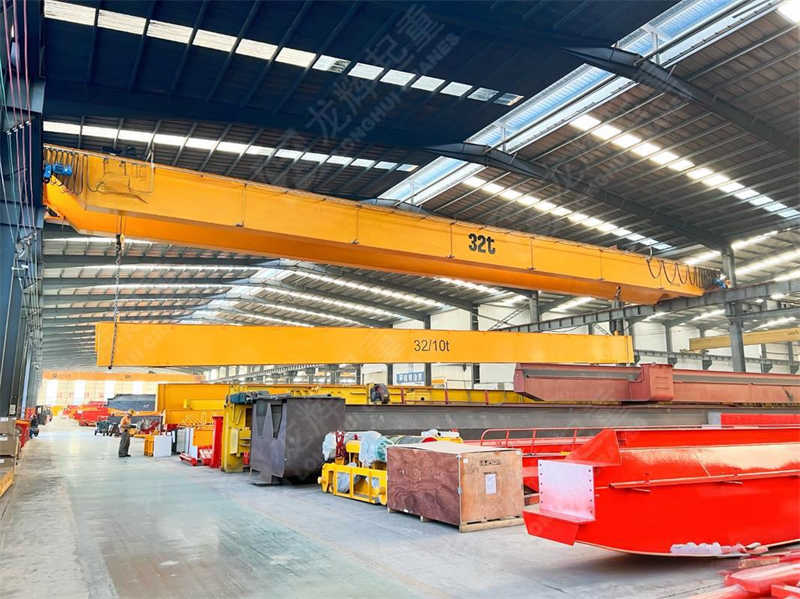
The 32-ton double-girder overhead crane is a medium-to-heavy duty crane widely used in the industrial sector, primarily for material handling operations in workshops, warehouses, and docks. This design proposal, based on advanced European crane concepts and incorporating relevant domestic standards and specifications, provides a complete customized solution. This design encompasses the calculation and selection of core components, including the main and auxiliary hoisting mechanisms, trolley running mechanisms, carriage running mechanisms, and main and end beam structures, ensuring safe and reliable operation under various operating conditions.
Designed in accordance with the JB/T3695-1994 standard, the 32-ton double-girder overhead crane is suitable for loads up to 32 tons and spans of 7.5-35 meters, operating in grades A3-A5, and operating stably within an ambient temperature range of -25°C to +40°C. This design is specifically optimized for 22-meter spans and 10-meter jibs, boasting a rated lifting torque of up to 1000, remote control support, and customizable colors.
Key Technical Parameters and Performance Indicators
The key technical parameters of a 32-ton double-girder overhead crane are the basis for equipment selection and design. These parameters directly determine the crane’s performance and application range:
Basic Parameters:
Rated Lifting Capacity: Main Hook 32 tons (Can be equipped with a 5-ton auxiliary hook to create a 32/5-ton model)
Working Class: A3-A5, adjustable based on frequency of use and load conditions
Boom Length: Optional 10 meters (customizable upon request)
Mechanical Parameters:
Lifting Height: Standard 12 meters (adjustable to factory building height)
Lifting Speed: Fully variable frequency control, slow speed for heavy loads (3.5 m/min), fast speed for light loads (7 m/min)
Trolley Speed: 20-30 m/min (variable frequency control)
Carriage Speed: 30-45 m/min (variable frequency control)
Environmental Parameters:
Operating Temperature: -25°C to +40°C
Power Supply: 380V AC, 50Hz, three-phase
Protection Rating: IP65 (electrical equipment)
Structural Parameters:
Main Beam: Box-type double beam, welded with high-strength steel plates
End Beam: Box-type, connected to the main beam with high-strength bolts
Operation: Remote control (standard) + cab operation (optional)
Appearance:
Color Options: Red, yellow, orange, and other options, customizable
Surface Treatment: Sandblasted, rust-removed, epoxy zinc-rich primer, polyurethane topcoat
Structural Design
The structural design of a 32-ton double-girder overhead crane is crucial to ensuring safe and reliable operation. This solution utilizes a proven box-girder structure. Through precise calculation and optimized design, we ensure structural strength, rigidity, and stability.
Main Girder Design
As the crane’s primary load-bearing component, the main girder utilizes a box-section design, offering high rigidity, strength, and stability. The main beam design process includes:
Determining cross-sectional geometry:
Determining beam height, width, and plate thickness based on span and lifting capacity
Calculating parameters such as section moment of inertia and flexural modulus
Considering load factors such as dynamic load coefficient and impact coefficient
Load calculation:
Permanent loads: Main beam deadweight, rails, and accessories
Variable loads: Lifting load, trolley, and mechanism weight
Horizontal loads: Operating inertia and lateral forces due to deflection
Strength verification:
Vertical strength verification (normal stress and shear stress)
Horizontal strength verification
Local stability verification (compression flange and web)
Manufacturing process:
Using a dedicated jig to ensure linear accuracy
Process flow: Jig preparation → Upper cover plate positioning → Bulkhead installation → Web installation → Lower cover plate installation
Welding process control to reduce welding distortion and residual stress
End beam design
The end beam is a key component that connects the main beam and supports the trolley running mechanism. This solution utilizes a box-type end beam design.
Key Design Points:
Connecting to the main beam with high-strength bolts facilitates transportation and installation.
Horizontal guide wheels prevent skew during operation.
Integrated trolley buffer and anti-collision devices.
Strength Verification:
Strength calculation under vertical loads
Strength calculation under horizontal loads
Strength verification of connecting bolts.
Trolley Frame Design
The trolley frame supports the lifting mechanism and trolley running mechanism. This solution utilizes a welded steel plate structure.
Optimized layout facilitates mechanism installation and maintenance.
Reinforced ribs enhance local rigidity.
Wheel Pressure Calculation:
Calculates maximum and minimum wheel pressures.
Verifies the load-bearing capacity of the track support structure.
Optimizes wheelbase to minimize wheel pressure variations.
Mechanism Design and Selection
The crane’s mechanism design directly impacts its performance and reliability. This proposal includes detailed calculations and optimized selections for each major mechanism to ensure coordinated operation and meet the requirements of various operating conditions.
Main Hoist Mechanism Design
The main hoist mechanism is the core component of the crane, responsible for lifting and lowering loads up to 32 tons:
Wire Rope Selection:
Calculate the maximum wire rope tension based on the rated load and pulley ratio.
Select the wire rope diameter and structure based on a safety factor (usually ≥6).
Verify the number of wire rope wraps and deflection angle on the drum.
Drum Design:
Determine the drum diameter (≥20 times the wire rope diameter).
Calculate the drum length to meet all lifting height requirements.
Design the rope groove parameters to ensure the wire rope is aligned properly.
Motor Selection:
Calculate steady-state lifting power, taking into account mechanism efficiency.
Install anti-collision devices (when multiple cranes share the track).
End stops and anchors (wind protection measures).
Electrical Control System
The 32-ton double-girder overhead crane’s electrical control system utilizes advanced programmable control and variable frequency speed regulation technology, ensuring precise equipment control and intelligent protection.
Control Solution:
Main Control System: PLC control, ensuring coordinated operation of all mechanisms.
Speed Regulation System: Full variable frequency control, ensuring smooth starting and braking.
Operation: Remote control (standard) + cab operation (optional).
Protection Features:
Capacity limiter (WTZ-A100N, suitable for 20-32 tons).
Overcurrent, overload, short circuit, and phase loss protection.
Dual travel protection (mechanical and electrical limit switches).
Emergency stop button (mushroom-shaped, red).
Monitoring System:
Load Monitoring: Real-time display of the lifting capacity.
Operational Status Monitoring: Displays operating parameters of each mechanism.
Fault Diagnosis: Automatic recording and alarm notification.
Electrical Components:
Main components are from international brands such as Schneider and Siemens.
IP65 protection rating, suitable for dusty environments.
Operational Cable: Oil-resistant and wear-resistant.
Manufacturing Process and Quality Control
To ensure crane quality, this plan establishes strict manufacturing process standards and a quality management system:
Material Control:
Main structural components utilize Q345B low-alloy, high-strength steel.
Material Incoming Inspection (Material Certification, Mechanical Property Retest)
Pretreatment (Sandblasting to Sa2.5 for Rust Removal)
Welding Process:
Welders must be certified (Special Equipment Welding Qualification)
Welding Procedure Qualification (PQR) and Welding Procedure Specification (WPS)
Nondestructive Testing (UT Testing of 100% of Main Welds)
Assembly Process:
Dedicated assembly cradle ensures precision
High-strength bolt connections (torque control)
Cleanliness inspection before assembly
Inspection and testing:
Process inspection (initial inspection, patrol inspection, final inspection)
Dynamic Load Test: 110% rated load to verify dynamic performance
Static Load Test: 125% rated load to verify structural strength
Acceptance Documents:
Product Certificate
Instructions and Certificates for Major Purchased Parts
Factory Inspection Report
Installation, Operation, and Maintenance Instructions
Safety Protection Devices
The 32-ton double-girder overhead crane is equipped with comprehensive safety protection devices to ensure the safety of equipment and personnel:
Load Protection:
Capacity Limiter (WTZ-A100N): Real-time load monitoring, automatically cutting off lifting power in the event of overload
Torque Limiter (with amplitude detection)
Stroke Protection:
Stroke limit switches for each mechanism (double protection)
Buffers (polyurethane or hydraulic)
End Stops
Electrical Protection:
Overcurrent, overload, and short-circuit protection
Low-pressure protection (brake engaged in the event of a sudden power outage)
Emergency Stop Switch
Mechanical Protection:
Anti-derailment device (horizontal guide pulley)
Wire rope anti-slip device
Pulley anti-skidding device
Environmental Safety:
Wind speed alarm (for outdoor use)
Lightning protection device (for outdoor cranes)
Anchoring device (wind and slip protection)
Technical and Economic Analysis
The technical and economic performance of a 32-ton double-girder bridge crane is a key concern for users. This proposal analyzes this from multiple perspectives:
Price Analysis:
Base Price: ¥298,000/unit (1-4 units)
Bulk Discount: ¥279,000/unit (5-9 units), ¥263,000/unit (10 or more units)
Price Influencing Factors: Configuration requirements, technical specifications, delivery time, etc.
Operating Cost:
Energy Consumption: Variable Frequency Control saves 20%-30%
Minor Repair: 6 months (local inspection and adjustment)
Medium Repair: 12-24 months (inspection and replacement of major components)
Major Repair: 5-8 years (comprehensive disassembly and inspection)
Common Troubleshooting:
Electrical Troubleshooting and Troubleshooting Solutions for Mechanical Troubleshooting
Structural Component Damage Repair Methods
Spare Parts Management:
Wear Parts List (wire rope, brake pads, etc.)
Key Spare Parts Inventory Recommendations
Reference Spare Parts Replacement Interval
Conclusion and Recommendations
This 32-ton double-girder bridge crane design is based on advanced European crane concepts, incorporating relevant domestic standards and actual user needs, providing a complete technical solution. The solution offers the following notable features:
Technological Advancement:
Fully variable frequency control achieves stepless speed regulation for heavy loads and light loads, while the speed is fast.
European lightweight design reduces wheel loads and construction costs.
Remote control improves operational flexibility and safety.
Safety and Reliability:
Multiple safety protection devices (such as the WTZ-A100N load limiter).
Structural strength is rigorously calculated and verified.
Redundant design of key components (such as the dual braking system).
Affordability:
Significant price advantage (bulk purchase starting at ¥263,000/unit).
Low operating and maintenance costs.
Long service life (designed for A5 duty class).
Customization Flexibility:
Spans can be customized based on requirements. Adjustable from 7.5 to 35 meters.
Available colors (red, yellow, orange, and more).
Optional features include a cab and air conditioning.
Implementation Recommendations:
Determine specific technical parameters (span, lifting height, etc.) based on actual factory conditions and usage requirements.
Consider bulk purchasing to reduce costs (maximum discounts available for purchases of 10 or more units).
Pay attention to installation and commissioning to ensure full performance.
Establish a comprehensive maintenance system to extend equipment life.
This 32-ton double-girder overhead crane design is technologically mature, safe, reliable, and economical. It can meet the heavy-lifting needs of most industrial applications and is an ideal choice for improving production efficiency and reducing labor intensity.
Contact our crane specialists
Send us a message and we will get back to you as soon as possible.