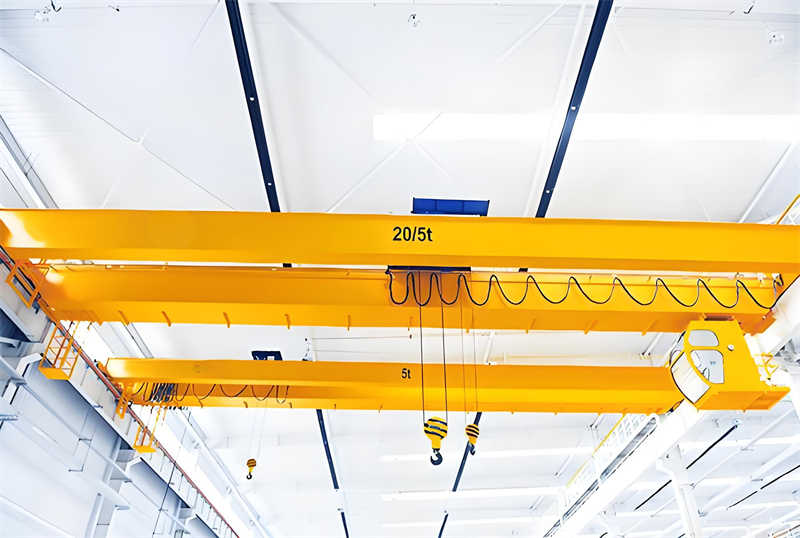
Home → News → QD 20/5 ton double girder bridge crane process plan
QD 20/5 ton double girder bridge crane process plan
I. Overview
This process plan provides a detailed plan for the manufacturing, installation, and commissioning of a QD20/5-ton double-girder bridge crane, aiming to ensure the crane’s quality, safety, and reliability. This plan is developed in accordance with the National Standards of the People’s Republic of China (GB50278-98, “Code for Construction and Acceptance of Lifting Equipment Installation Engineering”) and GBT14405-93, “General-Purpose Bridge Cranes,” and is applicable to the manufacturing, installation, and commissioning of the QD20/5-ton double-girder bridge crane.
II. Construction Preparation
Personnel Organization: A construction team consisting of experienced fitters, electricians, riveters, welders, crane operators, engineering technicians, construction management personnel, and safety management personnel will be assembled. Special operations personnel must hold the appropriate operator’s license.
Tool and Testing Instrument Preparation: Repair tools and testing instruments will be prepared to ensure accurate measurements and inspections during construction.
Construction Site Survey: The construction site will be surveyed and safety measures will be formulated based on actual conditions to ensure safety during construction.
Material and Auxiliary Material Preparation: Repair materials and auxiliary materials will be prepared to ensure a sufficient supply of materials during construction. Drawing study: Carefully study the drawings, familiarize yourself with the repair equipment, and ensure that the technical requirements during the construction process are met.
III. Construction Process
(I) Equipment and Material Acceptance and Foundation Acceptance
Inspect the delivered equipment and materials to ensure their quality meets the requirements. Also, inspect the crane foundation to ensure it meets installation requirements.
(II) Key Technical Points for Main Beam Fabrication
Main Beam Cutting: Cut the web, upper and lower covers, and large and small ribs of the main beam according to design requirements to ensure accurate dimensions.
Beam Assembly: Assemble the cut components to form the beam. During the assembly process, pay attention to the relative position and dimensional accuracy of each component.
Beam Underbody Welding: Weld the underbody of the beam to ensure welding quality. During the welding process, pay attention to the welding sequence and control of welding parameters.
Lower Cover Assembly: Assemble the lower cover to the beam to form the complete main beam structure. During the assembly process, pay attention to the fit and dimensional accuracy of the lower cover to the beam.
Beam Head Welding and Repair: Weld and repair the main beam head to ensure it meets design requirements. During the repair process, pay attention to controlling welding quality and dimensional accuracy.
Main Beam Waist Welding: Weld the main beam waist seam to ensure welding quality. During the welding process, pay attention to the welding sequence and parameters to avoid welding deformation.
Main Beam Repair and Inspection: The main beam is thoroughly inspected and repaired to ensure it meets design requirements. During the inspection, attention should be paid to measuring and controlling parameters such as the main beam’s camber, curvature, and waviness.
(III) On-site Construction
Safety and Technical Briefing Meeting: After the construction team enters the site, a safety and technical briefing meeting will be held. The engineering and technical staff will explain the repair process plan, and the safety management staff will explain safety measures and precautions. All construction team members will receive quality and safety training.
Temporary Power Line Installation: Electricians will connect temporary power lines for construction according to regulations to ensure power supply during construction.
Original Machine Parameter Inspection: The original machine parameters will be inspected to ensure they meet design requirements and recorded. Inspection content includes crane span, main beam camber, relative diagonal difference, and horizontal and vertical deflection of the large wheel end faces.
Disassembly and Lifting: Remove components such as the wire rope, trolley conductive system, crane trolley, driver’s cab, and the connecting bolts between the two main beams. The cracked main beam is then hoisted to the ground for repair. Strictly adhere to operating procedures during the hoisting process to ensure safety.
Main Beam Repair: Repair cracks in the main beam lower cover using manual arc welding with a single-sided, double-sided forming process. Ultrasonic testing is performed after welding to ensure weld quality. Furthermore, reinforcement welding is performed on the main beam lower cover. Ultrasonic testing is performed after welding, and the bridge arch is checked.
Main Beam Hoisting and Splicing Installation: The crane arrives on site to hoist the main beam and perform splicing installation. During installation, attention must be paid to the relative position and dimensional accuracy of the main beams.
Driver Cab and Trolley Hoisting: Hoist the cab and trolley to the designated location and install them.
Trolley Conductor and Wire Rope Installation: Install the trolley conductor and wire rope to ensure they meet design requirements.
Cleaning and power-on test: Clean the construction site, thoroughly inspect all parts of the crane, and power on for test after confirming that everything is correct. During the test, pay attention to observe the operating conditions of each component to ensure that it meets the design requirements.
IV. Acceptance and Handover
Conduct a test with relevant personnel from the user organization. Complete the handover procedures after passing the test. It is recommended that the user regularly maintain and service the crane to ensure long-term stable operation. If possible, it is best to upgrade to a new unit to improve production efficiency and safety.
Contact our crane specialists
Send us a message and we will get back to you as soon as possible.