This design presents a comprehensive analysis of the hoisting mechanism of a 32/5-ton double-girder bridge crane, encompassing the design of the main and auxiliary hook systems, transmission scheme selection, calculation and verification of key components, and the application of modern drive technology. As crucial material handling equipment in the industrial sector, the design of the hoisting mechanism of a bridge crane is directly related to the overall performance, safety, and reliability of the entire machine. Based on crane design specifications and relevant theories, this article details the design process for the hoisting mechanism of a 32-ton main hook and a 5-ton auxiliary hook. This includes the selection and calculation of components such as the motor, reducer, brake, and coupling; the design and verification of load-bearing components such as the wire rope, pulley block, and drum; and the application of modern technologies such as the “three-in-one” transmission mechanism.
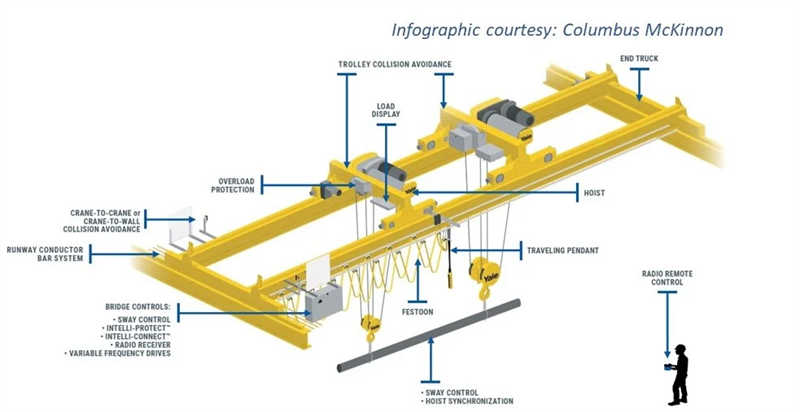
The 32/5-ton bridge crane is a large-tonnage double-girder bridge crane featuring a main and auxiliary hook design. With a rated lifting capacity of 32 tons for the main hook and 5 tons for the auxiliary hook, it is a heavy-duty crane widely used for material handling operations in heavy industrial plants, railway freight yards, and port terminals. This crane features stable performance, high efficiency, and ease of operation. The hoisting mechanism designed in this project is the most critical component of the crane, and its performance directly determines the overall operating capacity, safety, and reliability of the crane.
Based on the mission requirements and relevant reference materials, the main technical parameters of the hoisting mechanism for this 32/5-ton bridge crane were determined as follows:
Main Hoisting Mechanism Parameters:
Auxiliary Hoisting Mechanism Parameters:
General Parameters:
According to ISO and FEM standards, the crane’s working class is determined based on the load status and utilization level. In this design, both the main and auxiliary hooks are designed for M5 duty, indicating frequent use and heavy loads, placing the crane in a heavy-duty duty cycle. The M5 duty cycle corresponds to a JC40% mechanism duty cycle, requiring consideration of appropriate dynamic load factors and fatigue strength. The hoisting mechanism design must meet this duty cycle requirement, and all component selection and calculations should factor in the corresponding operating condition factors.
The main aspects of this 32/5-ton overhead crane hoisting mechanism design include:
The design objective is to ensure that the hoisting mechanism meets the 32/5-ton lifting capacity requirements through reasonable structural design and precise calculations, while also ensuring smooth, safe, reliable operation, and easy maintenance, while complying with relevant national standards and industry regulations.
The selection of a hoisting mechanism transmission scheme is a critical step in the design process, directly impacting the overall performance, reliability, and economic efficiency of the crane. Based on the parameters, characteristics, and operating requirements of a 32/5-ton bridge crane, this section will detail the transmission scheme determination process and specific configuration.
Modern bridge crane hoisting mechanisms are primarily driven by centralized or separate drives. Centralized drive utilizes a single prime mover to power multiple mechanisms. While cost-effective, it is complex and subject to energy transmission losses. Separate drive, in which each mechanism has its own prime mover, offers advantages such as flexible layout, easy installation and maintenance, and high transmission efficiency. Based on these advantages, this design adopts a separate drive scheme, with independent drive systems for the main hook and auxiliary hook, improving system reliability and flexibility.
In terms of transmission layout, the traditional method involves connecting components such as the motor, reducer, and brake via couplings and placing them on the trolley frame. This arrangement consumes considerable space. Modern cranes are increasingly adopting “three-in-one” transmissions, integrating the motor, brake, and reducer into a compact unit. This design offers a compact structure, lightweight, easy assembly, and immunity to platform deformation. Considering that 32/5-ton cranes are large-capacity cranes, this design utilizes a traditional split-type transmission for the main hoist mechanism to ensure sufficient transmission torque and easy maintenance. The auxiliary hoist mechanism utilizes a “three-in-one” transmission to save space.
The main hoist mechanism transmission scheme is shown in Figure 1. The motor is connected to a reducer via a coupling. The reducer output shaft drives the drum via another coupling, achieving the lifting and lowering of the spreader. A normally closed brake is installed in the system for safety, typically on the high-speed shaft to provide a low braking torque. The pulley system utilizes a double pulley system, with a balance pulley placed on the movable pulley system to ensure even load distribution.
The specific transmission route is: motor → high-speed shaft coupling → reducer → low-speed shaft coupling → drum → wire rope → pulley system → hook assembly. Each component of the entire transmission chain requires precise calculation and selection to ensure it meets the 32-ton lifting capacity requirement.
Due to the relatively small lifting capacity (5 tons) of the auxiliary hoist, a more compact transmission solution can be used. As shown in Figure 1.5, a “three-in-one” transmission configuration is considered, integrating the motor, brake, and reducer into a single unit to directly drive the drum. This solution offers the following advantages:
The auxiliary hoist pulley block uses a single-unit pulley block. Due to the high lifting speed (19.5 m/min), special attention must be paid to wire rope angle control and drum rope arrangement performance.
The pulley block is a critical component of the hoist mechanism, and its configuration directly affects the load bearing capacity and life of the wire rope. Based on the lifting capacity and work level, the main hoist mechanism uses a double-unit pulley block with a magnification of 6, while the auxiliary hoist mechanism uses a single-unit pulley block with a magnification of 4. This configuration balances wire rope tension and drum size, resulting in a more streamlined mechanical layout.
The hook assembly utilizes a standard hook system, with a 32-ton forged hook for the main hook and a 5-ton hook for the auxiliary hook. Both hooks are equipped with thrust bearings, allowing for free rotation and preventing wire rope twisting. The hooks are constructed from high-quality alloy steel (such as DG20Mn), heat-treated, and precision-machined to ensure sufficient strength and toughness.
Table 1: Comparison of pulley configurations for the main and auxiliary lifting mechanisms
| Project | Main lifting mechanism | Auxiliary lifting mechanism |
| Pulley type | Double pulley block | Single pulley block |
| Magnification | 6 | 4 |
| Pulley diameter | ≥20d(Wire rope diameter) | ≥18d |
| Pulley material | ZG270-500 | ZG230-450 |
| Bearing type | Double row spherical roller bearings | Deep groove ball bearings |
The following factors should be considered when arranging the various components of the hoist mechanism on the trolley frame:
This design places the main hoist mechanism in the center of the trolley frame, with the auxiliary hoist mechanism offset to one side, maintaining a sufficient safety distance between the two. The drum is supported at both ends and secured to the trolley frame via flange connections to ensure sufficient rigidity and stability.
Wire ropes and pulleys are key components in the hoisting mechanism that directly bear the load. The rationality of their design directly impacts the safety performance and service life of the crane. Based on crane design specifications and actual operating conditions, this section will detail the design and calculation process for the wire ropes and pulleys in the hoisting mechanism of a 32/5 ton overhead crane.
Wire ropes are the most sensitive load-bearing components in the hoisting mechanism. Their selection requires comprehensive consideration of multiple factors, including breaking strength, fatigue life, and flexibility. According to ISO 4308, crane wire rope selection is primarily based on maximum operating strength and safety factor. Main hoisting mechanism wire rope calculation:
The maximum working tension Smax is calculated as follows:
Smax = Q/(a·η)
Where:
Substituting the following equations:
Smax = 33,500 kg/(6 × 0.97) ≈ 5753 kgf ≈ 56.43 kN
The minimum breaking tension F0 of the wire rope should satisfy the following requirements:
F0 ≥ Smax·n
n is the safety factor. Based on the M5 operating level, n ≥ 6.
Thus:
F0 ≥ 56.43 × 6 = 338.58kN
Consulting the wire rope standards, we selected a 6×36WS+IWR structure with a nominal tensile strength of 1960MPa and a 20mm diameter wire rope. Its minimum breaking force is 369kN, which exceeds 338.58kN, meeting the requirements.
Auxiliary hoist mechanism wire rope calculation:
Similarly, calculate the auxiliary hook wire rope:
Q=5000+500=5500kg (assuming the hoist weighs 500kg)
a=4, η=0.96
Smax=5500/(4×0.96)≈1432kgf≈14.04kN
F0≥14.04×6=84.24kN
Selecting a 6×19S+IWR structure with a nominal tensile strength of 1770MPa and a 14mm diameter wire rope, its minimum breaking force is 118kN, which exceeds 84.24kN, meeting the requirements.
Table 2: Comparison of wire rope parameters of main and auxiliary hoisting mechanisms
| Parameter | Main lifting mechanism | Auxiliary lifting mechanism |
|———-|—————-|—————-|
| Structure Type | 6×36WS+IWR | 6×19S+IWR |
| Diameter(mm) | 20 | 14 |
| Nominal tensile strength(MPa) | 1960 | 1770 |
| Minimum breaking force(kN) | 369 | 118 |
| Safety factor | 6.54 | 8.4 |
| Length Calculation (m) | Lifting height 16m x 6 + 5 drum turns reserved ≈ 110m | Lifting height 18m x 4 + 5 drum turns reserved ≈ 85m
The main pulley parameters include pulley diameter, rope groove dimensions, and rim structure, which directly affect the service life of the wire rope.
Pulley Diameter Determination:
According to ISO standards, the minimum pulley winding diameter D should meet the following requirements:
D ≥ h·d
h is the winding ratio. For M5 duty class, h ≥ 20.
Main Hoisting Mechanism:
D ≥ 20 × 20 = 400 mm
Practically, D = 450 mm is used.
Auxiliary Hoisting Mechanism:
D ≥ 18 × 14 = 252 mm
Practically, D = 280 mm is used.
Pulley Material Selection:
Pulleys are subject to significant contact and bending stresses, so the material must possess sufficient strength and wear resistance. ZG270-500 cast steel is used for the main hoisting pulley, and ZG230-450 cast steel is used for the auxiliary hoisting pulley. The pulley groove surface must be finely machined, with a hardness within the HB180-220 range to minimize wear on the wire rope.
Pulley Bearing Selection:
The pulleys utilize double-row spherical roller bearings, which are self-aligning and can withstand heavy radial loads. The main hoist pulley uses a 22220 bearing, while the auxiliary hoist pulley uses a 22216 bearing, both meeting the dynamic load rating requirements.
The wire rope is secured to the drum using a pressure plate and a loosening prevention device to ensure secure retention. The hoisting mechanism must be equipped with the following safety devices:
Wire rope maintenance is also crucial. Regular lubrication and inspection for broken wires are required. According to GB/T5972, a wire rope should be replaced if the number of broken wires within a lay length reaches 10% of the total number of wires.
The drum is a key component in the hoisting mechanism for winding and storing wire rope. Its design quality directly affects the service life of the wire rope and the operating performance of the mechanism. As the power source of the hoisting mechanism, the proper selection of the motor determines the energy consumption characteristics and operational stability of the entire machine. This section details the design and motor selection calculation process for the hoisting mechanism of a 32/5-ton overhead crane.
Drum design must comprehensively consider wire rope capacity, structural strength, and lightweight requirements.
Main hoisting mechanism drum parameter calculation:
Auxiliary hoist drum parameters:
Diameter D = 280 mm, Length L = 400 mm, Wall thickness δ = 15 mm
Key design points for the drum structure:
Motor power selection requires consideration of rated lifting power and dynamic load.
Main hoist motor power calculation:
Rated lifting power:
PN = (Q·v) / (6120η)
Where:
Substituting into the equation:
PN = (33,500 × 7.51) / (6120 × 0.91) ≈ 45.2 kW
Considering a dynamic load factor φ2 = 1.15, calculate motor power:
Pj = PN·φ2 = 45. 2 × 1.15 ≈ 52 kW
Selected YZP280M-8 variable frequency motor, 55 kW, 740 rpm, IP54 protection, F insulation
Auxiliary hoist motor power calculation:
PN = (5500 × 19.5) / (6120 × 0.89) ≈ 19.3 kW
Pj = 19.3 × 1.15 ≈ 22.2 kW
Selected YZP200L-6 motor, 22 kW, 970 rpm
Table 3: Comparison of main and auxiliary hoist motor parameters
| Parameters | Main Hoist Motor | Auxiliary Hoist Motor |
|———-|——————|——————|
| Model | YZP280M-8 | YZP200L-6 |
| Rated Power (kW) | 55 | 22 |
| Rated Speed (r/min) | 740 | 970 |
| Protection Level | IP54 | IP54 |
| Insulation Class | F | F |
| Duty Cycle | S3-40% | S3-40% |
| Moment of Inertia (kg·m²) | 2.5 | 0.85 |
Heat Verification:
The motor’s allowable power under the base duty cycle should be greater than the actual operating power. For the YZP280M-8 motor, the allowable power under the S3-40% duty cycle is 55 kW, which provides a 6% margin compared to the calculated power of 52 kW and meets the requirement.
Overload Verification:
The motor’s maximum torque multiplier should meet the following requirements:
Tmax/TN ≥ 1.7 × φ2. For the YZP280M-8 motor, Tmax/TN = 2.8. 1.7 × 1.15 = 1.955 < 2.8, meeting the overload requirement.
Starting Capacity Verification:
The hoisting mechanism’s average starting torque should be able to overcome the static resistance torque and generate sufficient acceleration. Main hoist mechanism static drag torque:
Tj = (Smax·D) / (2a·i·η) = (56.43 × 0.45) / (2 × 6 × 30 × 0.91) ≈ 0.077 kN·m
Motor rated torque:
TN = 9550 × 55 / 740 ≈ 710 N·m
The starting torque multiplier is 2.8, significantly greater than the static drag torque, providing sufficient starting capacity.
Although both speed reducers and brakes function in mechanical equipment, their operating principles and structures differ.
A speed reducer is a transmission device that primarily reduces the output shaft speed by changing the gear ratio. It transmits power through the meshing of a gear pair, reducing speed by varying the size of the gears. Speed reducers can transmit high torque and are often used in applications requiring reduced speed and increased torque, such as cranes, excavators, and automobiles.
A brake, on the other hand, is a device used to control the speed of mechanical equipment, primarily through friction to slow or stop it. Brakes utilize friction between a brake band or disc and the moving parts to generate a braking torque, slowing or stopping the machine. Brakes provide stable braking force and are often used in applications requiring speed control and preventing overspeed, such as machine tools, elevators, and amusement rides.
Contact our crane specialists
Send us a message and we will get back to you as soon as possible.