Home → News → European crane driving technical parameter requirements and procurement specifications
European crane driving technical parameter requirements and procurement specifications
I. General
This procurement specification applies to the technical requirements for the crane systems of European-style bridge cranes (including single-girder and double-girder cranes). It aims to ensure that the purchased equipment complies with national safety standards, industry regulations, and actual production needs. European-style cranes, as industrial equipment that integrates European lightweight design with domestic technology, feature light weight, compact structure, energy efficiency, and low noise levels. They are mid-to-high-end industrial lifting equipment. Purchasers must select the appropriate crane configuration based on the requirements of this specification and the specific application scenario.
Basic Requirements:
Design and manufacturing must comply with DIN, FEM, ISO international standards, and Chinese national standards (GB/T).
The overall operating level must be no less than A5, and the operating level of the mechanism no less than M5.
The equipment service life must be no less than 15 years (under normal operating conditions).
Suppliers must provide complete CE/ATEX international certification documents.
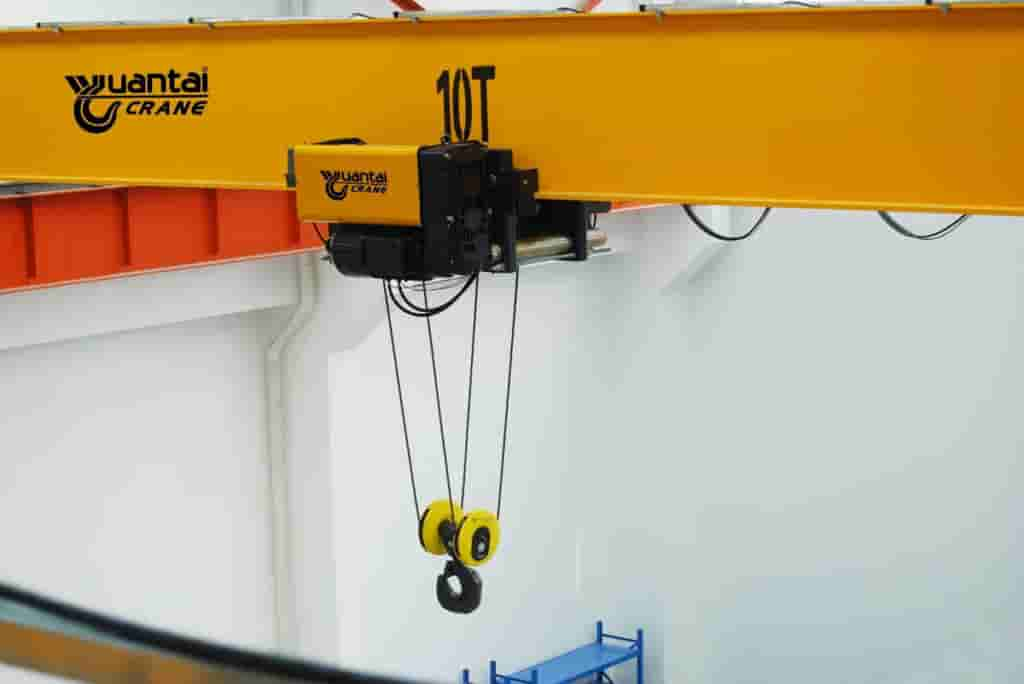
10 ton European-spec Single Girder Overhead Crane
II. Main Technical Parameter Requirements
2.1 Basic Performance Parameters
Rated Lifting Capacity:
Standard Configuration: 5 to 80 tons (double-beam), 1 to 16 tons (single-beam), with special models available up to 400 tons upon request.
When purchasing, choose a crane with a capacity one level higher than the maximum lifting capacity. For example, for a regular 8-ton lift, a 10-ton crane should be selected.
Overload Capacity: All cranes must have a static load test capability of 110% of the rated load and a dynamic load test capability of 125% of the rated load.
Span and Track Parameters:
Standard Span Range: 7.5 to 28.5 meters (single-beam), 5 to 60 meters (double-beam), in 0.5-meter increments.
Track Center Distance Tolerance: ±5mm
Track Compatibility: P22-P43 steel rails, or QU70-QU120 crane-specific rails.
Wheel Pressure Requirements: Due to the lightweight design of European cranes, wheel pressures should be 25%-35% lower than those of traditional cranes.
2.2 Dimensions and Space Parameters
Lifting Height:
Standard options: 6m, 9m, and 12m (low-rise factory); 16.5m, 19.5m, and 22.5m (high-rise factory).
The effective lifting height should be deducted from the maximum height of the hook assembly to ensure the actual available space.
Double-girder cranes can reach a lifting height of 48 meters (for special conditions such as composite tower installation).
Overall Dimension Limitations:
The total width of the crane end beam should be less than the clear distance between the factory building columns, leaving at least 100mm of clearance.
Crane height dimensions must meet the following requirements: The clearance between the highest hook position and the lower chord of the roof truss must be ≥ 200mm.
Must utilize variable frequency stepless speed regulation technology, with a starting acceleration of ≤0.2 m/s².
Equipped with an automatic deceleration function during high-speed operation, reducing the speed to 10% of rated speed 2 meters before the end of travel.
Fine speed range accuracy must reach ±1 mm (for precise positioning).
III. Structural Design and Material Requirements
3.1 Main Girder Structure
Single-Girder vs. Double-Girder Selection:
Single-Girder Crane: Suitable for lifting loads ≤ 16 tons and spans ≤ 28.5 meters. 35% lighter than double-girder cranes.
Double-Girder Crane: Suitable for lifting loads ≥ 5 to 400 tons. Offers increased stability and is suitable for precision lifting.
Material and Manufacturing Standards:
Main girder shall be constructed of Q355B or higher grade steel, with welding procedures conforming to EN 1090.
Main Girder Camber: (0.9-1.4) S/1000 (S represents span).
Static Stiffness: ≤ S/800 (main girder deflection under full load).
Dynamic Stiffness: ≤ S/500 (when the hoisting mechanism is suddenly unloaded).
Heavy Load Test: 100% rated load, testing the effectiveness of all safety devices.
Noise Test: ≤85dB(A) at 1m from the noise source.
VII. Installation and After-Sales Service
7.1 Installation Requirements
Site Preparation:
The purchaser must provide a crane beam with a flatness of ≤3mm/10m.
The power supply must be connected within 15 meters of the equipment.
Sufficient space for equipment assembly (span x 1.5) is required.
Installation Responsibilities:
The supplier will provide an installation plan and safety precautions.
Critical processes (such as main beam hoisting) will be supervised on-site by the supplier’s technical team.
The installation period generally does not exceed 5 working days per unit.
7.2 After-Sales Service
Warranty Period:
18 months for the entire machine (from the date of acceptance)
6 months for consumable parts such as wire ropes and brake pads
Response Time:
General Failures: Remote diagnosis within 24 hours, on-site service within 72 hours
Emergency Failures: Solution provided within 12 hours, on-site personnel response within 48 hours
Technical Training:
Operator Training: No less than 8 hours
Maintenance Training: No less than 16 hours (including practical training)
VIII. Handling of Technical Differences
If the technical parameters of the equipment provided by the bidder differ from these specifications, the following principles shall apply:
Safety and environmental protection clauses must be fully met without any deviation.
If performance parameters exceed the requirements of these specifications, verification data must be provided and the impact on price must be explained.
All technical differences shall be summarized in a “Technical Difference Table” as an annex to the contract.
Major differences (such as substitution of major materials) require re-sampling and testing at the bidder’s expense.
Matters not covered in these specifications shall be handled in accordance with GB/T 3811-2008 “Crane Design Specifications” and GB 6067.1-2010 “Safety Regulations for Hoisting Machinery.” The purchaser reserves the right of final interpretation of this specification.
Contact our crane specialists
Send us a message and we will get back to you as soon as possible.