Home → News → Technical description of QE double girder bridge crane
Technical description of QE double girder bridge crane
The QE double-girder bridge crane is an efficient, safe, and reliable heavy-duty lifting equipment widely used in various fields of industrial production. This article will comprehensively introduce the technical features, structural components, performance parameters, and application range of this type of crane.
I. Overview
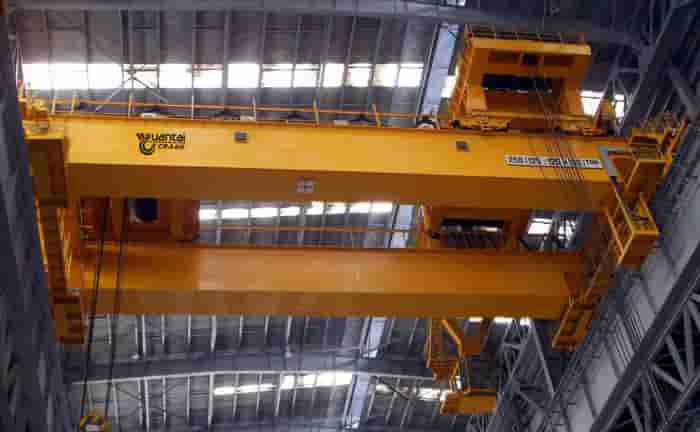
The QE double-girder bridge crane is a type of general-purpose bridge crane. It is a dual-trolley model developed from the QD bridge crane and complies with the national standard GB/T14405 “General-Purpose Bridge Cranes.” This equipment utilizes a double-girder, double-track, and dual-trolley construction. Each hoisting trolley is equipped with an independent transmission system, allowing the two hoisting trolleys to perform lifting operations independently or work together for simultaneous lifting and lowering, and simultaneous left and right movements.
This crane is primarily suitable for a variety of general-purpose applications, including material handling, equipment installation, and maintenance. It is a versatile lifting device used in industrial production. Its rated lifting capacity typically ranges from 5 to 100 tons, with a span range of 10.5 to 31.5 meters and operating classes up to A5 to A7, meeting the needs of diverse industrial scenarios.
QE Double Trolley Overhead Crane
II. Main Structural Features
1. Bridge Structure
The core feature of the QE crane is its double-girder structure, consisting of two parallel main beams forming a solid support frame. This design not only improves overall structural rigidity but also significantly enhances the equipment’s load-bearing capacity, offering distinct advantages over single-girder cranes:
Main Girder Design: The main beam is typically a box-type structure, welded from high-quality steel and internally reinforced with ribs to prevent excessive deformation when lifting heavy loads. The box beam undergoes rigorous heat treatment to maintain excellent strength and rigidity even under rated maximum loads.
End Beam Connection: The two main beams are connected by end beams, constructed of rectangular steel tubes or a box-type structure, forming a stable and rigid frame structure with the main beam. This design provides excellent overall rigidity and torsional resistance.
Load Distribution: The double-girder structure ensures more even load distribution, effectively avoiding localized stress concentrations and is particularly suitable for applications involving frequent heavy lifting.
2. Hoisting Trolley System
QE cranes are typically equipped with a dual trolley system, a key feature that distinguishes them from conventional bridge cranes:
Independent Drive: Each trolley has its own independent hoisting and operating mechanism, equipped with its own drive system, including a motor, reducer, brake, and drum mechanism.
Coordinated Operation: The two trolleys can operate independently or synchronously, including simultaneous lifting and lowering, and simultaneous left and right movements. This flexibility enables them to adapt to a variety of complex lifting requirements.
Variable Speed: The hoisting mechanism can be designed with a variable speed according to user needs, and some models also feature a 2x speed increase for light loads to improve productivity.
3. Drive and Operating System
QE cranes utilize advanced drive technology to ensure smooth and efficient operation:
Electric Drive: The crane is driven by an electric motor, utilizing a reducer, drum, and wire rope to vertically raise and lower loads. The electric drive system provides the crane with precise control.
Operating Mechanism: This consists of the trolley operating mechanism and the trolley operating mechanism. The trolley mechanism is responsible for the longitudinal movement of the crane along the factory rails and consists of components such as a motor, brake, reducer, and coupling. The trolley mechanism enables the trolley to move horizontally along the main beam.
Variable Frequency Control: Most QE cranes utilize variable frequency speed regulation technology to achieve smooth starting and stopping, reducing shock and vibration, improving operational efficiency and reducing long-term operating costs.
III. Main Technical Parameters
The main technical parameters of QE double-girder bridge crane are shown in the following table:
Parameter Category
Technical indicators
Remark
Rated lifting capacity
5-100 ton
Common specifications include 5t, 20t, 32t, 50t, 100t, etc.
Span range
10.5-31.5m
Can be customized according to the actual needs of the workshop
Working Level
A5-A7
Suitable for medium to high intensity work environments
Lifting height
6-30m
The standard lifting height is usually 6 meters and can reach up to 30 meters
Lifting speed
8-20 m/min
Varies according to work level and lifting capacity
Bridge Travel running speed
About 93.2 m/min
Specific values may vary depending on the model
Trolley running speed
20-40 m/min
Frequency conversion speed regulation can achieve stepless speed change
Table: Main Technical Parameters of the QE Double-Girder Bridge Crane
Depending on the specific model and application requirements, the crane can be equipped with various lifting devices, such as a hook, grab, electromagnetic suction cup, or a combination thereof.
IV. Electrical Control System
The QE double-girder overhead crane utilizes an advanced electrical control system to ensure safe and reliable operation:
Variable Frequency Speed Control System: Utilizes an advanced variable frequency speed control system to achieve smooth starting and stopping, reducing shock and vibration. Select models feature a light-load 2x speed increase function on the hoisting variable frequency system to improve productivity.
Safety Protection Devices: Equipped with a comprehensive electrical protection system, including:
Operation: Operates from the ground control room, remotely, or a combination of both. The operating system can be equipped with a variable frequency inching precision positioning function to enhance operational accuracy.
Power Supply System: The trolley power supply conductor is typically installed beneath the crane’s end beam, facilitating safe and convenient maintenance on the maintenance platform. The trolley is typically powered by a cable, equipped with a conductive bracket.
Ⅴ. Safety Devices
Safety is the primary consideration in crane design. The QE double-girder bridge crane is equipped with multiple safety protection devices:
Mechanical Safety Devices:
Buffers: Installed at the ends of the crane and trolley to reduce collision impacts
Windbreak: Ensures protection against wind during outdoor operation
Wire Rope Anti-Slip Device: Prevents the wire rope from detaching from the pulley or drum
Electrical Safety Devices:
Overload Limiter: Automatically cuts off lifting power when the load exceeds the rated value
Travel Limiter: Prevents each operating mechanism from exceeding the specified range
Emergency Stop Switch: Quickly cuts off power in an emergency
Structural Safety Design:
The main beam is constructed of high-strength steel and has an optimized structural design, ensuring sufficient strength and rigidity.
Critical connections utilize high-strength bolts or high-quality welding techniques.
Maintenance platforms and guardrails are provided for easy inspection and personnel safety.
VI. Application Areas
Due to its excellent performance and flexibility, the QE double-girder bridge crane is widely used in the following areas:
Heavy Industry:
Steel Industry: Handling heavy materials such as billets and plates
Shipbuilding Industry: Lifting and positioning of large ship components
Machinery Manufacturing: Installation and transfer of heavy equipment
General Industry:
Industrial and mining workshops: Lifting of various production materials
Open-air warehouses/cargo yards: Loading and unloading of long materials (timber, straight tubes, pipes, and bars)
Equipment Maintenance: Inspection and maintenance of large equipment
Special Applications:
Occasions requiring coordinated operation of two lifting points
Large-span, high-tonnage material handling requirements
Working environments requiring high positioning accuracy
VII. Equipment Advantages
The QE double-girder bridge crane offers the following significant advantages over conventional bridge cranes: Advantages:
High-efficiency productivity:
The dual-trolley design enables synchronous or asynchronous operation, significantly improving work efficiency.
The variable frequency speed control system shortens operation cycles and reduces energy consumption.
The optional speed-increasing function further increases operating speed under light-load conditions.
Excellent reliability:
The dual-beam structure provides greater structural stability and load-bearing capacity.
High-quality materials and precision manufacturing processes ensure long-term stable operation.
Demonstrated durability and low failure rates in practical applications.
Excellent operability:
Variable frequency control enables smooth starting and precise stopping for more accurate operation.
A variety of optional operating modes adapt to different operating requirements.
Humanized design facilitates maintenance.
Economical efficiency:
Although the initial investment is high, long-term operating costs are low.
High-efficiency operation reduces unit lifting costs.
Strong durability and long service life.
Ⅷ. Selection and Customization
When selecting a QE double-girder bridge crane, consider the following factors:
Basic Parameter Determination:
Rated lifting capacity: Determined based on the maximum lift weight, generally with a 10-20% margin.
Span: Determined based on the actual span of the factory or work area.
Lifting height: Consider the workpiece size and hoist height.
Working Class Selection:
Select the appropriate working class (A5-A7) based on frequency of use and load conditions.
Select a higher working class for frequent use or heavy loads.
Explosion-proof, corrosion-resistant, and other special environment configurations.
Customization Services:
Girder span can be customized to meet actual workshop needs.
Electrical control system can be adjusted to meet user requirements.
Exterior color and logos can be customized to company standards.
IX. Installation and Maintenance
Proper installation and regular maintenance are key to ensuring the long-term, stable operation of the QE double-girder bridge crane:
1. Installation Key Points
Track Installation: Ensure track straightness, levelness, and gauge meet standard requirements.
Structural Assembly: Strictly follow the manufacturer’s assembly sequence and technical specifications.
Electrical Wiring: Performed by a professional electrician, ensuring reliable grounding and good insulation.
Commissioning Tests: Include no-load, static load, and dynamic load tests to verify all functions.
2. Routine Maintenance
Routine maintenance of the QE crane focuses on lubrication and electrical component inspection, including:
Mechanical Section:
Regularly check wire rope wear
Maintain good lubrication at all lubrication points
Check brake pad thickness and braking performance
Inspect wheel wear and track condition.
Electrical Section:
Check cables and busbar wear
Test the effectiveness of various safety devices
Clean electrical components and check terminal tightness
Record motor operating current and temperature rise.
Structural Section:
Regularly check major load-bearing welds for cracks
Check high-strength bolt connections for looseness
Observe the main girder for abnormal deformation.
X. Technological Development Outlook
With the rapid development of industrial technology, With technological advancements, the QE double-girder bridge crane continues to evolve:
Intelligent Trends:
Introduction of remote monitoring and fault diagnosis systems
Development of automatic positioning and anti-sway control systems
Enabled data interaction with factory MES systems
Energy Saving and Environmental Protection:
Adoption of more efficient motors and drive systems
Development of energy recovery technologies
Use of environmentally friendly materials and surface treatments
Performance Improvements:
Optimized structural design to improve strength-to-weight ratio
Development of more precise control algorithms
Enhanced safety and protection features
As a vital piece of equipment in modern industrial production, the QE double-girder bridge crane’s technological development continues to advance in the areas of improving efficiency, enhancing safety, reducing costs, and achieving intelligent operation.
Conclusion
With the high stability of its double-girder structure, the efficient dual-trolley system, and advanced control technology, the QE double-girder bridge crane is an ideal solution for heavy material handling. This design prioritizes superior performance, safety, and reliability, while also balancing cost-effectiveness and aesthetics. It can meet diverse needs, from general industrial workshops to heavy manufacturing. With continuous technological advancements, the QE crane will continue to play an irreplaceable role in industrial production.
Contact our crane specialists
Send us a message and we will get back to you as soon as possible.