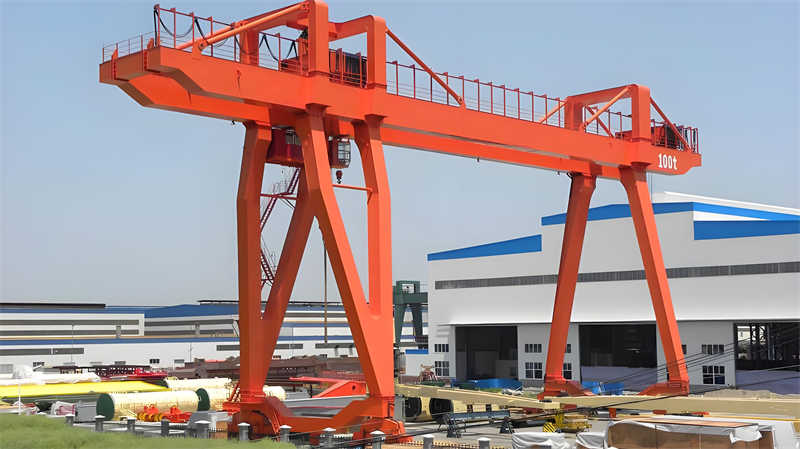
Wind Load Calculation: According to GB/T 3811, wind pressure is 250 N/m², and windward area F = Ψ·A (Ψ is the fill factor).
Load Combination:
Case 1: 1.2G + 1.4Q (Normal Operation)
Case 2: 1.1G + 1.3Q + 1.3P (Extreme Wind Load).
Strength and Stiffness Calculation
Strength Verification.
Stiffness Control:
Vertical static deflection of the main beam at midspan ≤ L/800 (allowable deflection 25mm for a 20-meter span).
Deflection at the cantilever end ≤ L1/350 (if cantilever is used).
II. Outrigger Stability Calculation
Outrigger Type
A combination of rigid and flexible outriggers is used. The portal frame structure must resist overturning moments.
Stability Verification
Euler’s formula: Calculate the critical load Pcr = π²EI/(μL)², ensuring a safety factor ≥ 1.5. Overturning Moment:
Stabilizing Moment Mstab = G·B/2 (B is the distance between the outriggers).
Tipping Moment Mtip = Q·L/4 + P·H (H is the height at which the wind load acts).
III. Traveling Mechanism Design
Trolley Traveling Mechanism
Wheel Pressure Calculation: Maximum Static Wheel Pressure Pmax = (G+Q)/n + Mtip/B (n is the number of wheels).
Drive Motor Power: Select according to the operating resistance F = μ(G+Q), variable frequency stepless speed regulation (reference speed 20-32 m/min).
Trolley Design
Refer to the trolley calculation sheet for 5t-50t bridge cranes (pulley and wire rope specifications must be adjusted for a 150-ton load).
IV. Safety Device Selection
Brakes: The hoisting mechanism uses dual brakes with a braking torque ≥ 1.5 times the rated torque.
Wind and Slip Protection: Rail clamps or anchoring devices with an anti-slip force ≥ 1.2 times the wind load.
Limiter: A weight limiter is required for lifting capacities ≥ 10t.
This design meets the strength, rigidity, and stability requirements of a 150-ton, 20-meter double-girder gantry crane. The main girder utilizes a box-type welded structure, the outriggers are designed as a rigid-flexible combination, the operating mechanism is equipped with variable frequency speed regulation, and the safety devices meet national standards. Finite element analysis is required to further optimize local stress concentration areas.
Contact our crane specialists
Send us a message and we will get back to you as soon as possible.