This design provides a comprehensive analysis and calculation of the metal structure system for a 10-ton electric single-girder gantry crane, covering the structural design, strength, stiffness, stability checks, and connection node optimization of core components such as the main girder, legs, and end beams. The document elaborates on the entire engineering design process, from load analysis and material selection to structural layout and manufacturing techniques. Combining the specific operational requirements of gantry cranes, innovative structural optimization solutions are proposed. Scientific calculation methods and reasonable safety factors ensure the safety and reliability of the crane under various working conditions, while also considering economy and maintenance convenience, providing a complete solution for the design of medium-duty gantry cranes.
As an important branch of overhead cranes, gantry cranes hold an irreplaceable position in open storage yards, material yards, and port handling operations due to their unique “gate”-shaped frame structure. The designed 10-ton electric single-girder gantry crane combines simple structure with practical functionality. Utilizing a single main girder paired with rigid legs on both sides, it meets the needs for heavy load lifting over large spans. Compared to double-girder structures, the single-girder design reduces self-weight and manufacturing costs but imposes higher demands on structural optimization and local stability.
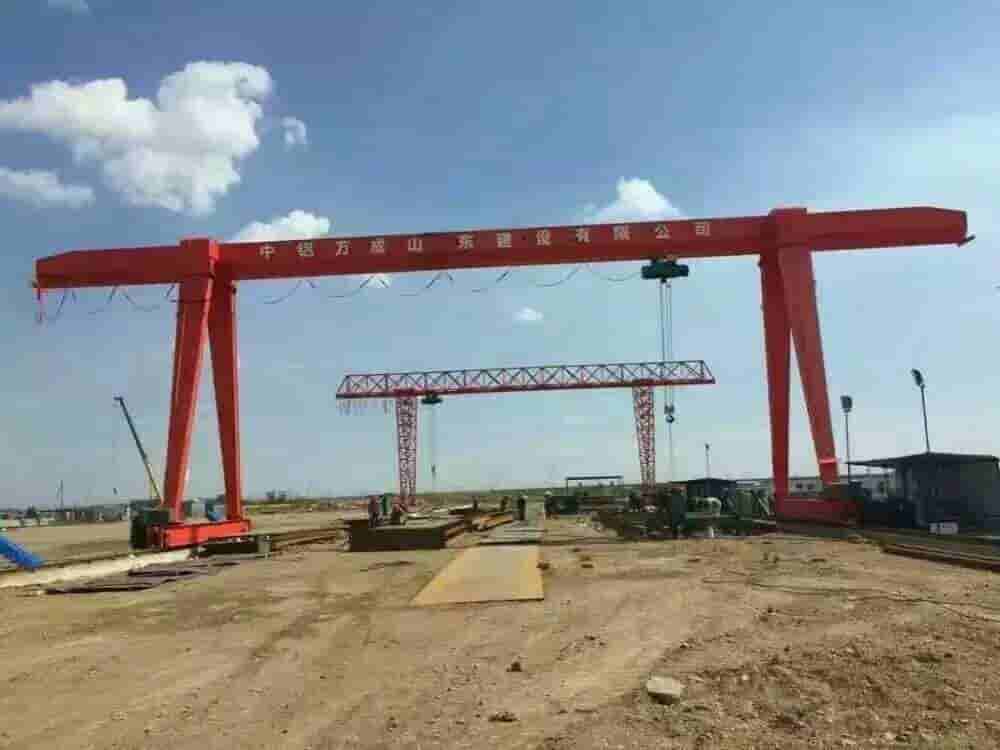
Regarding the design specification system, this design strictly adheres to mandatory standards and industry codes in China’s hoisting machinery sector. Load combinations and structural strength calculations are performed according to GB3811-2008 “Design Rules for Cranes”; safety devices are configured per GB6067-2009 “Safety Regulations for Hoisting Machinery”; basic parameters and construction requirements are determined with reference to GB/T14406-2011 “General Purpose Gantry Cranes”; simultaneously meeting the material performance requirements of GB/T700-2006 “Carbon Structural Steels” and GB/T1591-2018 “High Strength Low Alloy Structural Steels”. These standards collectively form the technical foundation of the design work, ensuring the crane meets the multiple objectives of safety, reliability, and economy from the design source.
Core design parameters are determined based on typical usage scenarios: rated lifting capacity of 10 tons, applicable span range of 18-30 meters (adjustable according to actual needs), lifting height of 9 meters, duty class A4 (equivalent to FEM 1Am), crane travel speed 30 m/min, trolley travel speed 20 m/min, hoisting speed 8 m/min. Ambient temperature conditions are -20°C to +40°C, for non-explosion-proof applications, using rail model QU70. These parameters reflect the typical configuration of a medium-duty single-girder gantry crane in general industrial settings, balancing operational efficiency and safety margins.
In structural type selection, this design adopts a box-section as the basic form for the main girder, offering better torsional stiffness and local stability compared to I-beams; the leg form uses a rigidly connected double-rigid leg system to ensure overall structural stability; end beams and the main girder are connected using high-strength bolted flange plates, facilitating transportation and on-site assembly; the electric hoist runs directly suspended from the lower flange of the main girder, simplifying the trolley structure. These choices reflect the trend of modern single-girder gantry cranes towards lightweight and modular design.
Table: Basic Technical Parameters of the 10-Ton Electric Single-Girder Gantry Crane
| Parameter Name | Indicator Value | Remarks |
|---|---|---|
| Rated Lifting Capacity | 10t | Includes lifting tool weight |
| Duty Class | A4 | Applies to entire crane & hoist mechanism |
| Span Range | 18-30m | Customizable design |
| Lifting Height | 9m | Rail top to hook lowest point |
| Hoisting Speed | 8 m/min | Can be increased by 20% when unloaded |
| Crane Travel Speed | 30 m/min | Variable frequency speed control |
| Trolley Travel Speed | 20 m/min | Electric hoist self-propelled |
| Maximum Wheel Load | ≤80 kN | Corresponding to QU70 rail |
Table Note: Specific parameters can be adjusted appropriately according to user’s actual needs
Scientific and reasonable load analysis is the foundation of crane metal structure design, directly affecting structural safety and economy. For the 10-ton electric single-girder gantry crane, load calculation needs to consider various factors, including permanent fixed loads, variable moving loads, and accidental loads under special conditions. According to GB3811-2008 requirements, these loads must be superimposed in different combinations to reflect the most unfavorable stress state of the crane in actual operation.
Vertical loads are the dominant factor in crane structural design, comprising the following components: First, the dead load (PG), including the weight of fixed parts like the bridge structure, leg system, travel mechanisms, and electrical equipment; in this case, accurately calculated using 3D modeling software for component weights and distribution. Second, the hoisting load (PQ), consisting of the rated capacity (10t) and the lifting tool weight (approx. 0.2t), multiplied by the dynamic factor φ2 when considering dynamic effects; for duty class A4, φ2 is 1.15-1.2. Finally, impact loads from starting/stopping the hoisting mechanism generate additional dynamic effects, typically reflected by the dynamic factor φ5 (1.1-1.3). In actual calculation, the maximum single wheel load reaches 80kN, crucial for rail beam design and leg local strength checks.
Horizontal loads mainly originate from inertial forces during crane travel and lateral forces from crabbing. The longitudinal horizontal load (PHL) from crane travel starting/braking is calculated as 10% of the maximum wheel load; the transverse horizontal load (PHS) from trolley travel starting/braking and crane crabbing is considered as 6%-10% of the vertical wheel load, with higher values for larger spans. For the single-girder structure of this design, the torsional moment generated by the off-center operation of the electric hoist must be specially considered; this torque causes additional torsional stress in the main girder, requiring strict control in box girder design.
Load combinations follow the “Road and Bridge Construction Calculation Manual” and GB3811-2008, divided into regular combinations (Class I) and special combinations (Class II). Regular combinations include dead load factor 1.2 and live load factor 1.45, used for strength and stiffness checks under normal service conditions; special combinations consider accidental factors like wind or seismic loads, using a factor of 1.0, for checking structural stability under extreme conditions. In the actual working environment of gantry cranes, structures working outdoors must also consider the maximum in-service wind pressure (qⅠ) and the ultimate out-of-service wind pressure (qⅡ); these wind pressures acting on the projected structural area generate significant horizontal forces, particularly affecting leg stability.
Table: Load Combination Cases for the 10-Ton Single-Girder Gantry Crane
| Case Type | Load Components | Partial Factors | Applicable Check Content |
|---|---|---|---|
| Regular Comb I | Dead + Hoist + Impact | 1.2PG + 1.45φ2PQ | Main Girder Strength, Stiffness |
| Regular Comb II | Dead + Hoist + Horizontal | 1.2PG + 1.15PQ + 1.5PH | Structural Stability |
| Special Comb I | Dead + Wind Load | 1.1PG + 1.3qⅠ | Anti-overturning Stability |
| Special Comb II | Dead + Seismic | 1.0PG + 1.0PE | Seismic Check |
Table Note: PG is structure dead weight; PQ is hoisting load; PH is horizontal load; PE is seismic action
Dynamic effects cannot be ignored in load analysis. Vibrations and impacts during crane operation significantly increase the actual stress levels. For the electric single-girder gantry crane, the dynamic impact factor φ1 during hoist start-up is 1.05-1.1; the unloading factor φ3 when the load is suddenly fully released is 0.5-1.0; these factors are closely related to the crane’s duty class and control characteristics. Actual measurements show that when the electric hoist trolley is at mid-span and suddenly lifts the rated load, the dynamic stress at the main girder mid-span can be 15%-20% higher than the static stress; this phenomenon must be fully considered in structural fatigue calculations.
The bridge main girder, as the core load-bearing component of the 10-ton electric single-girder gantry crane, directly determines the machine’s safety, reliability, and performance. This design uses a welded box-section as the basic form for the main girder, optimizing cross-sectional parameters and employing local reinforcement measures to meet strength, stiffness, and stability requirements while controlling self-weight. Compared to traditional I-beams, box girders have higher torsional stiffness and better local stability, effectively resisting eccentric loads and torsional moments generated by the electric hoist.
Cross-section size optimization is based on material mechanics theory and crane design codes. The main girder height (H) is typically 1/12 to 1/18 of the span. For the 24-meter span 10-ton single-girder gantry crane, the designed girder height is 1.4 meters, with a height-to-span ratio of about 1/17, ensuring stiffness while controlling structural height. The girder width (B) is 1/3 to 1/4 of the height, determined as 0.45 meters in this design, providing sufficient lateral stiffness to resist horizontal loads. The top flange plate thickness is 12mm, and the bottom flange plate thickness is 10mm. Considering the local compressive stress from the electric hoist wheel loads on the top flange, the thickness is appropriately increased to improve wear resistance and local stability. The web plate thickness is 8mm, with transverse stiffeners spaced at 1.2 meters to prevent shear buckling. Material selection is Q345B low-alloy steel, with a yield strength of 345 MPa, allowing a 15%-20% weight reduction compared to Q235 steel, along with better weldability and low-temperature toughness.
Local structural reinforcement is a key and challenging aspect of single-girder design. In the electric hoist rail support area, continuous T-shaped stiffeners (thickness 10mm, height 120mm) are added below the top flange to distribute concentrated wheel loads effectively. In the mid-span area (approx. 1/3 of the span), longitudinal stiffeners are arranged on both sides of the web to prevent web buckling under bending stress. Transverse stiffeners are spaced closer (0.8 meters) in the end shear zones to enhance shear capacity. The rail uses QU70 type special crane rail, fixed to the centerline of the top flange via clamp bolts. The rail mounting surface is milled to ensure flatness error ≤ 2mm, reducing impact vibration during electric hoist operation.
Stiffness control indicators strictly follow GB/T3811-2008 code requirements. The vertical static deflection limit of the main girder under rated load is 1/700 of the span (L). Finite element analysis in this design verifies a mid-span deflection of 28.5mm (L/842), meeting the requirement; the residual deformation after unloading is less than L/2000, indicating the structure works elastically. For horizontal stiffness, the lateral displacement caused by crane crabbing and trolley braking is controlled within L/2000, ensuring crane travel stability. Dynamically, the first natural frequency is designed to be above 2.5 Hz, avoiding the excitation frequency of the electric hoist (typically 1-2 Hz) to prevent resonance.
Manufacturing process design is crucial for ensuring main girder quality. Segmented welding is used, dividing the main girder into 3 segments (7.5 meters each end, 9 meters middle) for ease of transport and site assembly. The welding sequence follows the “inside first, then outside, symmetrical welding” principle: first welding the fillet welds between internal stiffeners and the web, then the longitudinal welds between the web and flanges, finally completing the cover passes. Post-weld, 100% ultrasonic testing is performed on main load-bearing welds, with quality grade not lower than Grade B per GB/T11345-2013. To control welding distortion, dedicated turning fixtures are used for segment positioning and welding, and preset camber (e.g., 30mm pre-camber at mid-span) is applied at key locations to compensate for welding and self-weight induced deflection.
Table: Main Parameters and Technical Indicators of the Main Girder Structure
| Parameter Name | Design Value | Code Limit Value | Verification Method |
|---|---|---|---|
| Section Height | 1400mm | – | 3D Modeling |
| Section Width | 450mm | ≥350mm | Lateral Stability Calc. |
| Top Flange Thickness | 12mm | Strength Check | σmax=215MPa\<295MPa |
| Bottom Flange Thick. | 10mm | Fatigue Check | Δσ=85MPa\<125MPa |
| Web Thickness | 8mm | Shear Check | τmax=95MPa\<170MPa |
| Mid-span Static Defl. | 28.5mm | L/700=34.3mm | Finite Element Analysis |
| Residual Deformation | 2.8mm | L/2000=12mm | Load Test |
| Natural Frequency | 2.7Hz | ≥2.0Hz | Modal Analysis |
Table Note: Material yield strength is based on Q345B, allowable stress considers a safety factor of 1.34
Fatigue design considers performance degradation under long-term alternating loads. Based on Miner’s linear cumulative damage theory, fatigue strength assessment is performed for key locations such as the connection between the main girder and legs, and the bottom flange at mid-span. The number of stress cycles is calculated based on a design life of 10 years, 6 working hours per day, 15 working cycles per hour, totaling about 3×10 cycles. The corresponding allowable fatigue stress range is 125 MPa (for Q345B steel, stress concentration category K3). Actual detection shows that the maximum stress range in the bottom flange when the electric hoist passes mid-span is 85 MPa, with a safety factor of 1.47, meeting the infinite life design principle. To improve fatigue performance, all welds in tension zones are ground smooth to avoid sharp notches; temporary welding and arc strikes are prohibited in high-stress areas to prevent introducing initial micro-cracks.
The legs, as the pillar components connecting the gantry crane bridge to the travel mechanisms, perform the critical function of transmitting all vertical and horizontal loads. This 10-ton electric single-girder gantry crane design employs a rigid leg structure, optimized in cross-section form and reinforced at key nodes to ensure load-bearing capacity and stability under various working conditions. Compared to flexible legs, rigid legs provide better lateral restraint, reducing crane sway during travel, but demand higher manufacturing precision and are more sensitive to foundation settlement.
Leg structure selection is based on load analysis and overall stability requirements. The design uses a symmetrical arrangement of double rigid legs. Each side leg consists of a main column, top beam, bottom beam, and diagonal bracing forming a spatial frame structure. The main column uses a box section (600mm×500mm), with steel plate thickness of 10-12mm, and internal transverse diaphragms spaced at 1m to enhance local stability. The diagonal bracing uses hot-rolled H-section steel (HM300×200×8×12), with an inclination angle controlled between 45°-55° to optimize force transmission. The total leg height is designed as 8 meters (rail level to ground) based on user site conditions, meeting the 9-meter lifting height requirement while ensuring sufficient clearance. Material selection is Q345B steel, consistent with the main girder, maintaining the same thermal expansion coefficient and weldability to reduce thermal stress.
Cross-section dimension calculation is based on the most unfavorable load combination. Leg strength checks consider three typical conditions: full-load trolley at the extreme position near the leg (Condition I); no-load condition with maximum out-of-service wind load (Condition II); special loads during installation/commissioning (Condition III). Calculations show that the maximum compressive stress in the main column under the most unfavorable Condition I is 185 MPa, bending stress is 62 MPa, combined stress is 247 MPa < 295 MPa (allowable stress for Q345B), safety factor 1.19. Stability checks include both overall and local stability. The slenderness ratio λ of the main column is 65 < 120 (code limit), meeting overall stability requirements; the width-to-thickness ratio of plate elements is controlled below 42 to prevent local buckling.
Connection node design is a critical part of the leg system. The connection between the leg and the main girder uses a rigid joint with high-strength bolts, featuring an 800mm×600mm×25mm flange plate with 24 pieces of 10.9 grade M24 bolts, ensuring joint bending resistance and installation accuracy. The joint area is locally reinforced with 30mm thick stiffener plates added inside the flange to distribute concentrated stresses. The connection between the leg bottom beam and the travel mechanism uses a hinged design, allowing slight rotation to compensate for rail installation errors; contact surfaces are milled to ensure over 75% contact area. All main welds use full penetration groove welds, followed by stress relief treatment (local heating to 550-600°C, holding for 2 hours) to reduce welding residual stresses.
Wind-resistant design is particularly important for outdoor gantry cranes. The leg system must withstand the maximum in-service wind pressure (qⅠ=250 Pa) and the ultimate out-of-service wind pressure (qⅡ=800 Pa). Wind loads are calculated per GB/T3811-2008, considering the structural shape coefficient (Ks=1.3) and height coefficient (Kh=1.0). The horizontal wind force acting on the legs can reach 12 kN (Condition I) and 38 kN (Condition II). To resist the overturning moment induced by wind loads, anti-overturning anchor devices are installed at the leg base, capable of locking the crane when wind speed exceeds operational limits; the travel mechanism is equipped with rail clamps that automatically grip the rails in the out-of-service state.
Table: Main Design Parameters and Check Results for the Leg System
| Design Parameter | Calculated Value | Code Limit Value | Compliance Status |
|---|---|---|---|
| Main Column Section | 600×500×10 | Slenderness λ<120 | λ=65 |
| Bracing Specification | HM300×200 | Strength Check | σ=135MPa |
| Flange Connection | M24×24 | Slip Factor 0.45 | F=320kN |
| Node Welds | Full Penetration | UT Grade B | 100% Pass Rate |
| Combined Stress | 247MPa | 295MPa | Met |
| Local Compressive Str. | 185MPa | 295MPa | Met |
| Anti-overturning Coef. | 1.33 | 1.25 | Met |
| Foundation Pressure | 85kPa | Bearing Capacity 120kPa | Met |
Table Note: Calculation based on most unfavorable Condition I (full load + in-service wind load)
Fatigue and fracture control requires special attention in leg design. According to analysis of cracking cases in ship loader portal leg structures, areas prone to fatigue cracks include the connection region between the leg and main girder, bracing nodes, and locations with sudden changes in cross-section. This design adopts multiple protective measures: avoiding weld concentration in high-stress areas, with adjacent weld spacing not less than 200mm; chamfering and grinding all hole edges with a radius not less than 5mm; setting removable inspection covers in vulnerable areas for easy daily inspection; requiring material impact toughness Akv ≥ 34J at -20°C to prevent low-temperature brittle fracture; performing ultrasonic testing on key welds to ensure absence of internal cracks.
To further improve fatigue life, the leg structure was optimized using finite element analysis to determine the optimal cross-sectional dimensions and shape, reducing stress concentrations. Additionally, reinforcement plates and ribs were added at key locations such as the leg-to-main girder connection and bracing nodes, enhancing local stiffness and strength.
Considering the complexity and uncertainty of working conditions, this design retains a certain safety margin. While meeting strength and stiffness requirements, lighter materials are prioritized to reduce the overall structural weight, improving the efficiency and stability of the handling equipment.
In summary, this design implements multiple effective measures for fatigue and fracture control in the leg structure, aiming to ensure the long-term, efficient, and safe operation of the equipment while maintaining good performance and stability.
Contact our crane specialists
Send us a message and we will get back to you as soon as possible.