This design and manufacturing document comprehensively elaborates the engineering technical scheme for single-girder gantry cranes, addressing the specific needs of modern industrial production for high-tonnage and large-span lifting equipment. With the development of industries such as shipbuilding, metallurgy, and large equipment manufacturing, higher requirements have been placed on the lifting capacity, span, and performance of lifting machinery. Traditional double-girder gantry cranes, while having strong load-bearing capacity, suffer from disadvantages such as excessive self-weight, high manufacturing costs, and significant energy consumption. This scheme successfully tackles the technical challenges of high-tonnage (50-100 ton class) and large-span (over 35 meters) working conditions through optimized single-girder structural design. While ensuring safety and reliability, it achieves a 20% reduction in steel usage, a 15% decrease in manufacturing costs, and a 10% drop in energy consumption.
The design of high-tonnage, large-span single-girder gantry cranes originates from the urgent need of modern industrial production for heavy equipment handling. With the rapid development of China’s equipment manufacturing and logistics industries, particularly the swift growth in sectors like shipbuilding, power, and chemicals, higher demands are placed on large lifting equipment. Traditional small and medium-sized cranes can no longer meet the needs of large component lifting and extensive work areas. The market urgently requires efficient lifting equipment that can both handle high-tonnage loads and cover large work areas.
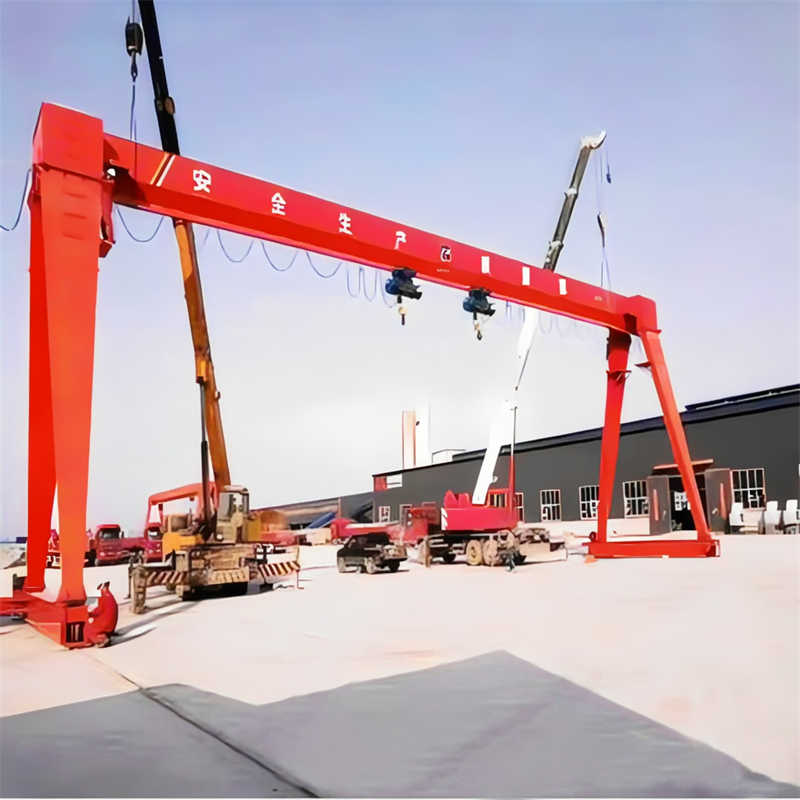
Regarding performance requirements, modern industrial production poses multiple challenges for such cranes: the lifting capacity typically needs to reach 50-100 tons or even higher; the span must meet the demands of large-area operations exceeding 35 meters; the lifting height generally needs to be over 20 meters to accommodate the lifting of high-level equipment; simultaneously, good operational stability, precise positioning control, and long-term durability must be guaranteed. These performance indicators are interdependent; for instance, the combination of high tonnage and large span significantly increases the main girder bending moment, posing a severe test to structural strength. A large lifting height affects the overall stability of the machine. These contradictions need to be balanced through innovative design.
Economic requirements are equally important. Compared to double-girder gantry cranes, the single-girder structure offers significant cost advantages: steel usage can be reduced by 20%-30%, manufacturing man-hours can be lowered by about 15%, the installation cycle can be shortened by 25%, and long-term operating energy consumption can be saved by over 10%. These economic advantages make the single-girder structure the preferred choice for high-tonnage crane design, but they must be achieved under the premise of ensuring safety and durability.
Technical feasibility analysis indicates that by adopting high-strength steel, optimizing cross-sectional shapes, and improving support structures, single-girder gantry cranes can fully meet the usage requirements of high-tonnage and large-span working conditions. Particularly, the popularization of computer-aided design technology and finite element analysis methods has made complex structural stress analysis more accurate, providing reliable tools for the optimal design of single-girder structures. Practical engineering cases also prove that scientifically designed single-girder cranes can maintain good structural stiffness and operational stability under conditions of carrying a 100-ton load with a 40-meter span.
Table: Performance Comparison of High-Tonnage Single-Girder Gantry Cranes and Traditional Double-Girder Gantry Cranes
| Performance Indicator | Single-Girder Gantry Crane | Double-Girder Gantry Crane | Comparative Advantage |
|---|---|---|---|
| Structural Complexity | Simple | Complex | Single-girder structure is simpler, fewer components |
| Self-Weight | Lighter (~20-30% lighter) | Heavier | Single-girder saves material, smaller foundation load |
| Manufacturing Cost | Lower (~15-25% lower) | Higher | Single-girder has lower material and labor costs |
| Installation Difficulty | Easier | More complex | Single-girder has fewer components, easier installation |
| Maintenance Convenience | Good | Average | Single-girder structure easier to inspect and maintain |
| Applicable Span | ≤50m | ≤60m | Double-girder more suitable for ultra-large spans |
| Applicable Tonnage | ≤100t | ≤1000t | Double-girder has stronger load capacity |
Based on the above analysis, this design adopts the single-girder gantry crane scheme, achieving a cost-effective solution for high-tonnage and large-span working conditions through structural innovation and parameter optimization. The design process will focus on solving key technical challenges such as deflection control of large-span single girders, stability optimization of L-type legs, and fatigue life under heavy load conditions.
The overall design of the high-tonnage, large-span single-girder gantry crane is the core link of the entire machine development. It requires comprehensive consideration of various factors such as technical parameters, structural forms, and usage environment. Through scientific calculation and scheme comparison, the optimal configuration scheme is determined. This design is based on national standards such as GB3811-2008 “Crane Design Code” and GB6067-2009 “Safety Code for Lifting Appliances”, combined with the special requirements of high-tonnage and large-span working conditions, completing the overall design work of the crane.
Rated lifting capacity is the most basic parameter of the crane. Aiming at high-tonnage requirements, this design sets the rated lifting capacity at 100 tons, considering a 25% overload capacity to meet safety requirements under occasional overload conditions. The span parameter is designed to be adjustable from 35-50 meters based on user site conditions and process requirements, ensuring stiffness requirements under large spans through optimization of the main girder structure. The lifting height is set at 18-25 meters, meeting the needs of most large component lifting operations.
Duty class is an important indicator in crane design. This design adopts class A6 (equivalent to FEM standard M6), indicating that the crane is suitable for frequent use under severe working conditions. Operating speed parameters are determined based on the balance principle of production efficiency and safety/stability: main hoisting speed 0.5-5 m/min (stepless speed regulation), trolley travel speed 10-20 m/min, gantry travel speed 20-30 m/min. All drive mechanisms adopt frequency conversion control to achieve smooth starting/stopping and precise positioning.
Environmental parameter design considerations include: operating temperature -20℃ ~ +45℃, maximum relative humidity 95%, wind resistance 60 m/s in non-working state (20 m/s in working state), seismic intensity 8 degrees. Electrical components protection class reaches IP55, important bearings adopt fully sealed structures, adapting to various harsh industrial environments.
Main girder structure adopts an eccentric rail box girder design. Compared with the traditional center rail box girder, it has advantages such as light self-weight, good torsional resistance, and simple manufacturing. The main girder width is set at 1/20 ~ 1/25 of the span, and the height is 1/14 ~ 1/18 of the span. By reasonably setting internal diaphragms and stiffeners, local stability is ensured. The main girder pre-camber is set at 1/1000 of the span to offset the deflection deformation under load.
Leg form selects the L-type structure. Although the cargo passage space is relatively smaller compared to the C-type leg, it has advantages such as convenient installation, good force-bearing performance, and high lateral stiffness, making it particularly suitable for high-tonnage working conditions. The legs and main girder are connected by high-strength bolts, facilitating transportation and on-site assembly. The lower part of the legs is equipped with adjustable support seats to compensate for uneven settlement of the rail foundation.
Trolley design adopts a low-built-height electric hoist scheme. Compared with traditional double-girder trolleys, the structural height is reduced by over 30%, increasing the effective lifting space. The trolley travel mechanism uses a three-in-one drive unit, which is compact and easy to maintain. For high-tonnage lifting requirements, a dual braking system (service brake + safety brake) is configured to ensure hoisting safety.
The entire machine adopts a symmetrical layout, with the main girder extending equally at both ends. The overhang length is about 1/4 ~ 1/3 of the span, increasing the operation coverage. The main girder and the two legs form a gantry frame structure. The lower part of the legs is equipped with the gantry travel mechanism, which travels longitudinally along the rails.
Table: Main Technical Parameters of 100t/40m Single-Girder Gantry Crane
| Parameter Category | Technical Parameter | Design Basis |
|---|---|---|
| Rated Lifting Capacity | 100t | User Requirements |
| Duty Class | A6 | GB3811-2008 |
| Span | 40m (adjustable 35-50m) | Site Conditions |
| Lifting Height | 22m | Process Requirements |
| Main Hoisting Speed | 0.5-5 m/min (VF) | Production Efficiency |
| Trolley Travel Speed | 15 m/min (VF) | Positioning Accuracy |
| Gantry Travel Speed | 25 m/min (VF) | Transfer Efficiency |
| Main Girder Form | Eccentric Rail Box Girder | Stiffness Requirement |
| Leg Form | L-type Rigid Leg | Stability Requirement |
| Power Supply | AC380V 50Hz | Industrial Standard |
| Control Mode | Cabin + Floor Pendant Remote Control | Operation Convenience |
Hoisting mechanism consists of an electric motor, reducer, drum assembly, braking system, and spreader, etc. The motor is selected from the YZP series variable frequency speed regulation motor, power 75kW, insulation class F. The reducer adopts a hard-geared three-stage reduction, transmission efficiency ≥96%. The drum diameter is Φ800mm, length 2400mm, made of Q345B steel plate. The braking system is equipped with two sets of hydraulic thrustor brakes, backing up each other to ensure safety.
Travel mechanism includes the trolley travel and gantry travel parts. The trolley travel mechanism uses 4 sets of wheels, all of which are drive wheels to prevent slipping. The gantry travel mechanism uses 16 sets of wheels (8 sets per side), 50% of which are drive wheels. The equalizing beam structure ensures uniform wheel pressure. All wheel materials use ZG340-640 cast steel, tread quenched hardness HB300-380, depth ≥15mm.
Electrical system consists of power distribution cabinet, control cabinet, frequency converter, sensors, and operating equipment, etc. The control system adopts an advanced PLC + frequency converter scheme, with functions such as fault self-diagnosis, load display, and limit protection. The operation mode supports both cabin and floor pendant remote control, enhancing operational convenience.
The overall design scheme is verified through 3D modeling and finite element analysis to ensure coordinated cooperation of various mechanisms, no interference, and reasonable force distribution. After the design scheme review is passed, it enters the detailed design stage, where precise calculations and construction drawings are made for each component.
As the skeleton of the high-tonnage, large-span single-girder gantry crane, the rationality of the metal structure design directly relates to the safety, reliability, and economy of the entire machine. Aiming at the special working conditions of the 100-ton class high tonnage and 40-meter class large span, this design achieves efficient metal structure design through scientific calculation methods and optimization strategies. Under the premise of ensuring strength and stiffness, the structural self-weight is minimized to the greatest extent, and manufacturing costs are reduced.
As the most important load-bearing component of the crane, the main girder design faces the dual challenges of high-tonnage load and large-span deflection. This design adopts an eccentric rail box girder structure. Compared with the traditional center rail box girder, it has advantages such as good torsional stiffness, uniform local stress distribution, and simple manufacturing process. The main girder cross-section height is determined to be 2800mm (about 1/14.3 of the span), width 2200mm (aspect ratio 1.27:1). This relatively wide and flat cross-section form helps improve lateral stability and torsional performance.
Regarding plate selection, the main girder top flange plate bears large compressive stress and uses Q345C low-alloy steel with a thickness of 24mm; the bottom flange plate uses Q345C with a thickness of 20mm; the web plate selects Q235B steel with a thickness of 14mm, with longitudinal stiffeners set internally. The spacing does not exceed 1.5 times the web height (about 1800mm) to prevent local instability. The main girder interior has transverse diaphragms set every 3000mm, thickness 10mm, which both enhance cross-sectional stability and serve as the support structure for the walkway.
Strength calculation is based on the GB3811-2008 code, considering multiple load combinations such as self-weight, hoisting load, inertial load, and wind load. Calculations show that under the most unfavorable working condition (rated load at mid-span), the maximum bending normal stress at the main girder mid-span section is 265 MPa < 295 MPa (allowable stress for Q345C), meeting the strength requirement. Stiffness calculation focuses on controlling the vertical static deflection of the main girder under the rated load. The calculated value is 58 mm < [f]=L/700=57.1 mm (code requirement), compensated by a pre-set L/1000=40 mm camber.
Local stress analysis pays special attention to the contact stress in the rail installation area. The rail is made of 45 steel forged steel, cross-section size 120mm×80mm, fixed on the main girder top flange via countersunk screws. Calculations show that the local contact stress under maximum wheel pressure is 890 MPa < 1200 MPa (allowable contact stress), and the Hertz contact deformation is 0.28mm, within the allowable range.
As the key component connecting the main girder and the end truck, the leg design needs to comprehensively consider strength, stiffness, and stability requirements. This design adopts the L-type rigid leg structure. Compared with the C-type leg, although the cargo passage space is smaller, it has advantages such as simple structure, clear force transmission, and high lateral stiffness, making it particularly suitable for high-tonnage working conditions.
The total leg height is determined based on the lifting height and main girder cross-section, with a design value of 18.5 meters (calculated from the rail top). The upper part of the leg and the main girder are connected by high-strength bolts (M30, grade 10.9), and the lower part is welded to the end truck. The leg cross-section is a box structure, overall dimensions 1200mm×800mm. The plate thickness varies from top to bottom (16mm at the top, 20mm at the bottom), ensuring strength while reducing self-weight.
Load analysis shows that the legs mainly bear axial compression and a small amount of bending moment. Under the most unfavorable condition (lateral wind load + off-center load), the maximum axial compression on a single leg reaches 820 kN, and the bending moment is 1450 kN·m. Verified by finite element analysis, the overall stability safety factor of the leg is 2.8 > 1.33 (code requirement), and local stability also meets the requirements.
Connection joint design is a key part of the leg structure. The upper connection joint uses a flange plate stiffening structure, arranged with 24 M30 high-strength bolts; the connection to the end truck at the lower part uses full penetration welding, followed by stress relief heat treatment after welding. All important welds undergo 100% ultrasonic testing to ensure welding quality.
The end truck, as the connecting member between the legs, is crucial for maintaining the integrity of the gantry frame. This design adopts a box-section end truck, cross-section size 1000mm×800mm, steel plate thickness 16-20mm. The end truck interior has cross stiffeners to improve torsional resistance. The gantry travel mechanism is installed at both ends of the end truck. The wheelbase is designed to be 6.5 meters, ensuring travel stability.
Aiming at the characteristic that large-span cranes are sensitive to wind load, this design specifically strengthens the wind resistant design. The wind load in the non-working state is calculated based on a 60 m/s wind speed. Wind resistance is enhanced by adding wind-resistant cable anchor devices (optional) and rail clamps. The working state wind pressure is calculated at 400 N/m², considering its impact on structural strength and stability.
The manufacturing quality of the metal structure directly affects the performance and safety of the crane. This design stipulates that all main structural components use CNC cutting for blanking to ensure dimensional accuracy; main girder welding adopts the submerged arc automatic welding process to control welding deformation; important welds undergo non-destructive testing to ensure they are defect-free.
Regarding assembly process, the main girder is manufactured in segments (each segment length ≤12m) and connected on-site via flanges; the legs are shipped as whole units to reduce on-site installation workload. All structural components are pre-assembled before leaving the factory to check dimensional fit and connection accuracy.
Anti-corrosion treatment adopts a composite coating system of blast cleaning (Sa2.5 grade) + epoxy zinc-rich primer (80μm) + epoxy mica iron intermediate coat (100μm) + polyurethane topcoat (60μm). Key parts are supplemented with sacrificial anode protection to ensure the durability of the structure in harsh industrial environments.
Table: Main Material List and Technical Requirements for Metal Structure
| Component Part | Material Grade | Thickness Spec (mm) | Technical Requirements | Execution Standard |
|---|---|---|---|---|
| Main Girder Top Flange | Q345C | 24 | Ultrasonic Testing Grade I | GB/T1591-2018 |
| Main Girder Web | Q235B | 14 | Flatness ≤3/1000 | GB/T3274-2017 |
| Leg Box | Q345C | 16-20 | Straightness ≤5mm | GB/T1591-2018 |
| End Truck | Q345C | 16-20 | Welding Deformation Control | GB/T1591-2018 |
| Stiffeners | Q235B | 10-12 | Close Fit | GB/T3274-2017 |
| Rail | 45 steel | 120×80 | Quenched Hardness HRC45-50 | GB/T699-2015 |
Through the above metal structure design, the 100-ton/40-meter single-girder gantry crane meets the requirements for strength, stiffness, and stability while achieving optimized control of structural weight. According to calculations, the total structural weight is about 145 tons, which is about 25% lighter than a double-girder gantry crane with equivalent parameters, saving about 48 tons of steel, with significant economic benefits. Finite element analysis shows that under the most unfavorable working condition, the maximum structural stress ratio is 0.89, and the displacement meets the code requirements, verifying the rationality and safety of the design.
The mechanism component design of the high-tonnage, large-span single-girder gantry crane is directly related to the operating performance and safety reliability of the entire machine. Aiming at the special requirements of the 100-ton class lifting capacity, this design carefully calculates and configures each working mechanism to ensure that while meeting the demands of high-tonnage lifting, goals such as smooth operation, precise positioning, and safety and reliability are achieved. The mechanism component design strictly follows national standards such as GB3811-2008 “Crane Design Code” and GB6067-2009 “Safety Code for Lifting Appliances”, adopts mature and reliable configuration schemes, and simultaneously incorporates advanced intelligent control technology.
The hoisting mechanism, as the core component of the crane, must be designed for absolute safety and reliability. For the 100-ton high-tonnage lifting requirement, this design adopts an electric hoist scheme with a dual braking system, configuring two independent braking devices (service brake and safety brake). If any one brake fails, the load can still be stopped safely.
Motor selection is the YZP355L2-10 variable frequency speed regulation motor, rated power 75kW, insulation class F, protection class IP55, suitable for frequent forward/reverse operation and high-intensity working environments. This motor is equipped with a high-performance frequency converter to achieve precise speed and torque control, ensuring the crane provides sufficient power and smooth acceleration during hoisting. At the same time, the electric hoist uses high-strength, wear-resistant wire rope traction. After careful calculation and selection, it ensures stable performance and long service life under long-term high-load operation.
To achieve precise load control, this design adopts advanced load sensor technology to monitor the load on the hook in real-time and transmit the data to the control system for timely adjustment and safety protection. In addition, an anti-sway device is installed to effectively suppress swinging during the hoisting process, improving operational efficiency and safety.
The gantry travel mechanism is another key link ensuring the efficient operation of the high-tonnage crane. The gantry travel mechanism in this design adopts a structural form with dual drive wheels and dual tie plates, ensuring stable travel speed and directional stability even under heavy load conditions.
The design of the gantry travel mechanism also focuses on energy saving and environmental protection. The drive system selects a new type of permanent magnet synchronous motor, which has the characteristics of high efficiency and low energy consumption, significantly reducing the operating cost of the crane. At the same time, to reduce maintenance workload and improve equipment reliability, the gantry travel mechanism also adopts a modular design, making the replacement and maintenance of various components more convenient and faster.
The rail system design of the gantry travel mechanism has also been carefully optimized. The rails are made of high-strength, wear-resistant materials, with excellent durability and stability. The layout and connection method of the rails have been strictly calculated and tested to ensure that they maintain accurate trajectory and stable operation when enduring huge pressure.
To further improve the operational efficiency and safety of the high-tonnage crane, this design also introduces an advanced intelligent control system. This system integrates information from various equipment such as load sensors, anti-sway devices, and braking systems, enabling real-time monitoring and remote control. This allows operators to more accurately grasp the operating status of the crane and respond to various unexpected situations in a timely manner.
Contact our crane specialists
Send us a message and we will get back to you as soon as possible.