HomeGantry crane → Installation Work Instruction for 10-ton Gantry Crane

Installation Work Instruction for 10-ton Gantry Crane

I. Project Overview

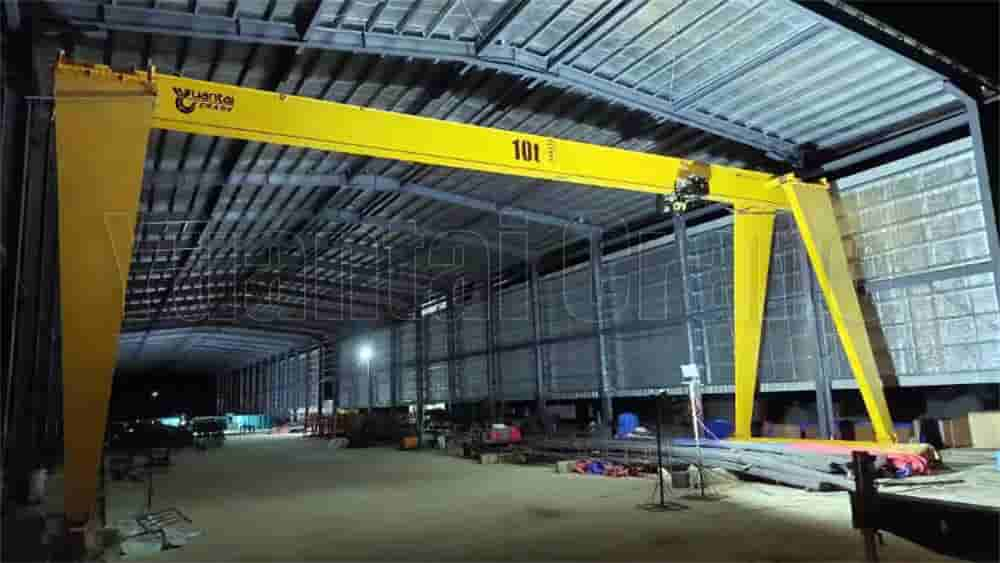
This instruction applies to the installation of a 10-ton gantry crane. This equipment is intended for use at a certain steel rolling project production site in Tangzhong and is classified as large-scale lifting equipment (total weight approx. 40 tons). As the equipment is a used machine transported after disassembly, special attention must be paid to checking for structural deformation and component damage. The installation process is complex and labor-intensive. This instruction is formulated specifically to ensure construction safety and efficiency.

II. Basis for Compilation

  1. Code for Construction and Acceptance of Crane Equipment Installation Engineering (GB50238-98)
  2. General Code for Construction and Acceptance of Mechanical Equipment Installation Engineering (GB50231-98)
  3. Safety Operation Procedures and Lifting Machinery Technical Manual
  4. Code for Construction and Acceptance of Steel Structure Engineering (GB50205-2001)
  5. Technical Specification for Operation of High-Strength Bolt Assemblies
MHO 10 ton gantry crane

III. Pre-Installation Preparation

(A) Site Requirements

  1. Track foundation bearing capacity ≥ 20 N/cm². Compact with a bulldozer before laying and test the compressive resistance coefficient.
  2. Gravel layer thickness ≥ 500mm, compacted layer by layer before laying sleepers (specification: 1250×200×200mm).

(B) Equipment and Tools

  1. Main Components: Rails (80 pieces, single length 12.5m, weight 0.537t), Beams (28 pieces, single weight 13.4t), Crane Columns (8.5m height, single weight 3.8t), Electric Hoist (3.3t), and ancillary facilities.
  2. Tools: 25-ton / 50-ton truck cranes, level, power wrench, 6×37+1 steel wire rope (diameter 28mm / 40mm), grinder, safety protection equipment.

(C) Safety Check

  1. Inspect the construction area environment, eliminate hazards such as falling objects from height and ground pits.
  2. Check the insulation performance of lifting equipment and power tools, and the breaking force of wire ropes.

IV. Installation Steps

(A) Track Installation

  1. Setting Out: Mark the track centerline on the sleepers, review, and communicate.
  2. Rail Laying:
    • Position rails and connect with fishplates, using special-shaped bolts with spring washers and tightening.
    • Joint misalignment and elevation difference ≤ 1mm, track span error ≤ 5mm, straightness deviation ≤ 2mm.
  3. Leveling Adjustment: Measure track flatness with a level; adjust shims where unqualified.

(B) Beam Assembly

  1. Rust Removal Treatment: Grind connection areas with a grinder to St3 grade.
  2. Short Beam Hoisting:
    • Hoist short beams to the long beam assembly position using a 25-ton truck crane, with 28mm diameter wire rope (safety factor K=8).
    • Use steel pipe padding at lashing points to prevent deformation.
  3. Connection and Fixing:
    • Pre-tighten with bolts first, adjust camber (0.9‰ ~ 1.4‰ of span) and sweep (f ≤ 11mm).
    • Tighten bolts with a power wrench, then apply anti-rust paint.

(C) Leg Installation

  1. Beam Positioning: Place the beam flat on the sleeper arrangement; vertical deviation ≤ 1/1000 of leg height.
  2. Hoisting and Placement:
    • Hoist legs using a 25-ton truck crane; single leg weight ≤ 5 tons.
    • Recheck the distance between the bottom ends of the two legs, adjust to the design value, then apply anti-rust paint.

(D) End Beam Installation

  1. Support Frame Fabrication: Fabricate 12 L1.2×70mm and 8 L450×450mm support frames.
  2. End Beam Fixing:
    • Level the ground on both sides of the track (length 8m). Hoist end beams onto the track using a 25-ton crane.
    • Level the end beams using support frames, fix them, then symmetrically position the other end beam.

(E) Integrated Hoisting

  1. Assembly Hoisting:
    • The combined weight of the beam and two legs is 26.1t. Use two 50-ton cranes (boom length 21.7m, operating radius 7.5m).
    • Use steel pipe padding at lashing points. Set lifting points at the junction of the beam and legs. Use 40mm diameter wire rope.
  2. Verticality Calibration: Check leg verticality with a laser theodolite; deviation ≤ 1/1000.

(F) Electrical System Installation

  1. Cable Laying: Avoid cross-wrap. Insulation resistance ≥ 0.5MΩ.
  2. Windproof Device: For coastal areas, the clamping force of rail clamps must meet the local maximum wind force level.
  3. Braking System: Braking torque ≥ 1.25 times the rated hoisting torque.

V. Commissioning and Acceptance

(A) No-load Test

  1. All mechanisms run smoothly without abnormal vibration or noise.
  2. Continuous running time ≥ 2 hours; check temperature rise and lubrication.

(B) Static Load Test

  1. Under 1.25 times the rated load (12.5t), main beam deflection ≤ 1/700 of the span.
  2. Inspect structural strength and welding quality.

(C) Dynamic Load Test

  1. Under 1.1 times the rated load (11t), verify reliable operation of hoisting and traveling mechanisms.
  2. Test braking distance and buffer stroke (≥ 150mm).

VI. Safety Measures

  1. Personnel Protection: Wear safety helmets, safety belts; use fall arresters for work at height.
  2. Lifting Security: Delineate the warning zone; prohibit entry of non-essential personnel.
  3. Emergency Plan: Equip with fire extinguishers, first aid kit; establish emergency procedures for collapse and electric shock.

VII. Quality Assurance

  1. Process Control: Self-inspect after completion of each process step; fill out the Installation Quality Record Form.
  2. Key Indicators:
    • Wheel tread diameter tolerance ≤ 0.5mm.
    • Rail joint gap ≤ 2mm.
  3. Documentation Archiving: Maintain construction logs, test reports, and acceptance certificates.

VIII. Maintenance and Upkeep

  1. Daily Inspection: Lubricate components, tighten bolts, clean equipment.
  2. Regular Inspection: Quarterly inspection of wire rope wear (diameter reduction ≤ 7%), brake clearance.
  3. Out-of-Service Protection: When out of service for extended periods, apply anti-rust oil and cover with waterproof tarps.

Attachments: Construction Layout Plan, Wire Rope Selection Calculation Table, High-Strength Bolt Torque Value Reference Table.

  Contact our crane specialists


Send us a message and we will get back to you as soon as possible.

    Send Your Needs