When a procurement team sits down to evaluate bids for a new overhead crane, one number dominates the initial conversation: the purchase price. A 10-ton double-girder crane for $28,000 compared to another at $42,000—on the surface, a savings of $14,000 looks like a procurement victory. The lower bid appears to protect the capital budget, satisfy the finance department, and meet the technical requirements on paper. It is an easy decision to make and an even easier one to defend in a boardroom presentation.
Yet, twelve months later, the real costs begin to surface. Unscheduled downtime interrupts a critical production shift. An inferior wire rope fatigues prematurely and requires replacement twice as often as anticipated. The drive system, built to a lower duty cycle tolerance, overheats during a busy season. Hoist motor inrush currents spike power consumption. The building’s runway structure, subjected to heavier wheel loads from an inefficient girder design, develops alignment issues that demand expensive civil repairs.
Within three to five years of operation, the cumulative outlay—energy, parts, labor, and lost production—has already eclipsed the initial purchase savings. By the end of the crane’s design life, the “cheapest” crane has cost 40% to 70% more than the nominally “expensive” alternative. The pattern is so consistent across industries and geographies that engineers have a name for it: the total cost of ownership trap.
At Dongqi Crane, we have observed this dynamic for more than four decades while supplying lifting solutions to over 96 countries. Time and again, we have been invited to modernization projects where a low-cost crane installed seven or eight years earlier has become a recurring financial liability. This experience has shaped our conviction that crane procurement must be guided not by the upfront price but by a rigorously calculated Life Cycle Cost (LCC). In response, we developed an LCC Calculator methodology that equips our clients to make procurement decisions grounded in 10-year financial reality rather than a single number on a quotation sheet. This article explains how the LCC framework works, what hidden costs the “cheapest” crane conceals, and how procurement professionals can use these insights to secure budget approval for equipment that genuinely represents the lowest long-term cost.
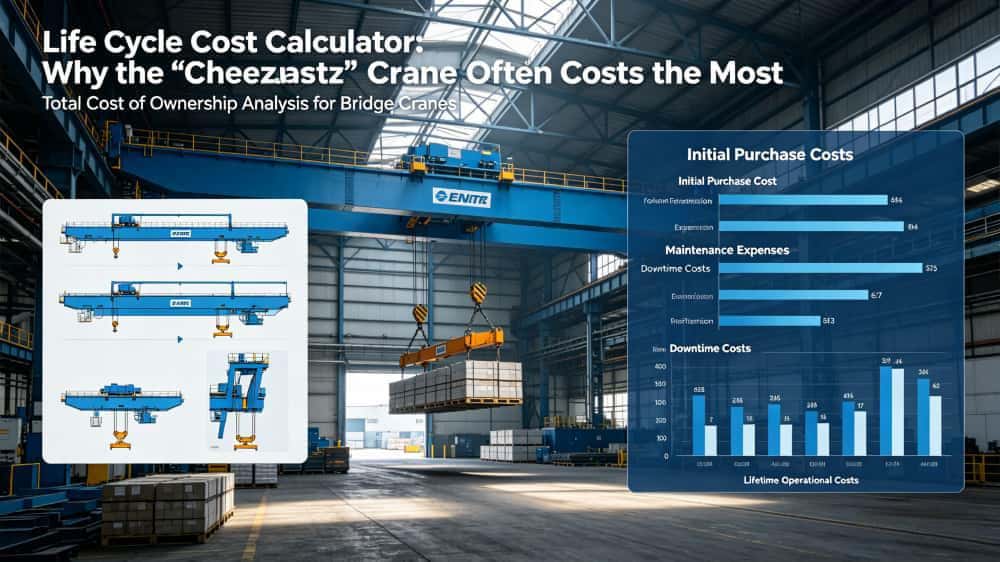
Life Cycle Cost analysis is a structured method for estimating the total cost of an asset from acquisition through operation, maintenance, and disposal. In the crane industry, the concept aligns with international standards such as ISO 15686-5 (Life cycle costing for buildings and constructed assets) and the broader principles defined in IEC 60300-3-3 (Dependability management – Life cycle costing). Applied to an overhead crane, LCC comprises five distinct cost categories:
The LCC equation can be expressed simply:
LCC = C_Acq + Σ(C_Op_n + C_Main_n + C_Down_n) / (1+r)^n – C_EoL
where n represents each year of the evaluation period and r is the discount rate reflecting the time value of money. For practical procurement decisions, a 10-year discounted cash flow model typically provides sufficient visibility to distinguish between competing designs.
Human cognitive bias heavily favors immediate, tangible costs over future, probabilistic ones. A saved dollar today feels more real than three dollars of avoided maintenance expense spread over the next seven years. Organizational incentive structures reinforce this bias: procurement managers are often measured on year-one capital expenditure savings, while the department that absorbs higher maintenance costs and production losses sits in a different reporting line with a different budget. The supplier offering the lowest purchase price exploits this organizational gap. The supplier offering the lowest life cycle cost must educate the buyer to close it.
To understand why the “cheapest” crane is rarely the least expensive over a decade of service, we must disassemble the cost structure of a typical overhead crane and examine how engineering choices made to reduce the purchase price shift costs into later stages of the equipment lifecycle.
An overhead crane’s daily electricity consumption is primarily determined by its hoisting load, distance traveled, and, critically, its own self-weight. Every time the hoist lifts the hook and any attached load, it also lifts the hook block, wire rope, and a portion of the hoist unit itself. More significantly, every long-travel and cross-travel movement must accelerate and decelerate the entire mass of the crane or trolley.
A conventional single-girder crane with a heavy-duty standard girder design can weigh 20–30% more than an equivalent European-standard compact crane like Dongqi’s optimized single-girder series. For a 10-ton, 20-meter span crane, that difference can translate to 1.5 to 2.5 tonnes of additional structural steel. This extra mass has to be moved hundreds of times every working day. Over 10 years, the cumulative energy penalty becomes substantial.
Consider a facility operating 8 hours per day, 300 days per year. The crane’s long-travel motor runs at 10 kW for a conventional heavyweight design versus 7.5 kW for a lightweight optimized design. Over 2,400 operating hours per year at a conservative average duty cycle of 40% motor-on time, the energy differential alone can be calculated:
This $288 annual difference, applied to the hoist and cross-travel motors as well, can easily surpass $500 per year. Over 10 years and discounted to present value, it adds approximately $4,000–$5,000 to the lifecycle cost—money that the cheap crane’s purchase price never accounted for.
Crane components are not designed to an absolute “lifetime” but to a fatigue life defined by the duty class standard (FEM 1Am–8m, ISO M3–M8, or CMAA A–F). A crane specified as FEM 2m (ISO M4) uses smaller-section structural members, lighter-duty gearboxes, and smaller-diameter wire ropes and pulleys than one specified as FEM 3m (ISO M6). The acquisition cost difference between the two duty classes may be on the order of 15–20%. But if the actual application demands FEM 3m—because the facility operates 12 hours a day with frequent full-capacity lifts—the lower-cost FEM 2m crane will begin to fail long before its 10-year design life expectation.
Typical premature failure modes in under-specified cranes include:
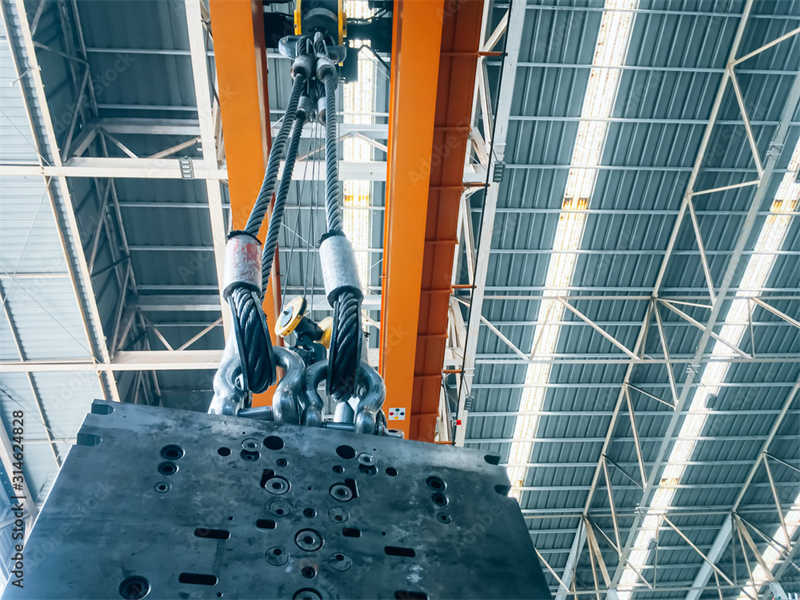
Data from Dongqi Crane’s after-sales service division, based on hundreds of maintenance contracts globally, indicates that the annual maintenance cost for a correctly specified crane averages 1.5–2.5% of its acquisition cost. For an under-specified crane in a heavy-usage environment, that figure routinely exceeds 5%. Over a 10-year period, the difference can consume many times the initial purchase price advantage.
If a manufacturing line generating $800 of value-added output per hour stops because the crane is inoperable, every hour of unplanned downtime erases the working margin that justified the crane purchase in the first place. A single unscheduled 8-hour repair event costs the facility $6,400 in lost production. Add four such events per year, and the annual cost reaches $25,600—almost the entire purchase price of a standard 10-ton crane recirculated as operating losses.
Lower-cost cranes contribute to downtime in three interconnected ways:
An often invisible cost of heavyweight crane designs is the additional structural load imposed on the building. A conventional double-girder crane may generate wheel loads 25–35% higher than a lightweight European-standard design for the same lifting capacity and span. This difference forces the factory’s civil engineers to either reinforce the building steelwork and foundations—adding one-time costs of $20,000–$80,000 or more—or accept a crane that will, over time, contribute to runway misalignment, cracked concrete pedestals, and excessive rail wear.
Because these costs are typically attributed to the building construction or maintenance budget, they rarely appear in crane procurement discussions. Yet they are a direct consequence of the crane design chosen. Dongqi Crane’s structural optimization philosophy—inherited from European FEM engineering standards—delivers cranes that minimize wheel loads and runway reactions, reducing both construction costs and long-term building maintenance.
To make these cost categories concrete, we present a comparative analysis based on a realistic procurement scenario. The numbers are derived from Dongqi Crane’s historical project data and verified against publicly available industry benchmarks, but they have been generalized to illustrate the LCC methodology.
| Parameter | Specification |
|---|---|
| Crane type | 10-ton single-girder overhead traveling crane |
| Span | 22.5 meters |
| Lifting height | 9 meters |
| Duty class requirement | FEM 2m / ISO M5 (8 hours/day, frequent moderate loads) |
| Operating days | 300 per year |
| Daily operating hours | 8 (single shift) |
| Electricity cost | $0.12/kWh |
| Discount rate | 5% |
Two competing bids are evaluated:
| Element | Bid A (Lowest Cost) | Bid B (Dongqi) |
|---|---|---|
| Crane system (FOB) | $18,500 | $27,000 |
| Transportation & insurance | $2,500 | $2,800 |
| Installation & commissioning | $3,000 | $3,200 |
| Total Acquisition | $24,000 | $33,000 |
The initial price gap is $9,000—a 37.5% premium for Bid B. This is the number that a price-focused procurement manager sees first.
| Parameter | Bid A | Bid B |
|---|---|---|
| Average total motor power (weighted by duty) | 14 kW | 10.5 kW |
| Effective active power draw (40% duty) | 5.6 kW | 4.2 kW |
| Annual energy consumption (×2,400 h) | 13,440 kWh | 10,080 kWh |
| Annual energy cost | $1,613 | $1,210 |
| 10-year undiscounted energy cost | $16,130 | $12,100 |
Dongqi’s lighter structural design and high-efficiency motors save $403 per year. Discounted over 10 years (present value annuity factor ~7.72), the energy savings total approximately $3,110.
Maintenance cost estimates are based on Dongqi Crane’s field service data, normalized for general representation:
| Category | Bid A (Lowest Cost) | Bid B (Dongqi) |
|---|---|---|
| Annual preventive maintenance (labor + travel) | $1,200 | $1,000 |
| Wire rope replacement interval | Every 18 months ($800 per replacement) | Every 36 months ($1,000 per replacement, higher-grade rope) |
| Brake components (pads, coils) | $400/year average | $150/year average |
| Gearbox oil and filters | $200/year | $250/year (synthetic oil, longer interval) |
| Other unscheduled repairs | $800/year average | $300/year average |
| Total annual maintenance cost | $3,333 | $2,050 |
Discounted 10-year maintenance cost for Bid A: approximately $25,730. For Bid B: approximately $15,830. The difference: $9,900.
| Parameter | Bid A | Bid B |
|---|---|---|
| Estimated unplanned downtime per year | 24 hours | 8 hours |
| Facility production value per hour | $500 | $500 |
| Annual downtime cost | $12,000 | $4,000 |
| 10-year discounted downtime cost | $92,640 | $30,880 |
This is the single largest cost element in the entire analysis. The Dongqi crane’s higher reliability and faster service response reduce downtime costs by $61,760 over the evaluation period.
| Cost Element | Bid A | Bid B |
|---|---|---|
| Estimated salvage value after 10 years | $1,500 (scrap steel value) | $6,000 (refurbishable equipment with resale market) |
The net end-of-life benefit difference is $4,500.
| Cost Component | Bid A (Lowest Cost) | Bid B (Dongqi) |
|---|---|---|
| Acquisition | $24,000 | $33,000 |
| Energy | $12,450 | $9,340 |
| Maintenance | $25,730 | $15,830 |
| Downtime | $92,640 | $30,880 |
| End-of-Life (minus residual) | -$1,500 | -$6,000 |
| Total LCC (10 years) | $153,320 | $83,050 |
The “cheapest” crane in terms of purchase price is 84.6% more expensive over a 10-year operating period. The $9,000 saved at acquisition multiplied into a $70,270 lifecycle penalty. Every dollar “saved” on the purchase price returned $7.80 in additional costs over the decade.
This result is not an outlier. International studies of industrial equipment procurement consistently find that acquisition cost represents only 10–25% of total lifecycle cost, while maintenance and downtime together account for 50–70%. The crane industry is no exception.
A natural question arises from the comparative analysis: what exactly creates the margin of reliability and efficiency that produces such a dramatic LCC differential? At Dongqi Crane, the answer lies in five engineering principles embedded in every product we manufacture.
Dongqi Crane’s overhead cranes are engineered to European FEM standards, which emphasize the use of higher-grade structural steel (Q355B and above), optimized box-girder geometries, and finite-element analysis (FEA) validation of every load path. The result is a crane girder that achieves the required stiffness and fatigue resistance at a lower self-weight than a conventionally designed structure. This weight reduction directly feeds into lower energy consumption, reduced wheel loads, and extended runway life—benefits that compound every year.
We source hoist and travel drive components exclusively from manufacturers whose quality systems match our own ISO 9001 and CE-certified production environment. Gearboxes feature ground and hardened gearing, bearings from internationally recognized manufacturers (SKF, FAG, or equivalent), and motors with insulation class F and temperature rise class B as standard. The margin above minimum requirements translates into extended service intervals and drastically lower probability of catastrophic failure.
Variable frequency drives (VFDs) are no longer a luxury add-on; they are an essential contributor to lifecycle cost reduction. VFD-controlled motions eliminate the current inrush of direct-on-line starting, reduce mechanical shock to the structure and rope, enable soft-start and soft-stop profiles that extend component life, and allow the crane to travel at variable speeds suited to the task. Dongqi Crane’s standard configuration for models above 5 tons includes VFD control on all motions, reducing both energy consumption and mechanical wear.
Dongqi Crane’s control systems incorporate condition monitoring capabilities that track motor running hours, hoist brake wear, overload events, and fault histories. This onboard intelligence enables condition-based maintenance rather than calendar-based intervention—servicing components when they actually need attention rather than on an artificial schedule that either over-maintains or under-maintains the equipment. For clients integrating with factory MES or ERP systems, we provide communication gateways that embed crane health data directly into the plant-wide maintenance dashboard.
Even the best-engineered crane requires support. Dongqi Crane’s parts logistics network, built over decades of exporting to 96-plus countries, ensures that routine and critical spares are positioned regionally for rapid dispatch. Our field service engineering teams, either directly or through certified partners, provide installation supervision, commissioning, periodic inspection, and emergency support, reducing mean time to repair and the associated production losses.
Recognizing that the detailed financial modeling shown above is not something procurement managers can construct from first principles on every bid, Dongqi Crane has developed a Life Cycle Cost Calculator—an interactive template that clients can use alongside their request for quotation.
The LCC Calculator is structured around the same worksheet methodology that our engineering team has refined over thousands of projects. It requests approximately 25 inputs grouped into four categories:
The calculator then generates a comparative LCC output table and a waterfall chart showing how the acquisition price gap is absorbed or reversed by annual operating, maintenance, and downtime costs. For procurement managers presenting to financial controllers or operations directors, this output provides the objective, numerical justification for selecting the more expensive initial bid when it demonstrably reduces long-term expenditure.
Using the Bid A vs. Bid B scenario from Part 3, the calculator would produce a simplified display such as:
| Line Item | Bid A | Bid B | Variance |
|---|---|---|---|
| Acquisition Cost | $24,000 | $33,000 | +$9,000 |
| 10-Year Energy | $12,450 | $9,340 | -$3,110 |
| 10-Year Maintenance | $25,730 | $15,830 | -$9,900 |
| 10-Year Downtime | $92,640 | $30,880 | -$61,760 |
| End-of-Life | -$1,500 | -$6,000 | -$4,500 |
| Total LCC | $153,320 | $83,050 | -$70,270 |
Accompanying this table, a simple chart visualizes how the initial $9,000 savings is overwhelmed by year 3 and becomes a net cash drain equal to $70,000+ over the decade.
The tool also allows scenario testing: “What if energy prices rise 20%?” “What if production value increases?” Sensitivity analysis built into the calculator enables procurement teams to explore “what-if” scenarios and understand the robustness of the LCC advantage under different economic conditions.
Understanding the LCC concept intellectually is different from successfully deploying it in an internal budget negotiation. Through years of working with procurement teams placing international crane orders, Dongqi Crane has observed that the following strategies shift organizational buying behavior away from pure-purchase-price bias.
Rather than presenting a crane purchase as a capital expenditure line item, connect it directly to the operational output it supports. If a crane lifts 20,000 tons of material per year, the effective cost per ton is:
The question shifts from “Can we afford the premium?” to “Can we afford to pay $0.35 more for every ton we lift for the next 10 years?” This framing makes the operational inefficiency of the cheap crane impossible to ignore.
An under-specified crane is not just a cost problem; it is a safety and business continuity risk. When a crane fails catastrophically, the immediate cost of repair is often dwarfed by the consequential losses: missed shipment deadlines, contractual penalties, damage to reputation with end customers, and in the worst case, personnel injury with subsequent regulatory and legal exposure. By quantifying the probability-weighted cost of failure—even at a conservative 2% annual probability—the risk-adjusted cost of the “cheapest” crane becomes indefensible.
Many organizations suffer from a structural dysfunction where the capital expenditure (CapEx) budget is managed independently from the operational expenditure (OpEx) budget that will absorb maintenance and energy costs. To overcome this, procurement should invite the maintenance manager, the production director, and the facility manager into the supplier evaluation process. When the individuals who will inherit the consequences of a poor crane purchase have a seat at the decision table, the evaluation criteria naturally broaden beyond the initial price.
Dongqi Crane actively encourages joint supplier visits and specification workshops that bring together engineering, procurement, and operations stakeholders. These sessions often reveal that a $40,000 crane avoids $200,000 in downstream costs that the OpEx budget cannot easily absorb—a revelation that transforms the procurement decision.
The journey from recognizing the LCC argument to placing an order involves practical steps that Dongqi Crane has systematized:
The phrase “you get what you pay for” carries exceptional force in the overhead crane industry. A crane is not a commodity that can be reduced to a list of matching specifications checked against a price column. It is a complex, dynamic system whose true cost is measured not on the day it is commissioned but on every day it operates—or fails to operate—over the subsequent decade.
The LCC analysis presented in this article demonstrates that the “cheapest” crane on a bid tabulation is very often the most expensive crane in service. It consumes more energy, breaks more often, idles production lines, and leaves the owner with scrap value rather than resellable equity. For a facility that depends on material handling continuity, the cost of buying a substandard crane is not a one-time penalty; it is a compound interest loan taken out against future productivity.
Dongqi Crane has built its engineering philosophy around a different premise: that a crane should be an appreciating asset to an operation, not a depreciating liability. Our Life Cycle Cost Calculator and the FEM-driven engineering that backs it exist for one reason—to give procurement professionals the objective evidence they need to choose the crane that costs the least where it matters most: over time.
About Dongqi Crane
Henan Dongqi Machinery Co., Ltd. (Dongqi Crane) is a Sino-New Zealand joint venture headquartered in Xinxiang, Henan Province—China’s “Cradle of Cranes.” With a 240,000-square-meter integrated manufacturing facility, more than 2,000 sets of precision production and inspection equipment, and a workforce exceeding 3,600 including 500 engineering and technical specialists, Dongqi Crane designs, manufactures, and services overhead cranes, gantry cranes, jib cranes, hoists, and specialized material handling systems. Our products, exported to over 96 countries and regions, carry certifications including CE, ISO 9001, ISO 45001, ISO 14001, ISO 50001, and GJB9001C. We serve industries ranging from steel and shipbuilding to automotive, logistics, and cleanroom manufacturing. Our commitment is to deliver European-standard lifting technology with global service support, ensuring that every Dongqi crane earns its place in our clients’ long-term operational success.
To request your copy of the Dongqi Crane Life Cycle Cost Calculator, or to submit a project for a comparative LCC analysis, contact our engineering and procurement support team.
Contact our crane specialists
Send us a message and we will get back to you as soon as possible.