Shipbuilding gantry cranes, as core lifting equipment in the ship manufacturing sector, have performance that directly impacts shipbuilding efficiency and quality. In crane design, the choice between single and double girder structures is a primary technical decision, involving multiple factors such as crane stability, economy, and applicability. This paper provides a comprehensive comparative analysis of single and double girder structures in shipbuilding gantry cranes from various dimensions, including structural form, mechanical performance, height characteristics, load transfer, economic analysis, and optimized design. Combining practical application cases and technological development trends, it offers a systematic reference basis for crane design selection. Through an in-depth analysis of the characteristics of both structures and their performance under different working conditions, the aim is to assist designers and shipbuilding enterprises in making more scientific technical choices, thereby promoting the efficient application of lifting equipment in the shipbuilding industry.
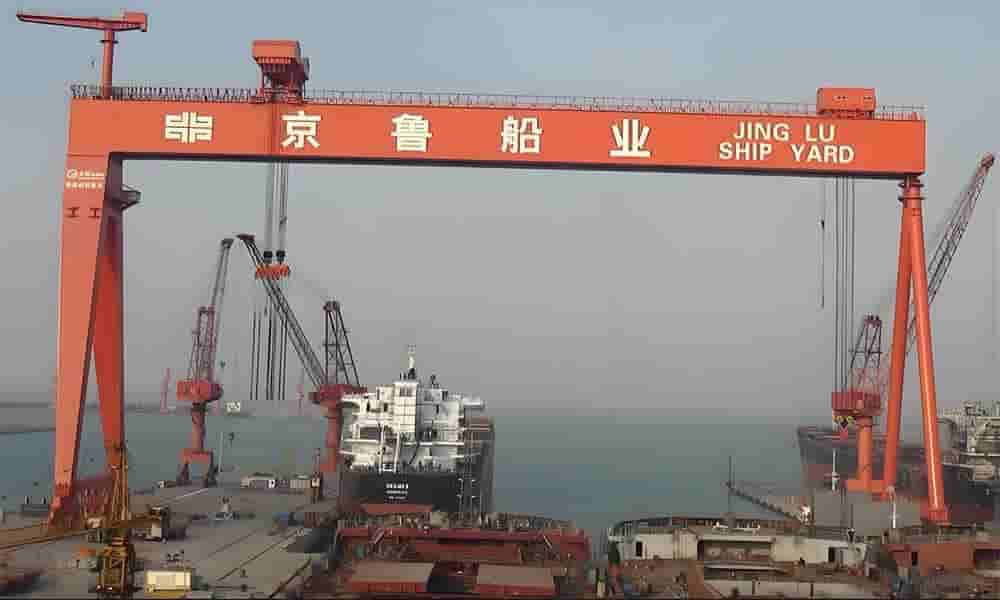
As critical equipment in modern shipyards, the selection of the main girder structure form for shipbuilding gantry cranes is crucial, directly affecting the equipment’s performance parameters and usage effectiveness. Single main girder and double main girder, as two mainstream structural forms, exhibit distinctly different technical characteristics and application scenarios in shipbuilding gantry crane design. Visually, the single girder structure uses a single box girder as the main load-bearing element, making the structure simple and clear; whereas the double girder structure consists of two parallel box girders connected by end beams to form an integrated load-bearing system. These two different structural forms lead to significant differences in performance, directly influencing their application positioning in the shipbuilding industry.
The main advantages of the single girder structure lie in its lighter self-weight, lower manufacturing cost, and compact structure. As only one main girder and relatively simple support structure are required, material consumption is significantly less than that of the double girder form, giving single girder cranes a more competitive price, especially suitable for applications with limited budgets and less demanding lifting requirements. However, this structure also has obvious limitations, primarily manifested as relatively lower rigidity. Under the same cross-sectional dimensions, the torsional resistance of a single girder is inferior to that of a double girder structure, limiting its effectiveness in applications with large spans and heavy lifting capacities. Practical engineering data shows that single girder structures are mostly used in small and medium-tonnage (typically below 100 tons) shipbuilding gantry cranes, capable of meeting general hull segment lifting needs, but falling short for super-large ship components.
Compared to the single girder structure, the double girder exhibits different technical characteristics. The double girder structure consists of two parallel box girders effectively connected by end beams, forming a stable rigid frame. Although this structure does not hold an advantage in terms of self-weight and material cost, its structural strength and rigidity are significantly enhanced, allowing it to better adapt to large-span and heavy-lift working conditions. In the shipbuilding industry, especially for large hull segment lifting and offshore platform modular construction, double girder cranes demonstrate irreplaceable advantages. The rated lifting capacity of modern large shipbuilding gantry cranes typically ranges from 100t to 2500t, with spans reaching 40-130 meters; such heavy-duty equipment almost exclusively uses double girder structural design. Another technical advantage of the double girder structure is reflected in the smoothness of trolley operation. Due to the support from tracks on both sides, trolley sway during operation is significantly reduced, which is particularly important for hull segment assembly operations requiring precise positioning.
From the perspective of height utilization, the two structural forms also show significant differences. Research data indicates that under the same lifting height conditions, the distance from the bottom surface of the main girder to the rail surface of the gantry is higher for the single girder type gantry crane than for the double girder type. This is because the lower trolley of the single girder structure needs to be suspended below the main girder, occupying a larger space height. This characteristic gives the double girder structure an advantage in height-restricted working environments, providing greater effective lifting space under the same clear height. For shipbuilding operations, especially in indoor dry docks or height-restricted work areas, this difference can be a key factor in selecting the crane type.
In terms of connection methods, single and double girder structures also have their own characteristics. The lower trolley of the single girder structure is typically installed in a suspended manner, saving space above the main girder but causing maintenance difficulties; whereas the trolley of the double girder structure runs on tracks between the two main girders, facilitating maintenance and inspection but resulting in a more complex structure. It is worth noting that with technological progress, innovative hybrid single-double girder designs have emerged in modern shipbuilding gantry cranes, attempting to combine the advantages of both, but this design also brings new challenges in computational analysis and manufacturing processes.
Lifting height is one of the key performance parameters of shipbuilding gantry cranes, directly affecting the equipment’s adaptability for hull segment lifting. Due to differences in design philosophy and mechanical construction, single and double girder structures show significant differences in height utilization efficiency, which in turn affects their suitability and performance in actual shipyard operations. A deep understanding of the height utilization characteristics of these two structures is crucial for both crane selection and shipyard process layout planning.
Analyzing from the structural height aspect, determined by its structural form, the distance from the bottom surface of the main girder to the rail surface of the gantry is typically higher for a single girder crane than for a double girder crane with the same rated lifting height. Research data indicates that under the same technical conditions of rated lifting height, the single girder structure requires more clear height to achieve the same effective lifting height. This characteristic mainly stems from the fact that the lower trolley of the single girder structure must be suspended below the main girder. This suspended design, while saving space above the main girder, inevitably occupies valuable height space below the main girder. In practical applications, this means that if a shipyard chooses a single girder crane, it must either accept a reduction in effective lifting height or increase the overall height of the building or gantry structure, both of which bring certain limitations – the former restricts the crane’s operational capability, while the latter increases construction costs.
The double girder structure shows a clear advantage in height utilization efficiency. Because the trolley of the double girder crane can be arranged to run on tracks between the two main girders, rather than being suspended below the main girder, this design significantly reduces the occupation of spatial height. Under the same gantry rail surface height conditions, a double girder crane can provide a greater effective lifting height, which is particularly important for modern large shipbuilding. As ship tonnage continuously increases, hull segment sizes also grow, demanding higher effective lifting heights from cranes. Especially for lifting operations of oversized modules like offshore platforms, every centimeter of effective height can be critical to project success. The inherent advantage of double girder cranes in this aspect makes them the preferred choice for large shipyards and heavy lifting operations.
Examining from a practical application perspective, the difference in lifting height also affects crane adaptability. Single girder cranes, requiring more spatial height, may face installation difficulties in height-restricted old shipyards or indoor dry docks; whereas double girder cranes can better adapt to such environments, offering greater operational flexibility. This is also why double girder cranes are often the more popular choice in shipyard renovation and expansion projects. It is worth noting that the maximum lifting height of modern shipbuilding gantry cranes can reach 60 meters; under such large height parameters, the impact of structural form on height utilization efficiency becomes even more pronounced.
Safety clearance is another important aspect of height utilization analysis. Due to the suspended design of the lower trolley in the single girder structure, sufficient safety clearance must be maintained between the trolley and the main girder structure, which invisibly increases the occupation of height space; whereas for the double girder structure, the trolley runs on the main girder tracks, allowing better control of relevant safety clearances and improving the compactness of space utilization. In shipbuilding operations, safety clearance not only relates to normal equipment operation but also affects lifting precision and work efficiency, areas where the double girder structure also performs better.
From the perspective of technological development trends, modern crane design is focused on optimizing height utilization efficiency. For both single and double girder structures, designers are attempting to achieve greater effective lifting height within limited space through means such as optimizing trolley layout and improving suspension methods. For example, some new single girder cranes adopt a semi-suspended trolley design, somewhat improving height utilization efficiency; while double girder cranes further enhance space utilization through compact track layout and trolley structure optimization. These technological innovations enable modern shipbuilding gantry cranes to better adapt to diverse shipyard environments and growing lifting demands.
The difference in load transfer paths is one of the core distinctions between single and double girder shipbuilding gantry cranes. This difference directly affects the equipment’s structural design, material selection, and service life. A deep understanding of the mechanical behavior of both structures is crucial for crane safety assessment and optimized design. Due to differences in construction form, single and double girder structures exhibit distinctly different load transfer mechanisms and stress distribution characteristics, which manifest as different structural responses and fatigue properties during crane operation.
The load transfer path of the double girder structure is relatively clear and direct. When the crane bears a moving load, this load is first transmitted to the rail system through the wheels, and then the rails directly transfer these forces to the web area of the main girder. In the double girder system, the wheel pressure from the upper trolley is transmitted to the outer web of the main girder, while the load from the lower trolley is distributed on the inner web of the main girder, forming a balanced force flow distribution. This dispersed and direct transfer mechanism allows the double girder structure to perform excellently when bearing large-tonnage loads, especially for the heavy segment lifting operations common in the shipbuilding industry. Practical engineering experience shows that the stress distribution in double girder cranes is more uniform, with relatively fewer occurrences of local stress concentration, which helps extend equipment service life and improve safety margins.
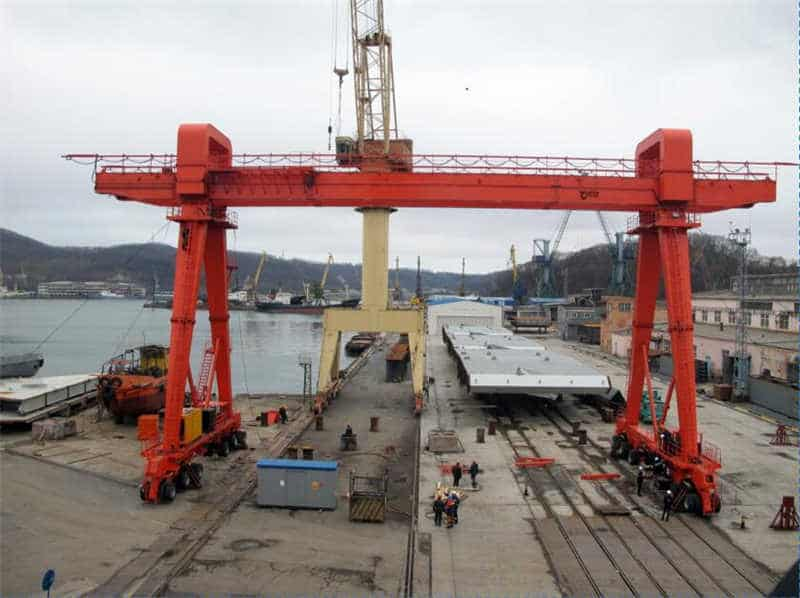
In contrast, the load transfer path of the single girder structure shows different characteristics. Due to the lack of support from a second main girder, all loads must be borne by the single main girder and transmitted through its cross-section to the legs. This centralized load transfer makes the stress state of the single girder more complex, especially when bearing asymmetric loads or horizontal loads; besides vertical bending, the single girder must also resist significant torsional deformation. Research indicates that under the same load conditions, the stress levels in the web and flange plates of a single girder structure are usually higher than those in a double girder structure, and stress concentration phenomena are more pronounced, requiring the use of higher-grade steel or larger cross-sectional dimensions during design to ensure sufficient safety factors.
Analyzing from the perspective of dynamic response, the two structures also show significant differences. Due to its higher torsional stiffness and overall stability, the double girder structure performs better under dynamic loads or partial loads, with vibration and swing amplitudes during trolley operation being significantly smaller than those of the single girder structure. This characteristic is particularly important for high-precision assembly operations in the shipbuilding industry, as excessive vibration seriously affects positioning accuracy and work efficiency. The common double trolley four-hook system in modern large shipbuilding gantry cranes further amplifies this advantage, making smooth lifting of oversized hull segments possible.
Local stress analysis reveals more technical details. In the double girder structure, the load is transmitted to the rails through multiple sets of wheels, and the local stress generated at each wheel pressure point is relatively small; whereas in the single girder structure, due to fewer support points, the local stress borne by each connection point increases significantly. This difference directly affects the structural fatigue life and connection detail design. Shipbuilding gantry cranes typically need to withstand millions of load cycles; differences in local stress levels will directly impact equipment durability and maintenance cycles. Engineering practice shows that the main load-bearing components of double girder cranes often have longer service lives and lower probabilities of cracking.
From the results of finite element analysis, the stress distribution and deformation modes of the double girder structure are more ideal. Relevant research establishing finite element models of cranes indicates that the double girder structure can meet strict requirements in terms of static strength, static stiffness, and stability, with main girder deflection typically controlled within 1/800 to 1/1000 of the span, fully meeting the needs of precision assembly operations. Although the single girder structure can also meet basic strength and stiffness requirements, its deformation under the same conditions is usually larger, especially torsional deformation, which may affect the normal operation and positioning accuracy of the trolley.
It is worth noting that modern analysis techniques are continuously deepening the understanding of crane structural mechanics. Advanced finite element methods and multi-body dynamics simulations enable designers to more accurately predict the mechanical behavior of single and double girder structures under various working conditions. These tools provide a solid foundation for structural optimization, allowing both single and double girder designs to improve performance through continuous refinement. For example, the torsional performance of single girders can be significantly improved by optimizing web opening forms and stiffener layout; while the material utilization efficiency of double girder structures can be further enhanced by optimizing girder spacing and cross-sectional shape.
The selection decision for cranes involves not only technical performance considerations but also a comprehensive assessment of economy and technical feasibility. Single and double girder structures show their respective advantages and limitations in these two aspects. Understanding these differences is crucial for investment decisions regarding shipyard equipment and infrastructure. From initial investment to long-term operation, the economic performance of the two structural forms varies, while technical feasibility is deeply influenced by application scenarios and process requirements.
In terms of manufacturing cost, the single girder structure shows a clear advantage. Due to less material usage and relatively simple manufacturing processes, the initial investment for single girder cranes is typically lower than for double girder cranes of equivalent specifications. Data analysis indicates that the single girder structure can save about 15%-25% in steel usage, a difference that can translate into substantial cost savings in large crane projects. For small and medium-sized shipyards or projects with limited budgets, this economic advantage often becomes a key factor in choosing the single girder structure. However, it is worth noting that as lifting capacity and span increase, the increased cross-sectional dimensions required for the single girder to meet stiffness requirements gradually offset its material cost advantage. In ultra-heavy-duty applications (e.g., above 400 tons), the cost difference between the two structures may become less noticeable.
The comparison of operating costs presents a different picture. Although the double girder crane has a higher initial investment, its long-term operational economy may be superior. This is mainly reflected in three aspects: First, the double girder structure typically has a longer service life and lower maintenance frequency, reducing downtime and maintenance costs; Second, its energy efficiency is often better under heavy load conditions, especially for heavy-duty scenarios involving frequent lifting of large segments; Third, the double girder crane has relatively lower skill requirements for operators, reducing labor costs. Whole-life cycle cost analysis shows that in heavy lifting and high-intensity usage environments, the total cost of ownership for double girder cranes over 5-8 years may be lower than that of single girder structures.
The assessment of technical feasibility needs to be combined with specific application scenarios. Single girder cranes are more suitable for small and medium-tonnage, medium to low-frequency lifting operations, showing good adaptability especially in compact spaces where height is not restricted. In contrast, the double girder structure indisputably dominates the field of large and heavy lifting, especially for the common demands of oversized segments and modular construction in the modern shipbuilding industry. Data indicates that 400-ton class and above shipbuilding gantry cranes almost exclusively adopt double girder design; such equipment can achieve millimeter-level positioning accuracy and integrate intelligent technologies like electronic anti-sway, meeting the requirements of precision assembly processes. From a market distribution perspective, China, as the world’s largest crane production base, holds a 65% domestic market share for cranes below 100 tons, with single girder products dominating the small and medium-tonnage field.
Economic analysis of project cases provides a more intuitive understanding. Procurement data from Xiangchuan Heavy Industry in 2023 shows that the winning bid price for a 50.5-meter span double girder shipbuilding gantry crane reached 9.6 million yuan, while the price for a single girder product of the same specification was about 70%-80% of that. This price difference reflects the gap in manufacturing cost and technical complexity between the two structures. It is noteworthy that with technological progress and economies of scale, the cost premium for double girder cranes is gradually narrowing, especially in the medium tonnage range (100-300 tons), where more and more shipyards are leaning towards choosing the double girder structure for better performance scalability.
Return on investment analysis needs to consider local market conditions and process requirements. In areas concentrated with ship manufacturing, such as the hoisting machinery industrial clusters in Changyuan, China, a complete industrial chain provides double girder cranes with more competitive prices and shorter delivery times. Simultaneously, these areas usually also possess stronger technical support and after-sales service capabilities, reducing operational risks throughout the equipment’s life cycle. For modern large shipyards pursuing high precision and high efficiency, the production efficiency improvement brought by double girder cranes can often quickly compensate for the initial investment difference. Actual operational data shows that double girder double trolley cranes can achieve efficiency improvements of over 30% in large segment lifting operations, which is significant for shortening shipbuilding cycles.
Observing from industry trends, both structural forms are continuously optimizing their economy and technical feasibility. Single girder design continuously improves its load-bearing capacity and span range by adopting high-strength steel and optimizing cross-sectional shapes; double girder structure is committed to lightweight and modular design, reducing material consumption and manufacturing costs. This parallel development keeps both technologies vibrant in their respective applicable fields, providing diversified choice schemes for shipyards of different scales and needs. In the future, with the application of new technologies such as digital twins and intelligent manufacturing, the evaluation models for crane economy and technical feasibility will become more refined, helping users make more scientific investment decisions.
The design optimization and technological innovation of shipbuilding gantry cranes never cease. With the continuously increasing demands for lifting equipment in the shipbuilding industry and the ongoing progress of engineering technology, single and double girder cranes are undergoing profound changes. Modern optimization design methods and technology development trends are reshaping the performance boundaries and application scenarios of these two structures. From materials science to intelligent control, from advanced manufacturing to condition monitoring, technological breakthroughs in multiple fields provide new possibilities for crane performance enhancement.
Finite element analysis technology has become a core tool for crane optimization design. Modern computing power makes it possible to establish refined crane models containing hundreds of thousands of nodes, enabling comprehensive analysis of static strength, static stiffness, stability, and modals through these models. Research shows that optimization design based on the finite element method can reduce the metal structure weight of cranes by 10%-15% while increasing load-bearing capacity and stiffness performance. This optimization effect is particularly important for single girder structures. Through methods like computational fluid dynamics and topology optimization, their torsional performance and local stress distribution can be significantly improved, narrowing the performance gap with double girder structures. In practical engineering cases, after multi-objective optimization design, the mid-span deflection of a certain type of single girder shipbuilding gantry crane was reduced by 18%, and the torsion angle was reduced by 22%, indicating a very significant performance improvement.
Lightweight design is an important direction in current crane technology development. For both single and double girder structures, reducing self-weight without sacrificing load-bearing capacity and stiffness is always the goal pursued by designers. The main ways to achieve this goal include: adopting high-strength special steels (Q690 and above), optimizing cross-sectional shapes, innovating structural forms (such as triangular truss girders), and applying composite materials. By comprehensively applying these technologies, GENMA’s 400-ton class double girder shipbuilding gantry crane achieved a significant reduction in structural weight while maintaining excellent load-bearing performance. The direct benefits of lightweighting are reduced foundation load and drive power, lowering energy consumption and carbon emissions, which is of great significance for conforming to green manufacturing development trends.
The integration of intelligent control systems is changing the operational performance and functional boundaries of cranes. Modern shipbuilding gantry cranes increasingly adopt PLC integrated control systems, combined with high-precision sensors and advanced control algorithms, to achieve millimeter-level positioning accuracy and electronic anti-sway functions. These technological advancements are particularly beneficial for the precise assembly of large hull segments, transforming lifting operations traditionally reliant on operator experience into quantifiable, reproducible automated processes. It is worth noting that due to their better rigidity, double girder structures usually have inherent advantages in achieving high-precision control; but through compensatory optimization of control algorithms, single girder systems can also achieve satisfactory positioning accuracy, especially in small and medium-tonnage applications.
Condition monitoring and predictive maintenance technologies are gradually becoming standard configurations for high-end cranes. Through sensor networks arranged at key parts, real-time monitoring of parameters such as structural stress, vibration, and temperature, combined with big data analysis and artificial intelligence algorithms, can detect potential faults and performance degradation in advance. This technology is particularly important for structurally complex, high-usage double girder double trolley cranes, effectively avoiding unexpected downtime and improving equipment availability. Practice shows that fatigue life assessment based on actual monitoring data can be over 30% more accurate than traditional methods, providing a scientific basis for the safe use of cranes and optimized maintenance schedules.
The concept of modular design is influencing the development direction of both structures. By decomposing the crane into standardized functional modules, not only are the manufacturing and installation processes simplified, but the flexibility of equipment configuration and maintainability are also improved. This design concept makes functional expansion and upgrading of cranes more convenient, reduces production costs, and also improves the overall performance and usage efficiency of the crane.
Furthermore, with the continuous development of IoT technology and 5G communication technology, the intelligence level of cranes is also constantly improving. Through the introduction of remote monitoring and unmanned driving technology, remote control and automated operation of cranes can be achieved, further improving work efficiency and safety.
In terms of energy saving and environmental protection, new cranes also pay more attention to energy efficiency and emission control. Adopting variable frequency speed control technology and hydraulic hybrid power systems can effectively reduce energy consumption and carbon emissions, achieving green and sustainable development.
In summary, modern shipbuilding gantry cranes have made significant progress in technological innovation and intelligence, not only improving their own operational performance and functional boundaries but also providing strong support for the green development and intelligent manufacturing of the shipbuilding industry. In the future, with the continuous advancement of technology and the expansion of application fields, cranes will play an important role in more fields, providing more efficient, safe, and environmentally friendly solutions for industrial production and logistics transportation.
Contact our crane specialists
Send us a message and we will get back to you as soon as possible.