Home → News → Comprehensive technical report of QD electric hook bridge crane
Comprehensive technical report of QD electric hook bridge crane
As the core equipment of modern industrial material handling, QD electric hook bridge crane is widely used in various industrial scenarios with its excellent performance and flexible adaptability. This report will comprehensively analyze the structural characteristics, technical parameters, application fields and purchase points of this type of crane, and provide a systematic reference basis for potential users.
Product Overview and Structural Features
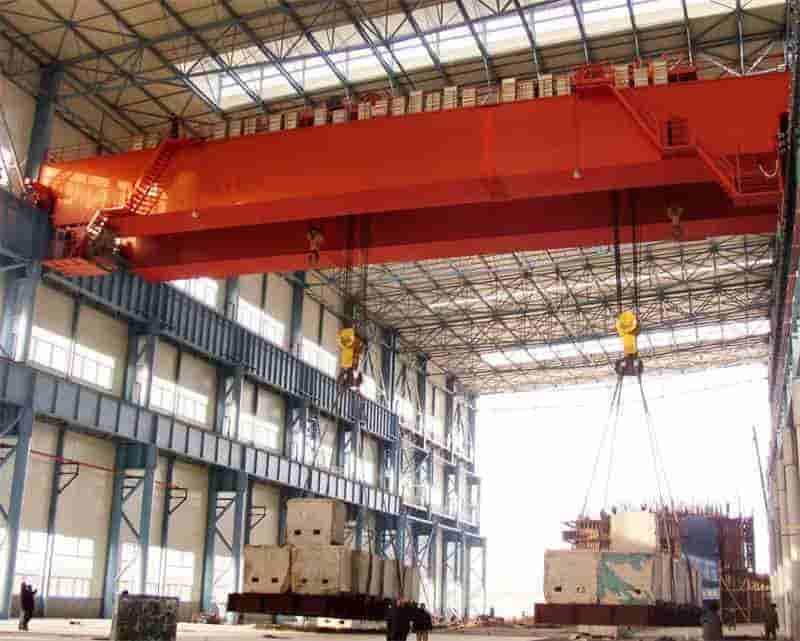
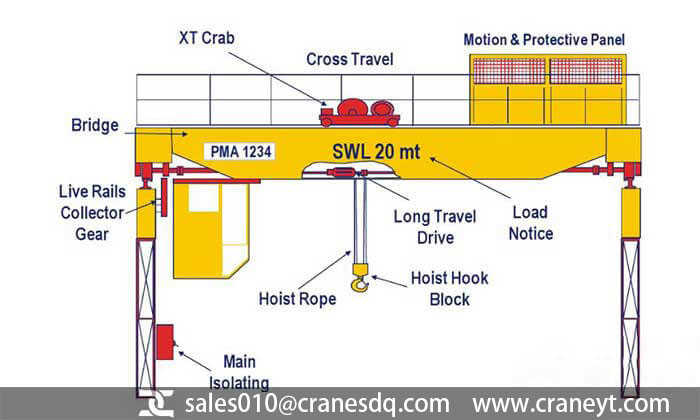
QD electric hook bridge crane is a general double-beam bridge crane, designed and manufactured in accordance with international general standards. The whole machine has a novel structure, beautiful appearance, good processability, and is flexible, stable, safe and reliable. This model mainly consists of two parts, the trolley and the car, forming a complete material handling system.
Core structural components:
Bridge system: As the main load-bearing structure of the crane, it adopts a box-shaped main beam design and is manufactured by automatic submerged arc welding process to ensure the stability and durability of the structure. The bridge consists of components such as the main beam, end beam, walkway and protective device.
Operating mechanism: The trolley is equipped with a precise lifting mechanism and trolley operating mechanism. The entire trolley can run smoothly along the trolley track laid on the main beam cover; the trolley part is composed of the crane bridge, trolley operating mechanism, trolley power transmission device, etc.
Metal frame: The metal structure of the crane mainly includes the bridge and trolley frame, which constitute the basic bearing frame of the equipment.
Featured design:
The trolley conductive system adopts an innovative I-beam track cable conductive device, which significantly improves the safety and reliability of power transmission.
The lifting mechanism can be equipped with a second set of safety devices according to user needs to provide double protection for critical lifting operations.
The operation mode is flexible and diverse, supporting ground handle control and remote control operation to meet the needs of different working conditions.
Main technical parameters and performance indicators
The technical parameters of the QD electric hook bridge crane are wide-ranging and can meet the diverse needs of different industrial scenarios. A variety of configuration options are available depending on the span, lifting capacity and working level.
Basic parameter range:
Lifting capacity: Standard configurations range from 5 tons to 50 tons, and special models can be expanded to 100 tons or even larger. Common main and auxiliary hook configurations such as 20/5 tons (main hook 20 tons, auxiliary hook 5 tons), 50/10 tons, etc., can meet the needs of layered lifting of different loads.
Span: The standard span is 10.5 meters to 31.5 meters, with a modulus increase of 3 meters, which is suitable for most industrial plant structures. Some models can provide span options ranging from 7.5 meters to 30 meters.
Lifting height: Usually the main hook lifting height is 6-14 meters, and the auxiliary hook can reach 14 meters or higher. Under special needs, some models can provide a lifting height of up to 30 meters.
Performance parameters:
Operation speed:
The crane can run at a speed of 45-64.3 m/min
The trolley runs at a speed of 18-42.3 m/min
The main hook lifting speed is 1.8-6.2 m/min, and the auxiliary hook is 7.6 m/min
The main lifting speed of the slow model can be as low as 1.8 m/min, suitable for precision lifting
Working class: usually A3-A6, the intermediate level (A5) is suitable for machining, metal structure, assembly and other workshops, and the heavy level (A6) is suitable for smelting workshops and continuous production handling work.
Power configuration:
The working power supply is generally 3-phase AC 50Hz 380V
Table: Example of technical parameters of QD 20/5 ton electric double beam bridge crane
Parameter
A5 working class
A6 working class
Span(m)
10.5-31.5
10.5-31.5
Total crane capacity (t)
20-41.3
20.9-43.8
Wheel pressure(KN)
160-219
167-229
Product series and model selection
QD electric hook bridge crane has formed a complete series of product lines, covering various material handling needs from light to heavy. Users can choose the most suitable model according to the specific application scenario.
Classification of standard models:
Divided by lifting weight: 5t, 10t, 16/3.2t, 20/5t, 32/5t, 50/10t and other standard models. Among them, the 16-ton model, as a representative of the middleweight, plays a pivotal role in the modern industrial field, and is particularly suitable for material handling in factories, warehouses and logistics centers.
Divided by speed: including standard speed and slow models, such as the QD 50/10-ton electric double-beam slow hook bridge crane, whose main lifting speed is only 1.8 meters/minute, suitable for precision lifting operations.
Divided by operation method: including ground handle control, remote control operation and cab operation. Some advanced models support computer control in the control room to achieve more precise control.
Special configuration options:
Double hook design: The main and auxiliary hook configuration allows one crane to meet the lifting needs of different weight levels at the same time, such as the 20/5t model can flexibly switch between a 20-ton main hook and a 5-ton auxiliary hook.
Customized span: Although the standard span is 10.5m to 31.5m, non-standard customization can be provided according to the actual size of the plant, such as a special design of a 24mm span.
Working system selection: According to the frequency of use, it is divided into two working systems, medium and heavy, to adapt to different intensity working environments.
Extended model range:
Some manufacturers can provide super-large tonnage models, with a lifting range extended to 5-100 tons, and even up to heavy specifications such as 125T, 160T, 200T, 250T, 320T, 500T, etc. At the same time, the lifting height can also be customized according to needs, up to 30 meters.
Application fields and industry solutions
QD electric hook bridge crane has become the core equipment of material handling systems in many industries due to its reliability and adaptability. Models with different configurations can meet the special needs of various industrial scenarios and provide targeted solutions.
Typical application scenarios:
Heavy industry: In heavy industrial environments such as smelting workshops and steel mills, heavy-duty models with A6 working level are capable of handling the handling needs brought about by continuous high-intensity production. Its sturdy structural design and reliable operating system ensure the stable performance of the equipment under harsh working conditions.
Manufacturing workshops: Mechanical processing, metal structure production and assembly workshops mostly use intermediate models with A5 working level to meet the needs of equipment lifting and material transfer in daily production. Models such as 32/10t are particularly suitable for the assembly of large mechanical parts.
Logistics warehousing center: Medium-sized cranes such as 16 tons play a key role in modern logistics warehouses, efficiently handling the loading, unloading and stacking operations of various types of goods. Its 45m/min trolley running speed and 6m/min hook lifting speed ensure logistics efficiency.
Industry customized solutions:
Continuous production line: For handling work involved in continuous production, it is recommended to use heavy-duty models, whose durability and stability can meet the needs of 24-hour uninterrupted operation. Slow models (such as main lifting 1.8m/min) are particularly suitable for precise positioning on precision assembly lines.
Special working conditions: Models with special materials and protection levels can be customized for corrosive environments or explosion-proof occasions; heat-resistant designs can be selected for high-temperature workshops; additional configurations such as wind and rain protection need to be considered for outdoor applications.
Space-constrained places: For special factory structures, customized solutions with non-standard spans can be provided, such as a compact design with a span of 24mm to maximize the use of limited space.
Economic benefit analysis:
The universal design of the QD crane greatly reduces the user’s usage threshold and maintenance costs. The 5~50/10 ton series of products provided by the one-stop service platform enable users to choose the most economical configuration according to actual needs and avoid over-investment. At the same time, standardized design and parts supply also make equipment maintenance more convenient and economical throughout its life cycle.
Purchase Guide and Service Support
Choosing a suitable QD electric hook bridge crane requires comprehensive consideration of multiple factors, and a high-quality service support system is also crucial. Understanding the complete purchase process and service content will help users make wise decisions.
Key purchase factors:
Working level matching: Select the appropriate working level (A3-A6) according to the frequency of use and load characteristics. The medium level (A5) is suitable for intermittent operations, and the heavy level (A6) is suitable for continuous heavy operations. The working level directly affects the service life and performance of the equipment.
Span determination: Measure the actual available span of the installation site and select the closest model in the standard span (10.5m-31.5m). Non-standard spans usually lead to higher costs and longer delivery times.
Lifting weight selection: Evaluate the maximum weight of daily hoisting objects and select a model with appropriate margins. The main and auxiliary hook configurations (such as 20/5t) can enhance operational flexibility. Considering possible future business expansion, moderately advanced configuration is more economical.
Speed requirements: Select a suitable speed combination based on operational accuracy and efficiency requirements. Standard speed (main hook lifting 6.2m/min) can be selected for routine processing operations, while slow speed models (1.8m/min) are suitable for precision assembly.
Service support system:
Customized design: Leading manufacturers provide full customization services from measurement to design, including free on-site measurement and customized design solutions. Users can provide specific parameters and special needs to obtain targeted solutions.
Installation and commissioning: Professional teams provide on-site installation services to ensure that the equipment is correctly positioned and debugged to the best state. Standardized installation is the basis for long-term and stable operation of equipment.
After-sales guarantee: A complete service network can provide timely maintenance and technical support. Some manufacturers have service outlets in many provinces across the country (such as Jiangxi, Hubei, Anhui, Guangdong, etc.). Clarify warranty terms and spare parts supply.
Key points of technical evaluation:
Bridge process: Give priority to products with box-shaped main beams and automatic submerged arc welding processes to ensure structural strength and durability.
Safety configuration: Check whether there is a redundant design such as a second set of safety devices. Evaluate safety features such as braking systems, limit devices and overload protection.
Electrical system: Understand the motor brand (such as Wuxi Motor) and control system configuration. Reliable electrical components are the guarantee of stable operation of the equipment.
Technical documents: Request detailed technical specification parameter tables and technical solution diagrams to fully understand the performance of the equipment. Compare the parameter differences of different manufacturers and identify the key advantages and disadvantages.
It is recommended that users consult and compare solutions from multiple suppliers before making the final decision, and at the same time examine the manufacturer’s engineering cases and production qualifications to ensure that the purchased crane can meet the long-term use needs.
Contact our crane specialists
Send us a message and we will get back to you as soon as possible.