This design provides a comprehensive design analysis of the hoisting structure for a 5-ton gantry crane, covering the complete process from wire rope selection to motor calculation. As an irreplaceable lifting equipment in open-air working environments, the design of the hoisting mechanism of a gantry crane directly affects the working performance and safety reliability of the entire machine. This article will elaborate in detail on the design calculation process of key components of the hoisting mechanism, including the formulation of the transmission scheme, selection of wire rope and pulley blocks, drum design and strength verification, selection of motor and reducer, configuration of brakes, and stability analysis. Simultaneously, aligning with the development trends of modern crane technology, modular design concepts and intelligent control technology are incorporated to meet the requirements of efficient, safe, and reliable operation.
Gantry cranes, as essential material handling equipment, are widely used in open-air warehouses, along railway lines, port terminals, and other locations, particularly suitable for loading and unloading scenarios requiring large spans and high lifting capacities. The designed 5t gantry crane falls into the category of medium-duty lifting equipment. The design of its hoisting mechanism needs to comprehensively consider factors such as duty class, usage environment, and economy. According to crane design standards, a 5t gantry crane typically corresponds to duty class M4-M5, suitable for medium-intensity loading and unloading operations.
The basic technical parameters are as follows: the rated lifting capacity is 5 tons; the lifting height, based on standard workshop or open storage yard requirements, is typically designed to be 10-18 meters; the hoisting speed, according to operational efficiency requirements, is generally set at 7-10 m/min; the duty class is M5, meeting medium usage intensity requirements. These parameters will serve as the basis for subsequent component design calculations. It is important to note that gantry cranes have significant structural differences from overhead cranes, and gantry cranes require special consideration for outdoor environmental factors such as wind load and track foundation conditions.
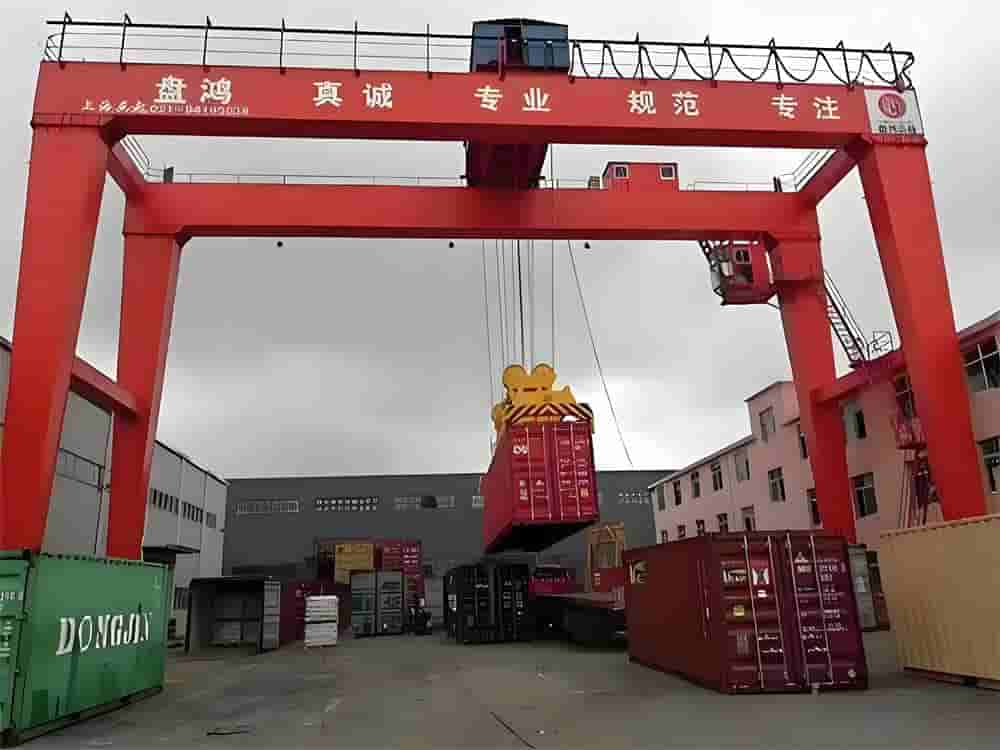
The hoisting mechanism is the core component of a crane, and its performance directly determines the working capability and safety of the entire machine. Modern hoisting mechanism design tends to adopt modular design concepts to reduce manufacturing costs while meeting customer needs. This design will adhere to the following principles: ensure sufficient strength and stiffness; optimize transmission efficiency; improve control accuracy; implement comprehensive safety protection measures; and facilitate maintenance. Furthermore, computer-aided design tools will be fully utilized during the design process, not only to create general assembly drawings but also specifically detailed drawings of the hoisting structure and the drum, to achieve a deep understanding and precise representation of the crane structure.
In terms of scheme selection, considering the medium lifting capacity of 5t and the structural characteristics of gantry cranes, a parallel shaft reducer transmission scheme is chosen. This arrangement offers a compact structure, ease of maintenance, and suits the structural features of gantry cranes. The drive method selected is electric drive, utilizing an AC variable frequency speed control system to achieve smooth starting and precise stopping, which is crucial for improving the efficiency and safety of loading and unloading operations.
The design of the hoisting mechanism’s transmission scheme forms the foundation of the entire system. A reasonable transmission layout decisively influences equipment performance, reliability, and maintainability. Based on the characteristics and usage requirements of the 5t gantry crane, this design adopts a parallel shaft reducer transmission scheme. This scheme connects the motor to the high-speed shaft of the reducer via a coupling, and the reducer’s low-speed shaft connects to the drum through a drum coupling, forming a compact and efficient drive train. This layout makes the structure more compact, facilitating the arrangement of components within the limited space of the gantry crane, while also aiding daily maintenance and inspection. The arrangement of the transmission system must coordinate with the main girder structure, especially for box girder gantry cranes where the main girder consists of top and bottom cover plates and two vertical webs forming a closed box section, with the crane trolley runway typically laid in the middle of the top cover plate.
The selection of the pulley block form directly affects the service life of the wire rope and transmission efficiency. This design adopts a dual pulley block arrangement. This structure can automatically balance the tension of the wire ropes on both sides of the drum, preventing the trolley from tilting due to uneven tension on both sides. The selection of the pulley block ratio is a key design aspect. For a 5t lifting capacity, a ratio of m=2 or 3 is usually adopted. After comparative analysis, a ratio of m=2 is chosen, which can meet the wire rope load-bearing requirements while maintaining a high hoisting speed. The determination of the pulley diameter follows the principle D≥(h-1)d, where h is the ratio coefficient of the pulley diameter to the wire rope diameter. Based on duty class M5, h=20 is taken.
The wire rope is the most critical load-bearing component in the hoisting mechanism, and its selection calculation is paramount. The maximum working tension Smax borne by the wire rope can be calculated by the following formula:
Smax = Q/(m*η)
Where Q is the rated lifting capacity (50kN), m is the pulley block ratio (2), and η is the pulley block efficiency (taken as 0.97). The calculated Smax is approximately 25.77kN. Considering the dynamic load factor ψ (taken as 1.1) and the safety factor n (taken as 5 for duty class M5), the minimum breaking force of the wire rope should satisfy F≥Smax×n×ψ=141.74kN. Based on this value, a 6×37+FC type wire rope is selected, with a nominal tensile strength of 1870 MPa, diameter 14mm, and a breaking force of 145kN, meeting the usage requirements.
The winding method of the wire rope also needs careful design to ensure uniform force distribution and avoid excessive wear. This scheme adopts a single-layer winding method. The wire rope leads out from one end of the drum, passes through the moving pulley and the fixed pulley, and is fixed at the other end of the drum. This arrangement is simple, reliable, and facilitates inspection and replacement of the wire rope. It is important to note that the fleet angle of the wire rope on the drum should not be too large, generally controlled within 1.5°, to prevent rope jumping and disorderly winding. To achieve this requirement, the relative position of the pulley and the drum must be reasonably determined, and a rope guide may be installed if necessary to guide the winding direction of the wire rope.
Regarding pulley design, the pulley material is cast steel ZG270-500, providing sufficient strength and wear resistance. Pulley diameter D=20×14=280mm, standard value 315mm is adopted. Pulley groove bottom radius R=0.53×14=7.42mm, taken as 7.5mm, groove depth 25mm, groove opening width 60mm. These dimensions ensure smooth passage of the wire rope while providing sufficient support surface. Pulleys are supported by rolling bearings, significantly reducing rotational resistance and improving transmission efficiency. Each pulley is equipped with a protective cover to prevent foreign objects from entering and causing wire rope derailment, and lubrication devices are installed for regular lubrication of the bearings.
Table: Wire Rope Selection Parameter Table
| Parameter Name | Value | Remarks |
|---|---|---|
| Wire Rope Type | 6×37+FC | Fiber core, good flexibility |
| Nominal Diameter | 14mm | Actual measurement ≥13.7mm |
| Nominal Tensile Strength | 1870 MPa | High strength grade |
| Minimum Breaking Force | 145 kN | Greater than calculated value 141.74kN |
| Pulley Block Ratio | 2 | Balances load capacity and speed |
| Safety Factor | 5 | Meets M5 duty class requirement |
The drum is a key component in the hoisting mechanism for winding the wire rope. Its design quality directly affects the safety performance and operational reliability of the crane. The drum not only needs to provide sufficient rope capacity but also must possess good bending and compression resistance. This design adopts a welded drum structure, with material selected as Q345B low-alloy high-strength steel. This material offers good weldability and high yield strength (≥345 MPa), meeting strength requirements under heavy-duty working conditions.
The main dimensional calculations for the drum include diameter, length, and wall thickness. The drum diameter is a key parameter affecting wire rope life. According to standard requirements, the drum diameter D should satisfy D≥(h-1)d, where h is the coefficient (taken as 20) and d is the wire rope diameter (14mm). Calculated D≥266mm. Considering manufacturing standards and structural coordination, the drum diameter Dt=400mm is adopted. The drum length L depends on the lifting height, pulley block ratio, and wire rope winding method. The calculation formula is:
L = (H×m/πDt + n) × (d + ε)
Where H is the lifting height (taken as 16m), m is the pulley block ratio (2), n is the number of safety turns (taken as 3), ε is the rope coil gap (taken as 2mm). Calculated L≈580mm. According to standardization requirements, the drum length is finally determined as 600mm.
The determination of the drum wall thickness δ needs to comprehensively consider the winding pressure from the wire rope and the bending stress caused by the drum’s self-weight. The empirical formula is δ≈0.02Dt+(6~10)=14~18mm, and δ=16mm is taken. To verify the rationality of this wall thickness, a strength check is required. The winding pressure of the wire rope on the drum p=2Smax/(Dtd), where Smax is the maximum wire rope tension (25.77kN). Calculated p≈9.2MPa. The compressive stress in the drum wall σc=pDt/(2δ)=115MPa<[σ]=170MPa, meeting the strength requirement.
Drum structure design also includes rope groove shape and end flange design. The rope groove adopts a standard groove shape, groove pitch t=d+(2~4)=16mm, groove bottom radius R=0.53d=7.5mm. The rope groove surface machining must achieve a surface roughness of Ra12.5 to reduce wire rope wear. Flanges are set at both ends of the drum, with a height of 1.5d=21mm, to prevent the wire rope from coming off. The connection between the drum and the reducer output shaft adopts a flange connection, transmitting torque through high-strength bolts. This connection method is compact, reliable in transmission, and convenient for disassembly and maintenance.
The support method of the drum is also a design focus. This design adopts a structure with one end fixed and one end floating. The fixed end is rigidly connected to the reducer housing via a bearing seat, bearing radial and axial forces. The floating end uses a spherical roller bearing, allowing for small displacements when the shaft expands due to heat, avoiding excessive thermal stress. The bearing selected is 22314C spherical roller bearing, with a dynamic load rating of 218kN, far greater than the actual load, ensuring sufficient service life. The bearing housing is made of cast iron HT250, offering good vibration damping and machinability.
The drum also needs to be equipped with a rope guiding device to ensure orderly winding of the wire rope and prevent rope disorder. This design adopts a spiral rope guide, consisting of a guide nut, guide rod, and bracket, which moves left and right with the change in lifting height, guiding the wire rope to arrange sequentially. The clearance between the rope guide and the drum is maintained within 2-3mm, which does not affect drum rotation and can effectively guide the wire rope. Furthermore, three safety turns are set on the drum. When the hook reaches the upper limit position, at least three unloaded safety turns of wire rope remain on the drum, preventing the wire rope from loosening and causing accidents.
The manufacturing process requirements for the drum are also very strict. Welded drums require annealing to eliminate welding residual stress. After machining, static balance tests are required, with unbalance not exceeding 0.5 N·m. The surface coating uses wear-resistant and anti-corrosion paint, suitable for outdoor working environments. To facilitate wire rope fixing, a rope clamp is set at one end of the drum, securely fixing the wire rope end with three M12 bolts. The drum design also needs to consider the fleet angle at the wire rope entry and exit points, generally controlled within 1.5°. Excessive fleet angle will accelerate wire rope wear and reduce service life.
The drive unit is the power core of the hoisting mechanism. Its reasonable selection directly relates to the working performance and energy efficiency of the crane. According to the working conditions of the 5t gantry crane, the drive unit needs to have sufficient lifting capacity, good speed control performance, and reliable braking function. This design adopts a typical drive scheme of motor + reducer + brake. By accurately calculating the parameters of each component, the system is ensured to operate under optimal conditions.
The selection calculation of the motor is the primary task in drive unit design. The rated power P of the motor should meet the hoisting power requirement, calculated by the formula:
P = (Q×v)/(1000×η)
Where Q is the rated lifting capacity (50kN), v is the hoisting speed (taken as 8 m/min = 0.133 m/s), η is the total mechanism efficiency (taken as 0.85, including pulley block, reducer, and coupling efficiency). Calculated P≈7.84kW. Considering the dynamic load factor in actual work and the duty class, the motor rated power is selected as 11kW, with a base duty type of S3-40% (intermittent periodic duty, 40% load duration), meeting the M5 duty class requirement. The motor model selected is YZP160L-8, rated power 11kW, speed 705 r/min, protection class IP54, insulation class F, suitable for frequent starting and reversing in crane applications.
The matching of the reducer needs to match the motor parameters and hoisting speed requirements. The reducer transmission ratio i is calculated by the formula:
i = (n×π×Dt)/(v×m)
Where n is the motor rated speed (705 r/min), Dt is the drum diameter (0.4m), v is the hoisting speed (0.133 m/s), m is the pulley block ratio (2). Calculated i≈33.3. According to the standard reducer series, a ZQH350 reducer is selected, with a nominal transmission ratio of 31.5. The actual hoisting speed is adjusted to 8.43 m/min, close to the design requirement. This reducer is a three-stage gear transmission, with gears using hard tooth surface grinding process, mechanical efficiency up to 96%, noise level ≤78dB, and service life over 20,000 hours. The reducer output shaft is equipped with spherical roller bearings, capable of withstanding large radial forces and certain axial forces, perfectly matching the drum connection end.
Brake selection is key to the safety of the hoisting mechanism. According to standards, the hoisting mechanism must be equipped with a normally closed brake, which automatically brakes when power is interrupted to prevent load dropping. The braking torque of the brake should satisfy:
T≥K×Q×Dt/(2×m×i×η’)
Where K is the safety factor (taken as 1.75), η’ is the transmission efficiency from the brake to the drum (taken as 0.98). Calculated T≥103 N·m. A YWZ5-200/23 electro-hydraulic brake is selected, with an adjustable braking torque range of 112-200 N·m, matching the 11kW motor, action time 0.5s, providing smooth and reliable braking. This brake uses a hydraulic thruster for operation, requires no adjustment of the brake shoe-to-brake wheel clearance, and is easy to maintain. The brake wheel diameter is 200mm, directly connected to the motor shaft end, making the structure compact. To ensure safety, the brake shoe wear should be checked every shift, and replaced immediately when the wear exceeds 50% of the original thickness.
The selection of the coupling needs to consider the transmitted torque and the ability to compensate for axial and radial misalignment. The high-speed shaft (between motor and reducer) uses an elastic pin coupling, model ML3 coupling, with allowable torque 160 N·m and allowable speed 6000 r/min, fully meeting usage requirements. This coupling transmits torque through rubber elastic pins, can buffer vibrations, and compensate for certain axial and radial misalignments. The low-speed shaft (between reducer and drum) uses a gear coupling, model CLZ3 gear coupling, with allowable torque 3150 N·m, allowing for large radial misalignment (≤0.5mm) and angular misalignment (≤1°), adapting to installation errors between the drum and the reducer output shaft.
The arrangement of the drive system needs to consider maintenance space and heat dissipation conditions. The motor, brake, reducer, and drum are arranged along the same axis, with sufficient disassembly space left between components. For example, the distance from the motor tail to the wall should not be less than 300mm, facilitating fan and bearing removal; a lifting ring is installed above the reducer for easy overall hoisting. The drive unit is entirely installed on a welded base, which has sufficient stiffness to prevent deformation under force from affecting gear meshing accuracy. To improve heat dissipation, the motor casing is designed with cooling ribs, and an independent fan can be added if necessary, ensuring that the temperature rise does not exceed the allowable value (155K for Class F insulation) under intermittent periodic duty.
Modern crane drive units are developing towards intelligence and energy saving. This design can be further upgraded to a variable frequency drive system, using PLC-controlled frequency converters to achieve stepless speed regulation of the motor, making the hoisting mechanism start and brake more smoothly, position more accurately, and save energy. Frequency control can also achieve intelligent adjustment of “high speed with light load, low speed with heavy load,” improving operational efficiency. In terms of braking, electrical braking (regenerative braking or DC braking) can be added to work in conjunction with the mechanical brake, reducing wear on the mechanical brake and improving safety.
The safety protection system of the hoisting mechanism is a key component for preventing accidents and ensuring the safety of personnel and equipment. A complete safety system for the hoisting mechanism of a 5t gantry crane requires multiple protection measures to ensure timely intervention under various abnormal conditions and avoid dangers. Modern crane safety design emphasizes “multiple protections, redundant configuration,” maintaining basic safety functions even if a single component fails.
The overload protection device is an essential protective element for the hoisting mechanism. This design installs an electronic weighing sensor at the wire rope fixed end to monitor the lifted load in real time. When the load exceeds 105% of the rated capacity, an audible and visual alarm is activated, and when it exceeds 110%, the hoisting power is automatically cut off. The system uses an S-type tension sensor, range 0-10t, accuracy ±0.5% FS, protection class IP66, suitable for harsh outdoor environments. The display is installed in the operator’s cab, and the weight signal is transmitted to the PLC for processing and participation in control logic. To increase reliability, a mechanical overload limiter is set as a backup protection, providing basic protection even if the electronic system fails.
The height limit device is used to prevent the hook from hitting the top or lowering excessively. This design configures two independent limit switches: one is a weight-operated lever limit switch installed near the drum, which cuts off the hoisting circuit when the hook approaches the upper limit position through a mechanical linkage; the other is a rotary encoder, which calculates the hook height by measuring the number of drum rotations, achieving digital control. Dual protection ensures that over-winding or breaking of the wire rope does not occur under any circumstances. The lower limit is achieved by an adjustable bolt switch, preventing excessive slack in the wire rope.
The safety design of the braking system adopts the principle of redundant configuration. In addition to the main brake, an emergency braking device is added, which can brake quickly in case of sudden power failure or control system failure. The emergency brake uses a spring-applied, electro-hydraulically released method, interlocked with the main brake control. The control circuit of the brake is designed in the safe mode of “release when energized, brake when de-energized,” ensuring that any power interruption leads to automatic braking. The brake is also equipped with a wear monitoring sensor, which sends an alarm signal when the brake lining wear reaches the limit value, prompting timely replacement.
Wire rope condition monitoring is an important aspect of accident prevention. This design installs a wire rope anti-slack device near the drum to prevent accidental loosening of the wire rope. Simultaneously, intelligent sensor technology is used to monitor the tension, vibration, and wear of the wire rope in real time. Data can be transmitted wirelessly to a ground monitoring system, allowing operators and maintenance personnel to grasp the equipment status at any time, foresee and eliminate potential faults in advance.
To further enhance the system’s intelligence level, this design also incorporates machine learning algorithms to predict the wear trend of the wire rope. When abnormal conditions are detected, it can automatically adjust warning thresholds, achieving dynamic management and effectively preventing lifting accidents caused by wire rope damage.
Furthermore, this design integrates rich fault diagnosis information into the operation interface. Once an abnormality occurs, the problem can be quickly located, greatly reducing troubleshooting time, improving work efficiency, and reducing equipment operation risks. Through this series of advanced design concepts and technical means, the aim is to create a highly intelligent, automated, safe, and reliable crane height limit and braking system, providing strong safety guarantees for modern industrial production.
Contact our crane specialists
Send us a message and we will get back to you as soon as possible.