HomeNews → Design scheme of 5T bridge crane bridge travel operating mechanism

Design scheme of 5T bridge crane bridge travel operating mechanism

As indispensable material handling equipment in modern industrial production, the design of the trolley operating mechanism of a bridge crane directly impacts the performance and reliability of the entire machine. This article comprehensively designs the trolley operating mechanism of a 5T bridge crane, encompassing key aspects such as drive mode selection, motor and reducer selection calculation, wheel and track design, brake system configuration, and safety protection measures.

Design Overview and Parameter Determination

The trolley mechanism of a bridge crane is the crane’s transport mechanism, responsible for longitudinally moving the crane along the factory rails, thereby transporting heavy objects along the length of the workshop. As small to medium-sized lifting equipment, 5T bridge cranes are widely used in factory workshops, warehouses, and other places. The design of their trolley mechanism must balance efficiency, stability, and cost-effectiveness.
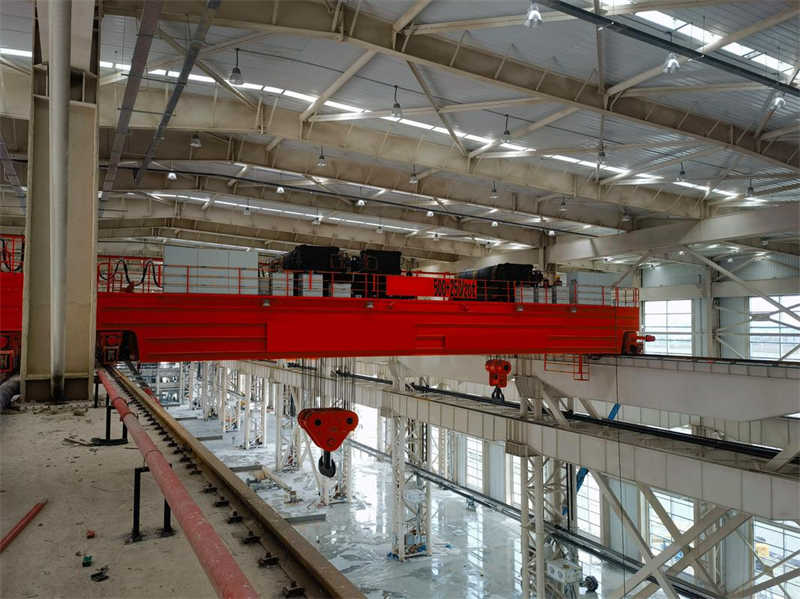
bridge crane bridge travel

Basic Design Parameters

Based on industry standards and actual requirements, the basic design parameters for a 5T bridge crane trolley mechanism are as follows:

  • Rated lifting capacity: 5 tons (main hook); some designs may include a secondary hook (e.g., 3 tons)
  • Span (L): Determined based on actual workshop requirements, typically ranging from 10.5 to 31.5 meters
  • Trolley operating speed (v₀): Generally 30-50 m/min (0.5-0.83 m/s)
  • Duty class: M4 or M5 (medium duty class)
  • JC value: 40% (indicating load duration)
  • Wheel diameter: 300-500 mm (determined based on load calculations)
  • Track type: P24 or QU70 (selected based on wheel load)

Mechanical Components

The 5T bridge crane trolley mechanism primarily consists of the following components:

  • Drive: Motor, reducer, coupling, etc.
  • Travel: Wheel assembly, angular bearing housing, etc.
  • Transmission: Drive shaft (for centralized drive), floating shaft, etc.
  • Braking: Brake and its control system
  • Safety devices: Buffers, limit switches, anti-collision devices, etc.

Operating Environment

The design must consider the following environmental conditions:

  • Indoor environment, no explosive atmosphere
  • Ambient temperature: -20°C to +40°C
  • Relative humidity ≤ 85%
  • Power supply: Three-phase AC 380V, 50Hz

Drive System Design and Selection

Bridge crane trolley travel mechanisms are divided into two types: centralized drive and separate drive. Each has its own characteristics and applicable applications. For 5T bridge cranes, the appropriate choice should be made based on specific requirements and budget.

Centralized Drive System

A centralized drive system uses a single motor to drive the wheels on both sides via a drive shaft. Features of this drive system include:

  • Structural Features: A long drive shaft connects the two driving wheels, typically requiring a floating shaft to compensate for manufacturing and installation errors.
  • Advantages:
    • Requires only one motor, resulting in lower costs.
    • Good synchronization between the wheels, minimizing deviation.
    • Simple electrical control system.
  • Disadvantages:
    • Complex drive shaft system, increasing deadweight.
    • Requires high installation and commissioning requirements.
    • Relatively low transmission efficiency.
    • Inconvenient maintenance; a single failure can render the entire crane inoperable.

Centralized drive systems are suitable for applications with smaller spans (generally less than 16.5m) and low operating speeds. For 5T cranes with limited spans and limited budgets, this solution may be considered.

Separate Drive

Separate drive means that the driving wheels on each side are driven by independent motors, eliminating the need for a mechanical drive shaft connection. This drive method is commonly used in modern bridge cranes and features the following characteristics:

  • Structural Features: Each side has an independent drive unit, typically consisting of a motor, reducer, and brake.
  • Advantages:
    • Eliminates long drive shafts, reducing deadweight.
    • Easy installation and flexible layout.
    • High transmission efficiency.
    • Easy maintenance and modular design.
    • If one drive fails, the other can still operate temporarily.
  • Disadvantages:
    • Requires two drive units, resulting in a slightly higher cost.
    • Requires certain electrical synchronization controls.
    • Prevents deviation caused by drive misalignment.

Separate drive is particularly suitable for long-span cranes. For 5T bridge cranes with spans exceeding 16.5m, separate drive is recommended. For example, the design example mentioned in page 4: “Trolley Travel Mechanism: Separate Drive Scheme, Using Four Wheels, Arranged Oppositely, and Separately Driven.”

Determining the Drive Method for a 5T Bridge Crane

After comprehensively comparing the characteristics of the two drive methods and considering typical 5T bridge crane application scenarios, this design recommends separate drive for the following reasons:

  1. Separate drive is a trend in modern crane design, and the technology is mature and reliable.
  2. Separate drive eliminates the need for long drive shafts, reducing the weight of the mechanism (bridge deadweight G = 0.45…).
  3. It is easier to install and maintain, and is well-suited to the usage habits of modern industrial enterprises.
  4. Even for smaller-span 5T cranes, separate drive offers greater layout flexibility.

The typical separate drive layout is a “four-wheel, opposite-facing” arrangement, with two wheels on each side, one driving and the other driven. This arrangement offers excellent stability and traction performance.

Motor Selection and Calculation

The motor is the power source for the trolley mechanism. The proper selection of the motor directly impacts the crane’s performance and economic efficiency. The following details the motor selection and calculation process.

Operation Resistance Calculation

The main resistances the trolley mechanism must overcome include friction, slope resistance, and wind resistance (wind resistance is generally not considered for indoor cranes). For a 5T bridge crane trolley mechanism, friction resistance is the primary consideration. Friction Resistance Calculation:

Total friction resistance Ff can be calculated as follows:

Ff = β × (Q + G) × (2f + μd) / D [kN]

Where:

  • β: Resistance coefficient, accounting for friction between the wheel flange and the rail sidewall, set to 1.5-2.5 (the smaller value is used for each drive).
  • Q: Rated lifting capacity, 5t (49kN).
  • G: Crane deadweight, estimated to be approximately 15t (147kN) (based on the deadweight ratio of the 32t crane bridge shown in Webpage 4).
  • f: Rolling friction coefficient, set to 0.3mm (0.0003m).
  • μ: Bearing friction coefficient, set to 0.015 for rolling bearings.
  • d: Wheel bearing inner diameter, initially selected as 200mm (0.2m).
  • D: Wheel diameter, initially selected as 400mm (0.4m).

Substituting the values:

Ff = 1.8 × (49 + 147) × (2 × 0.0003 + 0.015 × 0.2) / 0.4 = 1.8 × 196 × (0.0006 + 0.003) / 0.4

= 1.8 × 196 × 0.0036 / 0.4

≈ 3.18 kN

Slope resistance:

Slope resistance is generally not considered for indoor cranes. Total operating resistance:

F = Ff = 3.18 kN (This differs from the “trolley operating resistance F = 8 kN” mentioned on page 8, depending on the lifting tonnage).

Motor Power Calculation

The motor static power Pj is calculated as follows:

Pj = F × v / (1000 × η) [kW]

Where:

  • F: Total operating resistance, 3.18 kN
  • v: Operating speed, assumed to be 0.83 m/s (50 m/min)
  • η: Mechanism transmission efficiency, assumed to be 0.85

Substituting the values:

Pj = 3.18 × 0.83 / (1000 × 0.85) ≈ 3.11 kW

To account for the inertia during crane startup, the motor power needs to be multiplied by the starting factor kd (range 1.2-1.5):

P = kd × Pj = 1.5 × 3.11 ≈ 4.66 kW

Motor Selection

Based on the calculation results, after consulting the motor catalog, we selected the YZR series three-phase asynchronous motor for metallurgy and hoisting applications, specifically the YZR160M1-6. Its technical parameters are:

  • Rated power: 5.5kW
  • Rated speed: 930 r/min
  • Moment of inertia: 0.11 kg·m²
  • Duty cycle: S3 40%
  • Protection level: IP44

This motor meets the following requirements:

  1. Moderate power, slightly greater than the calculated value with sufficient margin
  2. Speed ​​suitable for crane operating mechanisms
  3. Designed specifically for cranes, suitable for frequent starts and stops

Table: Selection parameters of motors for trolley travel mechanisms

Parameter nameSymbolUnitNumerical
Total running resistanceFkN3.18
Running speedvm/s0.83
Static powerPjkW3.11
Startup coefficientkd1.5
Required powerPkW4.66
Select motor modelYZR160M1-6
Motor rated powerPekW5.5
Motor rated speedner/min930

Reducer Design and Selection

The reducer is a key transmission component connecting the motor and wheels. Its function is to reduce the motor’s high speed to a low speed suitable for wheel rotation, while also increasing output torque.

Gear Ratio Calculation

The total gear ratio i of the trolley travel mechanism can be determined by the following formula:

i = n/nw

Where:

  • n: Rated motor speed, 930 r/min
  • nw: Wheel speed, nw = v × 60/(π × D) = 50 × 60/(3.14 × 0.4) ≈ 2388/1.256 ≈ 39.6 r/min

Thus, the total gear ratio is:

i = 930/39.6 ≈ 23.5

Reducer Selection

Based on the transmission ratio and input power requirements, a vertical reducer specifically designed for cranes, model ZSC-400, was selected. Its key parameters are:

  • Nominal transmission ratio: 24.5
  • Permissible input power: 6.5 kW (meets the 5.5 kW requirement)
  • Input speed: 1000 rpm
  • Output shaft torque: 1200 N·m
  • Weight: Approximately 85 kg

This reducer utilizes a three-stage gear transmission. The gears are made of 20CrMnTi, carburized and quenched, with a tooth surface hardness of HRC 58-62 and an accuracy grade of 8-8-7.

Actual Operating Speed ​​Verification

When using the actual transmission ratio of 24.5, the actual operating speed is:

v’ = π × D × n / (60 × i) = 3.14 × 0.4 × 930 / (60 × 24.5) ≈ 0.79 m/s (47.6 m/min).

Compared to the design requirement of 50 m/min, the error is 4.8%, which is within the allowable ±5% range.

Coupling Selection

Couplings are required between the motor and reducer, and between the reducer and wheels. Selection based on shaft diameter and transmittable torque:

  1. Between the motor and reducer: Use an elastic pin coupling, model LX3, with an allowable torque of 160 N·m and an allowable speed of 5000 rpm.
  2. Between the reducer and wheel: Use a gear coupling, model CLZ3, with an allowable torque of 710 N·m and an allowable speed of 3000 rpm.

The following factors should be considered when selecting a coupling:

  • Torque transmission capacity
  • Ability to compensate for axial and radial misalignment
  • Adaptability to the frequent starting and stopping characteristics of the crane
  • Ease of installation and maintenance

Wheel and Track Design

The wheel assembly is the actuating component of the trolley’s running mechanism, directly contacting the track and bearing the entire load. Its design directly impacts its running resistance and service life.

Wheel Design

Based on the load characteristics and operating class of the 5T crane, the following wheel parameters are selected:

  • Wheel diameter: 400mm (preliminary selection, subject to verification)
  • Wheel material: ZG340-640 (cast steel), tread hardness HB300-380
  • Wheel construction: Double flange (to prevent derailment), flange height 20mm, thickness 20mm
  • Bearing type: Spherical roller bearing (self-aligning function, accommodating installation errors)

Wheel pressure calculation

The maximum wheel pressure Pmax occurs when the fully loaded trolley is positioned on one end beam:

Pmax = (Q+G)/4 × k [kN]

Where:

  • Q: Rated lifting capacity, 49kN
  • G: Crane deadweight, 147kN
  • K: Load unevenness factor, taken as 1.1

Pmax = (49+147)/4 × 1.1 ≈ 53.9 kN

Based on the wheel pressure and operating speed, check the wheel load curve to confirm that a 400mm diameter wheel meets the requirements.

Track Selection

Based on the wheel load and operating level, select the QU70 crane-specific track:

  • Track Height: 120mm
  • Base Width: 120mm
  • Head Width: 70mm
  • Theoretical Weight: 52.8kg/m

The permissible wheel load for the QU70 track is 70kN (>53.9kN), meeting the operating requirements. During track installation, ensure the following:

  • Track Gauge Deviation ≤ ±5mm
  • Track Height Difference ≤ 3mm
  • Joint Gap ≤ 2mm
  • Track Straightness Error ≤ 3mm

Wheelset Structure

The wheelset utilizes an angular bearing housing for easy installation and maintenance. The bearing housing houses 22216 spherical roller bearings with a dynamic load rating of 108 kN. The lifespan is calculated as follows:

L10 = (C/P)³×10⁶/(60×nw)

= (10⁶/53.9)³×10⁶/(60×39.6)

≈ 8.2×10⁴ hours

This is significantly longer than the required 4000 hours.

Braking System Design

The braking system is a key component for ensuring safe crane operation and must ensure reliability and timely operation.

Brake Selection

Based on the characteristics of the trolley operating mechanism, the YWZ5-315/23 electro-hydraulic drum brake was selected. Its main parameters are:

  • Braking torque: 160-200 N·m
  • Thruster model: Ed231/6
  • Brake drum diameter: 315mm
  • Weight: 38kg

This brake offers the following advantages:

  1. Smooth, impact-free braking
  2. Friction material with excellent wear resistance and long service life
  3. Automatic wear compensation and long maintenance intervals
  4. Adaptable to the frequent starts and stops of the crane

Braking Torque Calculation

The required braking torque Mz is calculated as follows:

Mz = kz × Ff × D / (2 × i × η) [N·m]

Where:

  • kz: Safety factor, assumed to be 1.75
  • Ff: Operating resistance, 3180 N
  • D: Wheel diameter, 0.4m
  • i: Transmission ratio, 24.5
  • η: Transmission efficiency, 0.85

Mz = 1.75 × 3180 × 0.4 / (2 × 24.5 × 0.85) ≈ 107 N·m

The selected brake’s minimum braking torque of 160 N·m is greater than 107 N·m, meeting the requirement.

Braking Distance Verification

The actual braking distance S can be estimated as:

S = v²/(2×a) [m]

Where:

  • v: Operating speed, 0.83 m/s
  • a: Deceleration, a = Fb/m = (Mz×2×i×η/D)/m
  • m: Total mass, (Q+G)/g = (49+147)/9.81 ≈ 20 t

Fb = 160×2×24.5×0.85/0.4 ≈ 16660 N

a = 16660/20000 ≈ 0.833 m/s²

S = 0.83²/(2×0.833) ≈ 0.41 m

Crane standards require that the braking distance S ≤ v²/(5000–6000) = 0.83²/5000–6000 ≈ 0.11–0.14 m. Obviously, a single brake cannot meet the requirements, so a dual-brake solution is required:

  • A conventional brake (160 N·m) is installed at the rear of the motor.
  • An auxiliary brake (80 N·m) is added to the high-speed shaft of the reducer.

The total braking torque is 240 N·m. Recalculate the braking distance:

Fb = 240 × 2 × 24.5 × 0.85/0.4 ≈ 24990 N

a = 24990/20000 ≈ 1.25 m/s²

S = 0.83²/(2 × 1.25) ≈ 0.28 m

This still does not meet the requirements, so the following measures are required:

  1. Select a brake with greater braking torque
  2. Reduce the initial braking speed (using variable frequency speed control)
  3. Increase the number of brakes

The final solution is to select two YWZ5-400/25 brakes (braking torque 250-315 N·m), for a total braking torque of 500 N·m:

Fb = 500×2×24.5×0.85/0.4 ≈ 52063 N

a = 52063/20000 ≈ 2.6 m/s²

S = 0.83²/(2×2.6) ≈ 0.13 m (meets the requirement)

Safety Protection Device Design

To ensure safe crane operation, the trolley mechanism must be equipped with multiple safety protection devices.

Conventional Safety Devices

  1. Limit Switches: LX10-11 limit switches are installed at both ends of the trolley’s travel range to prevent overtravel.
  2. Buffers: Polyurethane buffers are installed at both ends of the end beam to absorb collision energy.
  3. Anti-Collision Devices: When multiple cranes share a common track, infrared anti-collision sensors are installed.
  4. Track Cleaners: Clear obstacles on the track.
  5. Track Clamps: Prevent wind damage when operating outdoors.

Electrical Protection Measures

  1. Overcurrent Protection: Overcurrent relays are installed in each phase of the motor circuit. In the event of an overload or short circuit, the overcurrent relays will quickly operate, disconnecting the faulty circuit and preventing excessive current from causing damage to the equipment.
  2. Undercurrent Protection: For equipment that requires stable current operation, such as some precision machining equipment, undercurrent relays are installed. When the current falls below a preset value, the undercurrent relays activate to prevent unstable operation or even shutdown due to insufficient current.
  3. Overvoltage protection: When the grid voltage exceeds the device’s tolerance, the overvoltage protection device automatically activates to prevent damage caused by the excessive voltage. Overvoltage protection is typically implemented using components such as zinc oxide varistors.
  4. Undervoltage protection: Similar to undercurrent protection, undervoltage protection activates when the grid voltage falls below the device’s required voltage. When the voltage drops below a set threshold, the undervoltage protection device activates, cutting off the power supply to prevent unstable operation or even shutdown of the device due to insufficient voltage.
  5. Short-circuit protection: Devices such as fuses and circuit breakers quickly disconnect the circuit in the event of a short circuit, preventing damage caused by the short-circuit current. Short-circuit protection is one of the most basic protective measures in electrical systems.

  Contact our crane specialists


Send us a message and we will get back to you as soon as possible.

    Send Your Needs