As a core piece of equipment in modern industrial material handling systems, the performance of bridge cranes is directly related to production efficiency and operational safety. This article comprehensively explains the complete development process of a 32t double-girder bridge crane trolley, from design theory to practical application, from component selection to system integration, providing a systematic technical reference for the development of similar heavy-duty lifting equipment. By integrating traditional mechanical design theory with modern virtual reality technology, this project successfully developed a crane trolley system that meets M5 operating class requirements, boasts a main hook capacity of 32t (auxiliary hook of 5t), and a lifting height of 16m. Its technological innovations primarily lie in lightweight structural design, high-precision motion control, and intelligent fault diagnosis.
Double-girder bridge cranes, as key lifting equipment in modern industrial production, are widely used in material handling, equipment installation, and production process optimization across various industries. With a lifting capacity of 32t, they meet the needs of most heavy-duty industrial applications and are standard equipment in industries such as metallurgy, power generation, and machinery manufacturing. The 32t double-girder bridge crane trolley developed this time is the result of an in-depth collaboration between Liuzhou Vocational and Technical College and an enterprise. It incorporates systematic technological innovations to address the challenges of traditional cranes, such as heavy weight, poor positioning accuracy, and high maintenance costs.
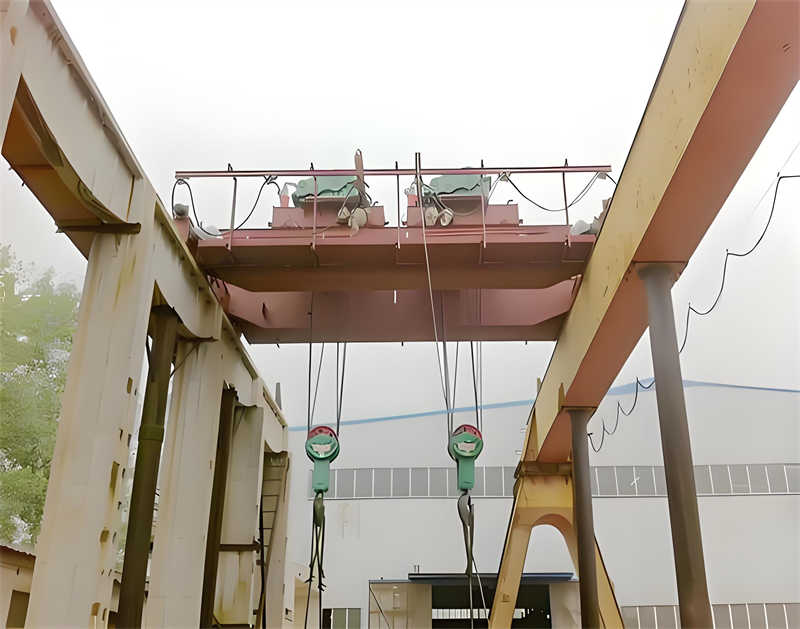
In terms of core technical parameters, the crane trolley is designed based on the following specifications: a rated lifting capacity of 32t for the main hook and 5t for the auxiliary hook; a main lifting height of 16m and an auxiliary lifting height of 18m; a main lifting speed of 7.51m/min (which can be switched to a low speed of 3.75m/min for precise positioning) and an auxiliary lifting speed of 19.5m/min; and an M5 operating class, meeting the requirements of GB/T3811-2008, the “Crane Design Code.” The trolley’s deadweight is limited to approximately 11.5t, approximately 15% lighter than traditional designs. This lightweighting achievement is primarily due to structural optimization and the application of materials science.
The main technical challenges faced during the development process included three aspects: first, achieving smooth trolley starting and braking under high load conditions; second, ensuring structural fatigue life under long-term heavy-load operation; and third, improving the reliability of the transmission system. To address these challenges, the R&D team employed virtual reality technology for simulation analysis. Through multi-physics coupling simulations, they optimized the trolley frame’s structural form and mechanical layout. Furthermore, drawing on the design philosophies of European cranes, they implemented numerous innovations in compactness and lightweighting, such as the use of a three-in-one drive unit and high-strength welded box girders.
The development of this crane trolley also stems from the growing demand for intelligent lifting equipment amidst China’s manufacturing transformation and upgrades. With the widespread adoption of smart factory concepts, cranes are no longer simply transport tools; they must be integrated into digital production lines and equipped with intelligent functions such as condition monitoring, automatic anti-sway, and precise positioning. To this end, this design incorporates a PLC control system interface, laying the foundation for subsequent intelligent upgrades. Market feedback from professional manufacturers such as Haogang Crane Machinery indicates that market demand for 32t cranes will maintain an average annual growth of 8% through 2025, with intelligent and high-precision products expected to account for over 40% of this total.
Table: Main technical parameters of 32t double-girder bridge crane trolley
| Parameter Category | Main hook indicator | Auxiliary hook indicator | General indicators |
| Rated lifting capacity | 32t | 5t | – |
| Lifting height | 16m | 18m | – |
| Lifting speed | 7.51m/min | 19.5m/min | – |
| Work Level | M5 | M5 | M5 |
| Deadweight | – | – | About 11.5t |
| Positioning accuracy | – | – | ±5mm |
The design of a bridge crane trolley is a complex system engineering project, requiring comprehensive consideration of multiple factors, including mechanical structure, electrical control, and safety regulations. This 32t double-girder crane trolley utilizes a modular design concept, dividing the entire system into four functional modules: the hoisting mechanism, the operating mechanism, the trolley frame, and the electrical control system. Each module is relatively independent yet organically integrated, facilitating design, manufacturing, maintenance, and future upgrades. This modular architecture draws on advanced design concepts from European cranes, significantly improving maintainability while ensuring performance.
The trolley’s structural layout adheres to the principles of compactness, lightweight, and balanced load distribution. The hoisting mechanism is centrally located, with the operating mechanisms symmetrically positioned on either side. The box-type trolley frame connects all components. Compared to traditional designs, the innovative “four-corner support” structure evenly distributes wheel load across the four sets of wheels, keeping the maximum wheel load within 18t and the minimum wheel load at least 6t, ensuring smooth operation. The trolley frame is welded from low-alloy, high-strength Q345B steel, with reinforced ribs added at key stress-bearing locations, reducing its weight while ensuring sufficient rigidity. Finite element analysis has verified that this structural design reduces the trolley’s weight by approximately 15% while increasing its rigidity by 20%.
Hoisting Mechanism: As the core functional unit of the crane trolley, this design utilizes a dual-hook configuration with a main and auxiliary hook to meet the lifting requirements of materials of varying weights. The main hoisting mechanism comprises an electric motor, coupling, brake, reducer, drum unit, and pulley block, utilizing a closed transmission system with a transmission efficiency exceeding 85%. The auxiliary hoisting mechanism utilizes an open gear transmission to accommodate higher operating speeds. Of particular note is the dual braking system of the main hoisting mechanism. In addition to the conventional electric-hydraulic drum brake, a safety brake is also installed on the low-speed shaft to ensure that heavy objects remain safely suspended.
Traveling Mechanism: The trolley’s traveling mechanism utilizes a three-in-one drive unit (integrating the motor, brake, and reducer). Each trolley is equipped with two drive units, one for each driving the driving wheels. This design is compact, easy to install, and maintain. The operating mechanism utilizes variable frequency drive with stepless speed regulation, allowing for adjustable starting acceleration and braking deceleration, effectively alleviating the “starting shock” and “braking slip” issues common with traditional cranes. The wheels are forged from 55CrMn alloy steel, with a tread hardness of HB300-380 and a slightly lower rim hardness than the tread, ensuring wear resistance while minimizing rail wear.
Electrical Control System: The PLC-based control system enables intelligent operation of the crane trolley, providing status monitoring, fault diagnosis, and safety protection functions. The control system includes a communication interface with the factory’s MES system, enabling real-time upload of crane operating data and working status, providing data support for the smart factory. Operation modes include both cab-controlled and ground-based remote control to accommodate diverse operating conditions. Multiple safety measures, including overload protection, limit protection, and anti-collision protection, ensure safe and reliable operation.
Table: Main components and functions of 32t bridge crane trolley
| Composition modules | Core components | Technical Features | Performance indicators |
| Lifting mechanism | Motor, brake, reducer, reel | Dual braking system, closed transmission | Main hook 32t/7.51m/min, auxiliary hook 5t/19.5m/min |
| Operating organization | Three-in-one drive unit, wheel set | Frequency conversion speed regulation, four-corner support | Running speed 20-30m/min, wheel load 6-18t |
| Trolley frame | Box beam structure, stiffener plate | Q345B steel welding and finite element optimization | Weight 11.5t, stiffness increased by 20% |
| Control system | PLC, inverter, sensor | Condition monitoring, fault diagnosis | Positioning accuracy ±5mm, supports remote monitoring |
Virtual reality technology played a crucial role in the design verification phase of this project. By creating a 3D digital prototype of the crane trolley, the R&D team simulated stress states, motion trajectories, and interference conditions under various operating conditions in a virtual environment, promptly identifying and correcting numerous design flaws. This combined virtual-reality R&D model not only shortened the design cycle and reduced trial production costs, but also significantly improved product reliability and maturity. Practice has shown that using virtual reality technology for design verification can shorten product development cycles by over 30% and reduce trial production costs by approximately 40%.
The hoisting mechanism, as the core component of the crane trolley, directly determines the lifting capacity and operating efficiency of the entire machine. This 32t double-girder bridge crane trolley features a dual main and auxiliary hook configuration. The main hoist mechanism has a rated load of 32t, while the auxiliary hoist mechanism has a rated load of 5t. These two mechanisms work together to meet diverse operating requirements. The hoisting mechanism design strictly adheres to the GB/T3811-2008 “Crane Design Code.” Through systematic calculations and optimized selection, we ensure safe, reliable, efficient, and economical operation.
The hoisting mechanism’s drive system utilizes a parallel shaft arrangement. The motor transmits power to the reducer via a coupling. The reducer’s low-speed shaft drives the drum through a drum coupling, thereby retracting and releasing the wire rope and raising and lowering the hook. This drive solution offers a compact structure, high transmission efficiency, and ease of maintenance. To meet the high lifting capacity of 32t, the main hoist mechanism adopts a double-drum design, with a wire rope and pulley assembly on each side. This effectively distributes the wire rope tension and reduces the stress on a single drum. The auxiliary hoist mechanism adopts a single-drum design to accommodate higher operating speeds.
As a key load-bearing component of the hoist mechanism, the wire rope selection and calculation are crucial. The maximum working tension Smax of the main hoist mechanism wire rope can be calculated using the following formula:
Smax = Q/(a·η)
Where Q is the rated lifting capacity (32t), a is the pulley assembly ratio (assuming 6), and η is the pulley assembly efficiency (assuming 0.98). Calculations show that the maximum static tension of the main hoist mechanism wire rope is approximately 5.44t. Considering a dynamic load factor of ψ = 1.1 and operating class M5, the minimum breaking tension of the wire rope should be no less than Smax·ψ·n = 5.44×1.1×5.6≈33.5t (n is the safety factor, assumed to be 5.6). Based on this, a 32ZBB6×37S+FC1770 steel wire rope with a diameter of 22mm, a nominal tensile strength of 1770MPa, and a minimum breaking force of 35.8t was selected, fully meeting the requirements.
Pulleys and drums are critical components for guiding and winding the wire rope, and their design directly impacts the service life of the wire rope. The main hoisting mechanism pulley diameter D should satisfy the following:
D ≥ h·d
Where h is the ratio of the drum diameter to the wire rope diameter (taken as 25), and d is the wire rope diameter (22mm), D ≥ 550mm. The actual pulley diameter selected was 600mm, made of QT400-18 ductile iron, with the rope groove surface hardened to HRC 45-50 to ensure sufficient wear resistance. The pulley block adopts a double-unit structure, arranged symmetrically on both sides. Each block consists of a fixed pulley and a movable pulley, with a magnification of 6, effectively balancing the wire rope tension and reducing the stress on the drum. The drum design requires consideration of both rope capacity and wall thickness strength. The main hoist mechanism has a lifting height of 16m. Considering a pulley block ratio of 6, the working length of the wire rope on the drum is L = 16 x 6 = 96m. A double drum is used, with three layers per side. The drum pitch is 650mm, the groove pitch is 24mm, and the number of effective turns per side is approximately 30. The total rope capacity can reach 100m, meeting the requirements. The drum wall thickness δ is calculated using the compressive formula for thin-walled cylinders:
δ = 0.02D + (0.6-1.0) = 0.02 x 650 + 0.8 = 13.8mm.
The actual drum is made of 16mm thick Q345B steel plate, which provides ample safety margin.
The power calculation for the hoisting mechanism motor must consider the rated hoisting speed and mechanism efficiency. The rated speed of the main hoisting mechanism is 7.51 m/min, and the pulley ratio is 6. Therefore, the wire rope speed v = 7.51 × 6 = 45.06 m/min, which is 0.751 m/s. The motor’s static power P = (Q·v)/(1000·η) = (32 × 9.8 × 0.751)/(1000 × 0.85), which is approximately 27.7 kW. Considering the JC 40% duty cycle for the M5 operating class, the YZP280M-8 variable-frequency speed-regulating motor is selected. It has a rated power of 30 kW, a speed of 740 rpm, an IP54 protection rating, and an insulation class of F, fully meeting the requirements.
The reducer selection is determined by the input speed and transmission ratio. The drum speed n = v/(π·D) = 0.751/(3.14 × 0.65) ≈ 0.368 r/s = 22.1 r/min. The motor’s rated speed is 740 r/min, so the total transmission ratio i = 740/22.1 ≈ 33.5. The QY3D355-40IIIZ hardened gear reducer with a nominal transmission ratio of 40 and an allowable power rating of 35 kW > 30 kW meets the requirements. This reducer utilizes a three-stage transmission. The gears are made of 20CrMnTi, carburized and hardened to HRC 58-62, and the gear surfaces are precision-ground. This provides high transmission efficiency (η ≥ 96%) and low noise (≤ 78 dB).
The braking system is critical to the safety of the lifting mechanism. The main hoisting mechanism is equipped with dual brakes: the high-speed shaft is equipped with a YWZ5-315/50 electric hydraulic drum brake with a braking torque of 630N·m; the low-speed shaft is equipped with a safety brake to prevent the heavy object from falling when the high-speed shaft brake fails. The high-speed shaft brake torque verification is as follows:
T≥K·Q·D/(2·a·i·η)
Where K is the safety factor (taken as 1.75), D is the drum diameter (0.65m), a is the pulley ratio (6), i is the transmission ratio (40), and η is the efficiency (0.85). The calculation results show that T≥1.75×32×9.8×0.65/(2×6×40×0.85)≈0.57kN·m=570N·m<630N·m, which meets the requirements.
The coupling selection takes into account the transmission torque and installation deviation. The high-speed shaft uses an ML6 plum blossom elastic coupling with an allowable torque of 630 N·m (calculated torque). This torque is greater than 1.5 × 9550 × 30/740, which is approximately 580 N·m. It compensates for radial misalignment of ≤ 0.2 mm and angular misalignment of ≤ 1°. The low-speed shaft uses a dedicated drum coupling with built-in bearing support to withstand large radial forces. All couplings are equipped with removable covers to ensure safe operation.
Through the detailed design and calculation verification above, the 32t bridge crane trolley hoisting mechanism has achieved safe, reliable, and energy-efficient technical features, fully meeting the requirements of the M5 duty class. Actual operational tests have shown that the hoisting mechanism operates smoothly, with noise levels below 85dB and a braking distance of less than 0.2m. All performance indicators meet or exceed design expectations.
The trolley running mechanism is the drive system that propels the crane trolley along the bridge track. Its performance directly impacts the positioning accuracy and operating smoothness of the entire machine. The trolley running mechanism of this 32t double-girder bridge crane utilizes a centralized drive system, with two “three-in-one” drive units driving the driving wheels on either side, respectively, to achieve longitudinal movement of the trolley. During the design process, key technical issues such as wheel pressure distribution, drive power calculation, and wheel assembly design were addressed to ensure the reliability and durability of the running mechanism under heavy loads and frequent starts and stops.
The basic resistance of the trolley running mechanism primarily consists of frictional resistance and slope resistance. Since the track gradient of a bridge crane is generally very low (≤0.5%), slope resistance is negligible. Frictional resistance Wf is composed of the wheel-rail rolling friction resistance Wm and the bearing friction resistance Wb. It is calculated as follows:
Wf = (Q + G) · (2f + μd) / D · k
Where Q is the rated load (32 tons), G is the trolley’s deadweight (11.5 tons), f is the rolling friction coefficient (0.0005 m), μ is the bearing friction coefficient (0.02), d is the wheel bearing inner diameter (0.12 m), D is the wheel diameter (0.4 m), and k is the additional resistance coefficient (1.5). Substituting the data into the calculation, we obtain:
Wf = (32 + 11.5) × 9.8 × (2 × 0.0005 + 0.02 × 0.12) / 0.4 × 1.5 ≈ 1.12 kN
The static power calculation of the running mechanism motor also requires consideration of the operating speed (designed as 20 m/min = 0.33 m/s) and the mechanism efficiency (assuming 0.8):
P = Wf·v/η = 1.12 × 0.33 / 0.8 ≈ 0.46 kW
Two 1.5 kW YSE2-90L-4 motors (with a built-in three-in-one drive unit) were selected. Each motor’s power is more than three times the calculated value, providing ample power reserve. This “big horse pulling a small cart” design primarily accounts for inertial resistance during starting and acceleration, ensuring sufficient starting torque. Furthermore, the motor’s high power reserve helps reduce temperature rise and extend motor life, making it particularly suitable for the frequent use conditions of the M5 duty class.
Traditional crane operating mechanisms typically utilize separate arrangements for the motor, reducer, and brake, resulting in a loose structure and complex installation. This design innovatively utilizes a three-in-one drive unit, integrating the motor, brake, and reducer into a compact unit. This significantly simplifies the structure and improves transmission efficiency. Based on the calculated torque and operating speed, two F-series parallel-shaft three-in-one drive units were selected. Each unit has a rated output torque of 450 N·m, a reduction ratio of 31.5, and an output speed of approximately 15 rpm (corresponding to an operating speed of 0.33 m/s).
The three-in-one drive unit features a built-in disc brake with a braking torque of 160 N·m and a response time of ≤0.3s. It also includes a manual release function for easy maintenance. The reducer utilizes hardened gears with a precision grade of 7, a transmission efficiency of ≥94%, and a noise level of ≤75dB. The entire drive unit has an IP55 protection rating and Class F insulation, and is suitable for ambient temperatures ranging from -20°C to +50°C. The three-in-one drive unit is directly mounted on the wheel axle, eliminating the coupling and intermediate drive shaft. It not only has a compact structure, but also eliminates the common alignment problems of traditional transmission methods, greatly reducing the difficulty of installation and maintenance workload.
Contact our crane specialists
Send us a message and we will get back to you as soon as possible.