Home → News → Double-beam European electric hoist bridge crane instruction manual
Double-beam European electric hoist bridge crane instruction manual
I. Product Overview
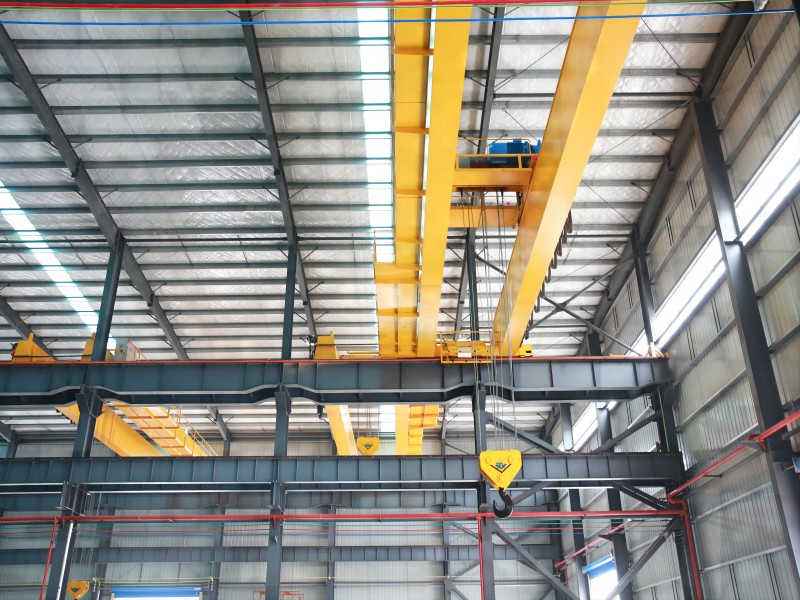
The double-girder European-style electric hoist bridge crane is an efficient and reliable lifting device suitable for material handling in various industrial environments. This crane is designed and manufactured in accordance with JBT3695-2008 “Electric Hoist Bridge Crane” and GB6067-2010 “Safety Regulations for Hoisting Machinery” to ensure safety and stability.
II. Key Performance Parameters
Rated lifting capacity (t): 3, 5, 10, 16.32, 20.5, 32.5, 50.10, 75.20, 100 (Derivative models: 53.2, 55, 103.2, 105). When the lifting capacity is expressed as a fraction, the numerator represents the main hook lifting capacity, and the denominator represents the auxiliary hook lifting capacity.
Working Class: Classified as A5 (medium) or A6 (heavy) based on work frequency and load factor.
Lifting Height (m): Bridge cranes have a lifting height of 3 meters. The maximum lifting heights for various specifications are as follows:
Rated lifting capacity(t)
5
10
16
20
32
50
75
Lifting height (m)
18
18
12-14
12-14
12-14
12-14
12-14
III. Structural Features and Operating Principle
Overall Structure: The entire crane consists of four main components: the bridge, the trolley (the hoisting mechanism with the running gear and hook), the crane running gear, and the electrical equipment.
Hoisting Mechanism: Both the trolley and the running gear are driven by separate electric motors. A crane with a lifting capacity of 10t is a single-hook crane with a single hoisting mechanism. Cranes with capacities of 20.5t, 32.5t, 50.10t, and 75.20t have two hooks and therefore two independent hoisting mechanisms. The main hook is used to lift heavy objects, while the auxiliary hook, in addition to lifting lighter objects, can also assist with the main hook in tilting or tipping objects. However, two hooks are not allowed to lift two objects simultaneously.
Metal Structure: This includes the bridge, trolley frame, and maintenance platform. The bridge consists of two box-shaped end beams, two box-shaped main beams, and a walkway outside the two main beams. Tracks are laid on the upper surface of the main beams for the trolley to travel. The main beam and end beams are connected by bolts and are removable for easy transportation and installation.
The crane’s operating mechanism is separately driven, with two or four symmetrical, independent drive units. The drive unit utilizes a three-in-one reduction motor.
The trolley’s operating mechanism is separately driven by a three-in-one reduction motor.
IV. Electrical System
Crane power supply: Three-phase, four-wire AC, 380V, 50Hz. Safety busbars can be used for electrical conduction throughout the crane.
Crane Operation: Ground-level operation, controlled via the buttons on the ground-level flashlight.
V. Installation and Adjustment Requirements
Main End Beam Connection: Bolt the main end beams together. Note that these bolts are special, made of 45-gauge, special-grade material. For safety reasons, the user is permitted to perform intermittent welding as shown in the diagram, but avoid over-welding to prevent deformation.
Electrical Assembly: Assemble the crane’s end travel switches to the end beams. Assemble the trolley motor control box, hoist control box, and other electrical equipment in the operator’s cab. Connect the relevant electrical components and adjust the two operating motors to ensure consistent rotational direction.
Trolley Installation: Install the trolley on the crane bridge.
VI. Test Methods
After crane installation, perform no-load, static load, and dynamic load tests to ensure that all crane components operate properly and meet design requirements.
Ⅶ. Safety Operating Procedures
Operators must undergo professional training and be familiar with the crane’s performance and operating procedures.
Before operation, check that all crane components are in good condition and the electrical system is functioning properly.
Overloading is strictly prohibited. Ensure that the weight of the hoisted object does not exceed the crane’s rated capacity.
Maintain full attention during operation and refrain from chatting with others or engaging in activities unrelated to the operation.
Ⅷ. Maintenance
Regularly inspect all crane components for wear and damage, and replace or repair them promptly.
Regularly clean the crane of dust and debris, and keep the electrical system clean and dry.
Regularly check the crane’s lubrication to ensure that all components are properly lubricated.
Ⅸ. Transportation and Storage
During transportation, ensure that all crane components are securely fastened to prevent collisions and damage.
Store the crane in a dry, well-ventilated location to protect it from moisture and corrosion.
During long-term storage, regularly inspect all crane components to ensure they are in good condition.
Contact our crane specialists
Send us a message and we will get back to you as soon as possible.