The design of European cranes complies with the third edition of FEM1001, the European Institute for Material Handling, Rules for the Design of Hoisting Mechanisms for Heavy Lifting Equipment. This standard is similar to the latest DIN, ISO, BS, and CMAA standards, but may have minor differences. During the design process, we fully consider these differences and ensure that the final product meets or exceeds the requirements of the relevant standards.
Welding standards are DIN 18800 and BLATT 7; crane component design and structural standards follow DIN 15018 and BLATT 2; and welding grades are based on DIN 8563 and BLATT 3. These standards ensure the quality and safety of the crane steel structure.
The design of brakes and couplings strictly complies with DIN 15434, VDE 0580, and DIN 15431 standards to ensure reliability and stability.
The hook design complies with DIN 15401 (single hook), DIN 15402 (double hook anchor hook), and DIN 15404 (hook inspection certificate) standards to ensure hook strength and safety.
The electrical equipment design complies with VDE 0113, VDE 0100, and CEE standards to ensure the safety and reliability of the electrical system.
The motor is selected in accordance with IEC Recommendations 341, 345, and 721, optimized according to FEM standards, and fully complies with the Swedish crane component standard IKH 6.30.01 to ensure efficient and stable operation.
The gearbox design complies with ISO DI S 6336 II 6336 V DIN 51150 standards to ensure transmission efficiency and reliability.
The entire machine utilizes the most advanced optimization technology and European design concepts, featuring a low height, light weight, and a small maximum hook size. This reduces plant height, saves construction costs, and increases the effective working area.
The entire machine utilizes a modular manufacturing approach, resulting in a high degree of component standardization and interchangeability, facilitating installation and maintenance. Bolted connections and plug-in electrical connections further enhance installation and maintenance convenience.
The entire machine utilizes a flexible structural design, resulting in smooth and gentle operation, effectively reducing vibration and noise, and improving work efficiency and comfort.
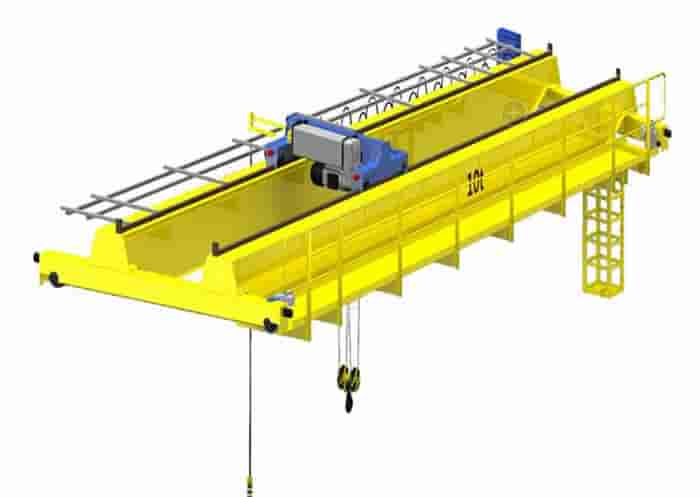
The main girder is welded from steel plates, with the web cut into an arched shape, providing excellent strength, rigidity, and stability. During the manufacturing process, we strictly adhere to relevant standards for welding, inspection, and non-destructive testing to ensure the quality and safety of the main girder.
The end beam adopts a European modular design, featuring low weight and compact size. It consists of a box beam, bearing housing, spherical bearings, wheels, buffer blocks, connecting plates, and track-cleaning plates, ensuring its strength and stability. The end beam is also equipped with an anti-derailment device and buffer blocks to effectively prevent wheel derailment and collision impact.
The main beam and end beams are connected using 10.9-grade high-strength bolts with anti-loosening nuts to ensure a secure and strong connection. Torque markings are also posted for easy installation and maintenance.
The trolley track is constructed of square steel to increase the effective contact area between the wheel tread and reduce the track’s deadweight. The square steel track must be of grade no less than Q345B and must be of excellent straightness and weld quality. Defects such as weld deformation are not permitted.
The operator cab features an enclosed, space-capsule-style, all-view structure with a see-through window panel at the bottom. Doors and windows are constructed of high-quality materials, ensuring operator comfort and safety.
In summary, the technical design of this European-style crane fully considers multiple aspects, including design implementation standards, overall structure, and bridge design, ensuring the crane’s safety, reliability, and efficiency.
Contact our crane specialists
Send us a message and we will get back to you as soon as possible.