Metallurgical and casting cranes are essential, critical equipment in the modern metallurgical industry. Their performance and safety are directly linked to production efficiency and personnel safety. In recent years, with the continuous advancement of industrial technology and increasingly stringent safety production requirements, deficiencies in the braking systems and rope structures of traditional metallurgical cranes have become increasingly apparent. To improve crane braking reliability and load-bearing capacity, and reduce safety hazards, dual-brake and dual-rope modifications have become a hot topic within the industry. This modification aims to provide multiple safety features for the crane by increasing braking system redundancy and employing a dual-rope winding system, ensuring stable and safe operation even under extreme operating conditions. This article will delve into the specific solutions, implementation process, and results of dual-brake and dual-rope modifications for metallurgical and casting cranes, aiming to provide a reference for related companies upgrading their equipment.
As essential and critical equipment in industrial production, metallurgical and casting cranes perform heavy lifting and handling, playing a key role in ensuring smooth production processes and improving efficiency. However, in real-world applications, many metallurgical cranes face a series of pressing challenges, particularly in complying with current stringent metallurgical safety production standards. Among these, the most prominent issues are the design of the braking system and rope winding method.
Existing metallurgical cranes are typically equipped with a traditional single brake system, which is inadequate for the complex operating conditions and frequent load fluctuations found in metallurgical environments. Due to the limited braking capacity of a single brake system and the lack of necessary redundancy, the consequences of brake failure can be severe, potentially causing the crane to lose control and posing a serious threat to surrounding personnel and equipment, increasing safety risks.
At the same time, the traditional single-rope winding method also presents significant problems. This severely limits crane operating efficiency, especially when handling large and heavy materials. The increased pressure on the single rope makes it susceptible to wear and breakage, impacting the crane’s service life and stability. Furthermore, the single-rope winding method can cause unnecessary shaking and oscillation during crane operation, further reducing operating accuracy and efficiency.
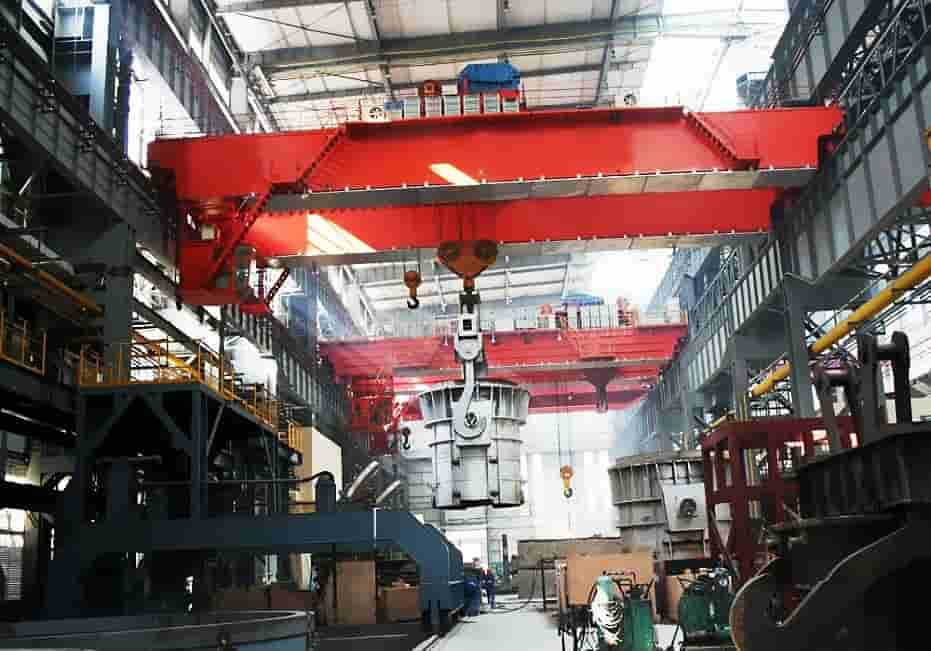
To address these issues, dual-brake and dual-rope retrofits are particularly necessary. The introduction of a dual-brake system can significantly improve the safety performance of metallurgical casting cranes. Compared to traditional single-brake systems, dual-brake systems offer stronger braking capacity and more stable braking. Even in the face of sudden or emergency situations, such as power outages or unexpected load increases, the dual-brake system ensures the crane comes to a smooth and rapid stop, effectively reducing the possibility of accidents.
The dual-rope winding system improves the overall performance of metallurgical casting cranes in another way. By adopting a dual-rope winding system, the load pressure of a single rope is significantly shared. This not only means the crane can handle greater loads during lifting tasks, but also effectively reduces the risk of rope wear and breakage, significantly extending the rope’s lifespan and overall reliability. Furthermore, the dual-rope winding system effectively reduces crane shake and sway during operation, improving operational precision and stability. This is undoubtedly of great significance for improving the overall efficiency and product quality of metallurgical casting production lines.
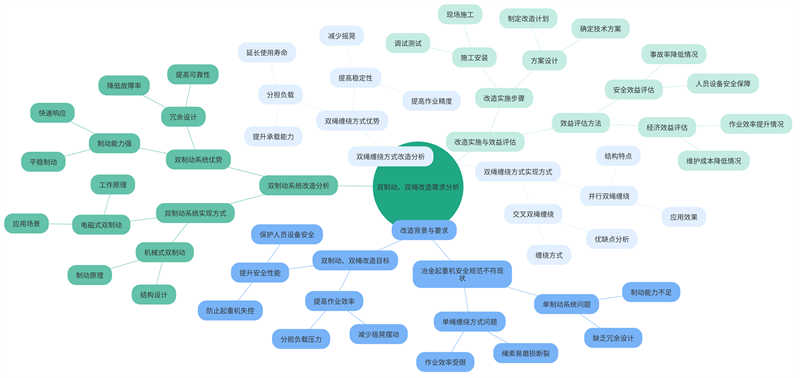
Dual brake systems play a crucial role in the safety of heavy equipment such as cranes. They typically consist of two core components: the service brake and the safety brake. The service brake, such as a hydraulic brake, electromagnetic brake, or hydraulic clutch, is responsible for daily lifting, lowering, and moving operations, ensuring stable operation of the crane under various operating conditions. The safety brake, on the other hand, serves as an emergency backup system, rapidly activated upon detecting an abnormality or malfunction, effectively preventing serious accidents such as crane loss of control or a fall. The two work together to jointly perform the braking task of the crane, ensuring its safety and stability.
Retrofitting the service brake is a key step in upgrading the dual brake system. The goal is to enhance braking performance and reliability through technological upgrades and material optimization. First, internationally advanced braking technologies and materials are introduced, such as high-performance brake pads and ceramic fiber composites. These new materials not only increase the friction coefficient of the brake, ensuring stable braking performance, but also effectively improve wear resistance, significantly extending the service life of the service brake. Second, the structural design of the service brake is deeply optimized. Through precise mechanical analysis and structural simulation, key components such as the brake arm, hydraulic cylinder, and spring are optimized and improved to ensure stable operation of the service brake under various operating conditions, such as heavy loads, rapid speeds, and continuous operation, reducing the probability of failure due to mechanical wear or overload.
Safety brake configuration is equally crucial. Select the appropriate safety brake model and specifications based on the crane’s specific parameters and operating environment, such as rated load, operating speed, and ambient operating temperature. Ensure that the safety brake can quickly and accurately activate in an emergency, effectively preventing the crane from losing control. Furthermore, the safety brake’s reliability and durability should be considered to ensure stable performance over long-term use.
Electrical control and device modification is key to ensuring stable operation of the dual-brake system. First, optimize the design and layout of the electrical control circuit to improve the control system’s response speed and stability. Use advanced PLC programmable controllers or intelligent control systems to achieve precise control and monitoring of the dual-brake system. Second, introduce advanced sensors and detection technologies to monitor the brake’s operating status and performance parameters in real time. For example, pressure sensors are used to monitor pressure changes in the hydraulic system, and temperature sensors are used to detect the temperature of the brakes. Through real-time monitoring and data analysis, potential faults can be discovered and addressed in a timely manner, improving the reliability and safety of the dual braking system.
For a 65t metallurgical crane, retrofitting the double-rope winding system is a critical project involving both safety and efficiency. When choosing ropes, we recommend using high-strength, highly wear-resistant fiber rope or wire rope, such as aircraft-grade stainless steel fiber rope or specialized high-strength steel wire rope, to ensure optimal performance and longevity despite heavy loads and frequent friction. These materials offer not only high tensile strength but also excellent wear resistance, making them suitable for the demanding operating environments of metallurgical cranes.
When designing the winding system, it is important to ensure that the two ropes evenly share the load. Traditional single-rope winding methods can overload a single rope and accelerate wear. Therefore, we have developed a novel double-rope cross-winding system, in which the two ropes are arranged in a cross pattern on the drum, alternating between the lifting and lowering operations of the crane. This design effectively balances the load, preventing excessive stress on a single rope, thereby extending the service life of the entire system.
To ensure stable operation of the double-rope winding system, precise rope tension balance is essential. This means that during crane operation, regardless of load size or lifting motion, both ropes must maintain consistent tension. This prevents rope jumps and oscillations caused by tension differences, ensuring smooth crane operation. Installing a tension sensor and integrating it with an advanced control system allows for real-time monitoring and automatic adjustment to maintain optimal tension.
Although a 16t metallurgical crane has a relatively small rated load capacity, the ropes are still subject to severe wear and fatigue from frequent lifting and lowering operations. Therefore, retrofitting the double rope winding system is equally important and necessary. During the retrofit process, high-quality rope materials must be selected and a suitable winding method must be designed. Ease of rope replacement and maintenance must also be considered to ensure continuous and stable crane operation.
To meet user demands for efficient, stable, and long-lasting cranes, we have developed a double rope winding system retrofit solution for 16t metallurgical cranes. When selecting ropes, we recommend high-end materials such as imported ultra-high-strength fiber rope or specially heat-treated alloy steel wire rope. These materials can not only withstand extreme tensile loads but also exhibit excellent wear and fatigue resistance, maintaining stable performance even under harsh operating conditions.
To ensure that the two ropes evenly share the load and avoid the risk of damage caused by overloading a single rope, we will design an innovative dual-rope independent control system. This system utilizes a precise mechanical structure and intelligent sensors to independently tension and regulate the two ropes, ensuring optimal load distribution under all operating conditions. Advanced lubrication and dust control devices are also employed to reduce frictional losses and maintain stable system operation.
Maintenance convenience is a crucial aspect of the renovation process. We will implement a dedicated human-machine interface and a comprehensive fault diagnosis system, displaying key operating parameters of the dual-rope winding system, such as tension and wear, in real time. Remote monitoring capabilities will also be provided to enable maintenance personnel to immediately understand the equipment’s operating status, accurately identify potential issues, and promptly address them. Furthermore, the layout design will be optimized to reduce maintenance costs and extend rope life.
Table: Comparison of 65t and 16t crane modification details
| Renovation details | 65t metallurgical crane | 16t metallurgical crane |
| Rope material | High-strength, high-wear-resistant fiber rope or wire rope | Imported ultra-high strength fiber rope or special heat-treated alloy steel wire rope |
| Winding method | Double rope cross-wrapped system, alternately bearing the load | Dual rope independent control system for precise load distribution |
| Tension balance | Install tension sensor to automatically adjust tension | Mechanical structure combined with intelligent sensor for independent tensioning control |
| Wear resistance | Adapt to high-intensity working environment | Withstands extreme tensile loads and has anti-fatigue properties |
| Lubrication and dust prevention | Not mentioned | Adopt advanced lubrication system and dust prevention device |
| Maintenance convenience | Not mentioned | Human-computer interaction interface, fault diagnosis system, remote monitoring |
Table: Comparison of additional functions of 65t and 16t crane modifications
| Additional Features | 65t metallurgical crane | 16t metallurgical crane |
| Real-time monitoring | Possible tension sensor monitoring | Real-time display of double rope winding system operating parameters |
| Control system | Advanced control systems | Smart sensors combined with precise mechanical structure |
| Troubleshooting | Not mentioned | Complete fault diagnosis system |
| Remote Monitoring | Not mentioned | Equipped with remote monitoring function |
| Maintenance costs | Not directly mentioned | Optimize layout design and reduce maintenance costs |
| Extended lifespan | Balanced load, extended service life | Reduce friction loss and maintain stable operation |
Before officially commencing renovation construction, thorough and comprehensive preparation is essential to ensure the entire renovation process is carried out safely, orderly, and efficiently. The primary task is to develop a detailed construction plan and schedule. This plan should detail each construction step, required materials, staffing, timelines, and other details, and anticipate potential problems and response strategies based on the actual situation. Furthermore, according to the design and construction plans, all necessary construction materials and tools, including various building materials, construction machinery, and electrical equipment, should be prepared in advance, ensuring that their quality meets national standards and project requirements. Personnel involved in the construction should receive systematic training and safety education to familiarize them with construction procedures, operating procedures, and various safety regulations and systems, enhancing their safety awareness and emergency response capabilities.
During the renovation construction process, strict process management must be implemented. A professional project management team should be established to track and monitor the construction progress throughout the entire process, ensuring that all projects proceed in an orderly manner according to the established timelines. This team should also strictly control construction quality to prevent quality issues caused by negligence or improper operation. Establish and implement a comprehensive set of construction specifications and standards, covering every stage from pre-construction design, budgeting, and bidding to material usage, construction techniques, and process integration during construction. This ensures that every construction activity has clear procedures and a solid basis for implementation. Furthermore, prioritize safety management at the construction site, regularly conduct safety hazard inspections, and promptly identify and address potential safety risks to create a safe and harmonious construction environment.
To ensure the safety of personnel and equipment during renovation construction, a comprehensive and detailed safety measure must be implemented. Prominent safety warning signs and slogans, such as “Attention Safety” and “Keep Out of Danger Area,” should be placed in prominent locations on the construction site to alert passersby and construction workers. Furthermore, based on construction needs and risk assessment results, sufficient quantities and types of personal protective equipment (PPE), such as hard hats, safety glasses, gloves, and masks, should be provided, and construction workers should ensure their proper use and proper wearing. Establish a comprehensive regular safety inspection system to regularly inspect and maintain mechanical equipment, electrical equipment, scaffolding, and other equipment on the construction site to ensure they are in good operating condition and free of safety hazards. Develop a detailed emergency plan for possible accidents or emergencies. The plan should include emergency organization structure, emergency contact information, emergency handling procedures, etc., to ensure that a quick response and effective countermeasures can be taken in an emergency to protect the safety of personnel and equipment.
After completing a crane modification, a crucial step is to conduct a static load test. This test aims to rigorously verify the crane’s stability and load-bearing capacity by simulating actual load conditions. During the test, loads are gradually applied to various crane components, including but not limited to the main beam, end beams, and operating mechanisms, according to preset load weights. This allows technicians to comprehensively observe and analyze the crane’s performance under static loads, ensuring that it maintains stable operation without abnormal vibration or deformation.
Dynamic load tests focus more on verifying the crane’s performance during actual operation. Unlike static load tests, dynamic tests simulate crane operations under various operating conditions, including lifting, lowering, and moving movements. Through professional operation and monitoring, the crane’s accuracy and stability in executing these maneuvers are evaluated. Furthermore, the braking system’s response time and effectiveness are key monitoring features during dynamic load tests. During the test, the braking system’s operating status must be closely monitored to ensure its rapid response in emergency situations, effectively protecting operator safety and the integrity of the equipment. Braking System Performance Testing
Braking system performance testing is a critical step in ensuring safe crane operation. By testing parameters such as braking torque, braking distance, and braking time, we comprehensively assess the performance and reliability of the braking system. Braking system performance testing requires specialized testing equipment and tools, performed in accordance with established testing procedures and standards. By analyzing the test results, we can determine the performance level of the braking system and identify any issues that may arise, enabling improvements and optimization. This ensures that the braking system maintains stable operating conditions under various operating conditions, providing a strong guarantee for safe crane operation.
Table: Performance test indicators and results after transformation
| Test items | Test indicators | Test Method | Test results |
| Static load test | Stability | Simulate load conditions under actual working conditions | No abnormal vibration and deformation |
| Carrying capacity | Gradually apply loads to crane components | Meet the preset load requirements | |
| Dynamic load test | Movement accuracy | Simulate the operation process of the crane under different working conditions | Accurate movement without deviation |
| Stability | Operate and monitor crane movements | Smooth operation without abnormalities | |
| Braking system response time | Emergency brake test | _ seconds (specific test data required) | |
| Braking effect | Braking system working status monitoring | Effective braking to ensure safety | |
| Braking system performance test | Braking torque | Use professional testing equipment and tools | _ Nm (specific test data required) |
| Braking distance | Follow established testing procedures and standards | _ meters (specific test data required) | |
| Braking time | Analyze test results | _ seconds (specific test data required) |
After undergoing the dual-brake and dual-rope retrofit, the metallurgical casting crane demonstrated significant improvements in safety and operational efficiency. Specifically, the retrofitted crane utilizes advanced dual-brake technology, significantly improving braking response speed. This ensures the crane can quickly, accurately, and stably stop in emergency situations, effectively reducing the risk of accidents. This improvement is crucial for ensuring production site safety and equipment integrity. The introduction of a dual-rope winding system not only enhances the crane’s overall stability but also extends its service life. In practical application, the redundant dual-rope design provides the crane with improved balance and vibration resistance when carrying heavy loads, resulting in smoother and more reliable operation. Furthermore, the dual-rope system effectively distributes rope wear, extending its service life and further reducing maintenance costs. In actual operation, the metallurgical casting crane, after undergoing the dual-brake and dual-rope retrofit, demonstrated increased efficiency and enhanced stability. This not only meets the requirements of modern industrial production for efficient and stable equipment operation, but also demonstrates the significance of the retrofit in improving the overall technical level of the metallurgical casting industry.
During this dual-brake and dual-rope retrofit on a metallurgical and casting crane, we accumulated extensive practical experience and technical insights. Regarding brake selection, we deeply understood the importance of using advanced braking technology and materials to improve braking performance. For example, selecting high-performance friction materials and advanced hydraulic systems can significantly enhance braking efficiency and reliability. In designing the dual-rope winding system, we focused on exploring optimal winding paths and optimizing tension balance strategies to ensure smooth crane operation and minimize wear differences between the ropes. Through these practical explorations and technological innovations, we successfully improved the overall performance and service life of the metallurgical and casting crane. However, we also identified some deficiencies during the retrofit process. For example, in the electrical control and device upgrades, the performance of some sensors and detection technologies needs improvement. To further enhance the intelligence and safety of the crane, we recommend strengthening technological innovation and R&D efforts in future retrofits. By continuously optimizing retrofit plans and technical approaches, we can further enhance the performance and safety of metallurgical and casting cranes, providing strong support for the sustainable development of related industries. Subsequent Maintenance and Care Recommendations
To ensure the continuous, stable operation and optimal performance of metallurgical casting cranes modified with dual brakes and dual ropes, enhanced ongoing maintenance and care are essential. Specifically, a strict regular inspection system should be established and implemented, including but not limited to meticulous inspection of the brakes, wear assessment of ropes and key components, and timely replacement of severely worn parts. Furthermore, mechanical components should be regularly cleaned and lubricated to reduce wear and maintain optimal operating condition. Furthermore, a comprehensive maintenance record and management system should be established to standardize and manage maintenance processes. This system should record the details of each maintenance session, information on component replacements, and service life analysis. This data should be compiled, collated, and analyzed to improve maintenance plans and enhance equipment lifespan and reliability. Furthermore, enhanced professional training and education for operators is essential. Improving operators’ operational skills and safety awareness, fostering good operating habits, and fostering a deep understanding of equipment performance will help reduce the possibility of safety incidents caused by misoperation and provide a strong guarantee for the long-term, stable operation of the crane.
Contact our crane specialists
Send us a message and we will get back to you as soon as possible.