As indispensable large-scale lifting equipment in modern industrial production and heavy equipment manufacturing, the installation construction process of gantry cranes is directly related to the safety and performance of the equipment. Traditional segmented installation methods can no longer meet the requirements for efficient and precise installation of ultra-large tonnage gantry cranes, hence the integrated lifting construction method has emerged. This article comprehensively elaborates on the technical principles, process flow, control points, and application value of the 900-ton gantry crane integrated lifting construction method. Starting from precise pre-construction preparation and foundation treatment, the article details the design and installation of the tower system, the core role of the hydraulic synchronous lifting system, the process control during the integrated lift, and finally the entire process of precise positioning and final fixation inspection. Furthermore, it delves into the technical advantages, safety and quality control measures, and the application adaptability of this method in different engineering environments, providing a scientific and reliable technical reference for the installation of large lifting equipment.
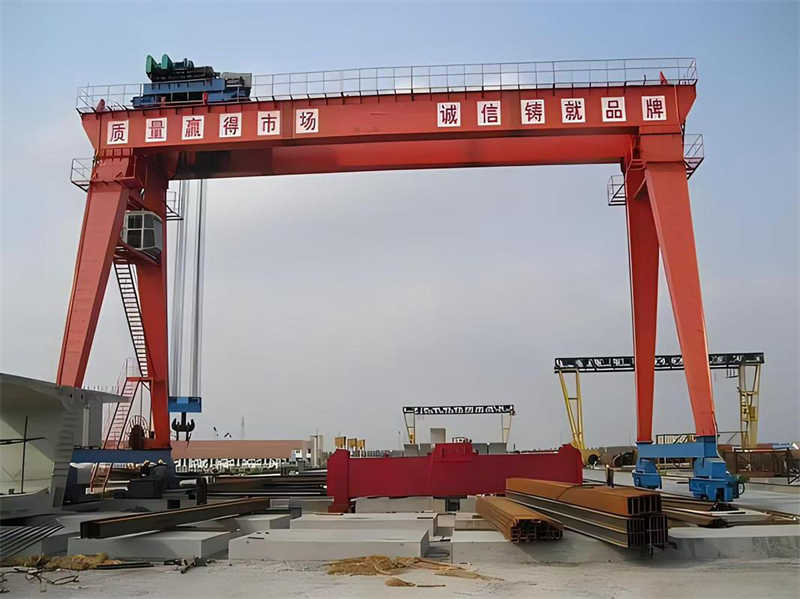
The 900-ton gantry crane integrated lifting construction method represents an advanced level of technology in the field of large lifting equipment installation. It fundamentally changes the traditional “bottom-up” segmented assembly model, innovatively adopting the concept of “ground assembly, integrated lifting.” Utilizing a computer-controlled hydraulic synchronous lifting system, it lifts the crane structure, weighing thousands of tons, to its design position in a single operation. This method not only improves installation efficiency but also significantly reduces the risks associated with working at height, ensuring installation accuracy and quality.
Traditional gantry crane installation methods typically employ a “building block” construction sequence: first installing the leg structures, then using the legs as supports to hoist the main girder segment by segment. This approach has several drawbacks: on one hand, it requires extensive assembly work at height, posing high safety risks; on the other hand, when installing the rigid leg, it often needs to be temporarily used as a mast. However, because its bottom support is the travel wheel structure, controlling its stress and displacement is extremely difficult, and safety hazards are particularly prominent during luffing operations. In contrast, the integrated lifting method completes most assembly work on the ground, reducing work-at-height tasks by over 80%, significantly enhancing construction safety.
The core technology of the integrated lifting method lies in the coordinated operation of the hydraulic synchronous lifting system and the tower support system. The hydraulic synchronous lifting system typically consists of hydraulic power units, clusters of lifting cylinders, a sensor network, and a computer control system, using flexible steel strands for load bearing. This system can precisely control synchronous lifting at multiple points, with lifting capacities reaching 900 tons or even higher. In practical applications, a shipyard successfully used a 3000-ton gantry tower frame and computer-controlled hydraulic synchronous integrated lifting technology to install a crane with a total mass of 2800 tons, demonstrating the reliability and powerful load capacity of this technology.
The Tower Support System is another key element of the integrated lifting method. The dedicated lifting tower provides a stable support foundation for the entire lifting process. Compared to traditional methods that use the crane’s own structure for support, the dedicated tower has clear load paths, stable structure, and allows for precise calculation and control. The tower system is usually composed of standard sections, allowing for height and configuration adjustments based on the crane’s size and weight, offering excellent adaptability. During the lifting process, the cluster of hydraulic cylinders, controlled by computer synchronization, climbs orderly along the tower, pulling the steel strands to steadily lift the entire crane.
Synchronous Control Technology is key to ensuring the success of the integrated lift. Modern integrated lifting systems use multiple sensors to monitor the position and height difference of each lifting point in real time. The computer control system continuously adjusts the output force of each cylinder based on sensor feedback, ensuring that the height difference between points remains within the allowable range during lifting. This precise synchronous control effectively avoids structural deformation and the generation of additional stress, ensuring the structural integrity of the crane and its performance after installation.
Table: Comparative Analysis of Traditional Method vs. Integrated Lifting Method
| Comparison Item | Traditional Segmented Installation Method | Integrated Lifting Method |
|---|---|---|
| Installation Sequence | Bottom-up segmented assembly | Ground assembly followed by single lift |
| Work-at-Height Volume | Extensive assembly work at height | Only minimal connection work at height required |
| Construction Period | Longer, greatly affected by weather | Reduced by over 30%, ground work less affected by weather |
| Installation Accuracy | Significant cumulative error | High precision from ground measurement and adjustment |
| Safety Risk | High risk from work at height, poor stability | Risks concentrated on ground, stable lifting process |
The applicable scope of the integrated lifting construction method is wide, especially suitable for the installation of large-tonnage, large-span gantry cranes. For large gantry cranes of 900-ton class and above, the integrated lifting method is almost the only safe and economical choice. This method has certain requirements for site conditions, needing sufficient assembly space and bearing capacity, but in modern engineering construction, these conditions can usually be met. With the continuous advancement of hydraulic synchronous lifting technology and the improvement of computer control precision, the integrated lifting method will play an increasingly important role in the field of large lifting equipment installation.
“Meticulous preparation is the cornerstone of success.” In the integrated lifting of a 900-ton gantry crane, comprehensive and detailed preparatory work is the foundation for ensuring the smooth progress of the project. Pre-construction preparation involves not only conventional personnel organization and equipment allocation but also requires precise design review, site planning, and foundation quality inspection tailored to the specific requirements of the integrated lifting process. These tasks are directly related to the safety and accuracy of the subsequent lifting process.
Design Review and Construction Planning are the primary steps in preliminary preparation. The construction team needs to organize technical personnel to thoroughly review the crane design drawings and installation technical requirements, focusing on key parameters such as main girder structural dimensions, weight distribution, and lifting point positions, as these data will directly affect the configuration of the lifting system and tower design. According to a case study of a large gantry crane construction, the contractor must strictly follow national standards such as “Crane Design Code” GB3811 and “Code for Construction and Acceptance of Crane Equipment Installation Engineering” GB50278 for technical preparation, while also preparing detailed construction organization design based on the actual site conditions. During the design review process, special attention must be paid to the calculation of the crane’s center of gravity, as this relates to the control of structural stability during lifting. Simultaneously, based on the design drawings and site conditions, the layout position of the lifting towers and foundation requirements should be determined, and detailed construction layout drawings should be drafted, dividing functional areas such as material storage areas, component assembly areas, and main girder assembly areas.
Site Preparation is a key prerequisite for the integrated lifting method. The integrated lifting of a 900-ton gantry crane requires a large, flat area for ground assembly. The site dimensions should be at least 10 meters longer than the crane’s main girder length and 10 meters wider than its span to facilitate component transportation and assembly operations. The site levelness error should be controlled within ±10mm, and drainage slopes should be set to prevent water accumulation. Typically, the site bearing capacity is required to be above 15t/m². In site preparation, access routes and working positions for large cranes must also be planned to ensure that large components like the main girder and legs can be smoothly hoisted to the assembly platform. In one project, the contractor specifically emphasized compacting the site and laying steel plates to distribute the load evenly, avoiding local settlement affecting assembly accuracy.
Foundation Construction and Acceptance are the safety guarantees for the integrated lift. The foundations for the gantry crane include both the leg foundations and the lifting tower foundations. These must be constructed strictly according to the design drawings to ensure accurate dimensions, elevations, and embedded part positions. After the foundation concrete is poured, sufficient curing is required, and loading can only begin after the design strength is reached. Before lifting, final acceptance of the foundations must be conducted. Inspection items include: foundation axis position deviation (≤5mm), elevation deviation (±3mm), position deviation of embedded anchor bolts (≤2mm), and concrete strength report (reaching 100% of design strength). It is particularly noteworthy that the lifting tower foundations need to consider the impact of dynamic loads, typically requiring a 20% higher safety factor than static load calculations to cope with potential load imbalances during the lifting process.
Construction Equipment and Personnel Preparation are the basic conditions for project implementation. The 900-ton gantry crane integrated lifting operation requires the configuration of various large equipment, including but not limited to: hydraulic synchronous lifting system (including cylinder clusters, power units, and control system), tower system, large-tonnage cranes (for ground assembly), high-precision measuring instruments, etc. All equipment must be checked for integrity before entering the site, especially the hydraulic lifting system, which requires no-load and load tests to ensure parameters like pressure and synchronization accuracy meet design requirements. In terms of personnel, a professional construction team needs to be formed, including mechanical engineers, hydraulic engineers, riggers, surveyors, and other special trades. All operators must be certified and receive detailed technical briefings and safety training. One project report specifically mentioned that special training was conducted for hydraulic system operators and measurement monitoring personnel for two weeks to ensure familiarity with system operating procedures and emergency measures.
Technical Verification Before Construction is an important means of risk control. Before the formal lift, small-scale model tests or computer simulation analyses should be conducted to verify the feasibility of the lifting scheme. In modern engineering practice, BIM technology is often used to create 3D models to simulate the entire lifting process and check for potential interference issues or uneven force distribution. Simultaneously, expert review panels should be organized to evaluate the construction scheme, particularly conducting detailed calculations and analyses on tower stability, structural strength, and wind load effects to ensure sufficient safety margins under various working conditions. According to the installation experience of a 2800-ton gantry crane at a shipyard, multiple simulation calculations and expert demonstrations were conducted before the lift, with special discussions on emergency measures for when wind force exceeds level 6. This rigorous approach is key to ensuring the success of large-scale lifting operations.
Table: Pre-Lift Checklist for 900-ton Gantry Crane
| Inspection Category | Key Inspection Items | Permissible Deviation | Inspection Method |
|---|---|---|---|
| Foundation Works | Axis Position | ≤5mm | Total Station Measurement |
| Elevation | ±3mm | Level Gauge Measurement | |
| Embedded Part Position | ≤2mm | Steel Tape Check | |
| Structure Assembly | Main Girder Straightness | ≤L/5000 and ≤10mm | Wire Line Measurement |
| Leg Verticality | ≤H/3000 and ≤5mm | Theodolite Measurement | |
| High-Strength Bolt Torque | ±3% of Design Value | Torque Wrench Check | |
| Lifting System | Hydraulic System Pressure | ±5% of Set Value | Pressure Gauge Reading |
| Sensor Accuracy | ±0.1% FS | Standard Weight Test | |
| Steel Strand Integrity | No broken wires, rust | Visual Inspection |
The quality of pre-construction preparatory work directly determines the smoothness of the integrated lifting construction. Through strict design review, precise site preparation, solid foundation construction, complete equipment and personnel configuration, and rigorous technical verification, a solid foundation can be laid for the integrated lifting of the 900-ton gantry crane, effectively mitigating potential risks and ensuring the safe and precise completion of this high-difficulty lifting operation. In practical engineering applications, these preparatory tasks often take up 30%-40% of the entire project cycle but are a crucial guarantee for the smooth progress of subsequent lifting operations.
The tower system and the rational configuration of hydraulic lifting equipment are the core links to ensure the safe and stable lifting of the crane. Their design and installation precision directly determine the success or failure of the integrated lift. This section will detail the structural characteristics of the tower system, the technical parameters of the hydraulic lifting equipment, and their collaborative working mechanism.
The Lifting Tower System is the load-bearing core of the integrated lifting process. Its design must meet strength and stiffness requirements under extreme load conditions. For the integrated lifting of a 900-ton class gantry crane, a dual-tower configuration is typically used. The tower height is determined based on the designed height of the crane legs, generally 3-5 meters higher than the positioning point to allow sufficient lifting space. The tower structure often adopts a space truss or lattice design, composed of standard sections connected by high-strength bolts, facilitating height adjustment to adapt to different project needs. In one shipyard’s installation of a 2800-ton gantry crane, a 3000-ton class gantry tower system was used, with tower column cross-sections reaching 3m×3m and individual standard section lengths of 6m, ensuring connection hole consistency through precision machining. The top of the tower is equipped with a lifting beam for installing the hydraulic lifting cylinders. The beam design must consider load distribution when multiple cylinders work together, often optimized using finite element analysis to ensure uniform stress distribution. The tower base is connected to the foundation via anchor bolts and is equipped with shear keys to resist horizontal loads. The diameter of anchor bolts embedded in the foundation concrete is usually not less than 36mm, with an embedment depth of not less than 25 times the diameter.
The Hydraulic Synchronous Lifting System is the “muscle and nerves” of the integrated lifting method, providing precisely controlled lifting power. This system mainly consists of four parts: hydraulic power units, clusters of lifting cylinders, a sensor network, and a computer control system. The lifting cylinders use center-hole hydraulic jacks, bearing the load through flexible steel strands. The rated lifting capacity of a single jack is typically 200-500 tons. The number of cylinders is determined based on the total lifting weight; a 900-ton crane generally requires 4-8 lifting cylinders. It is important to note that the actual usable load capacity of hydraulic jacks must consider a safety factor; the reduction factor for center-hole hydraulic jacks is generally 0.5-0.6. The hydraulic power unit provides power for the system, employing redundant design, typically with main and backup pump sets to ensure that a single failure does not affect normal system operation. The sensor network includes displacement sensors, pressure sensors, and tilt sensors, etc., monitoring the height, load, and structural attitude of each lifting point in real time. The sampling frequency is not less than 10Hz, with a measurement accuracy of 0.1mm.
The Computer Synchronous Control System acts as the “brain” of the entire lifting process, responsible for processing sensor data and issuing control commands. Modern hydraulic synchronous lifting systems use a distributed control architecture, consisting of a master computer, field controllers, and remote monitoring terminals. The master computer runs dedicated control software, adjusting the oil pressure and flow of each cylinder based on preset lifting curves and real-time feedback data through PID algorithms to achieve precise synchronization at multiple points. The synchronization accuracy of the control system is typically controlled so that the height difference between adjacent lifting points does not exceed 25mm. In one engineering project, the control system used a triple-redundant design; when any sensor or control channel malfunctioned, the system could automatically switch to the backup channel and alarm, greatly enhancing system reliability.
The Steel Strand Load-Bearing System is the link connecting the hydraulic cylinders and the crane structure, and its safety factor is directly related to lifting safety. The lifting steel strands use high-strength, low-relaxation prestressed steel strands with a standard tensile strength of not less than 1860 MPa, a single diameter of 15.2-17.8mm, and a single breaking force of 260-320 kN. Each lifting cylinder is configured with multiple strands (typically 6-19) to form a load-bearing bundle, connected to the crane’s lifting points via special anchors. The safety factor for the steel strands is not less than 3.5, and they must undergo strict inspection for defects before use, ensuring no broken wires, rust, or other flaws. During installation, special attention must be paid to arranging and guiding the strands to prevent twisting and mutual friction, usually protected using separator plates and rubber pads. In one large lifting project, the contractor specially designed a steel strand tension equalization device to ensure even force distribution among the strands and avoid overloading of any single strand.
The Tower Stability Auxiliary System ensures the safety of the lifting process, including wind-resistant cables, horizontal bracing beams, and temporary supports. When the tower height exceeds 30 meters, a cable system is usually required, using steel wire ropes with a diameter not less than 18mm, forming a 30°-45° angle with the ground, tensioned via lever hoists or hydraulic tensioners. For dual-tower systems, horizontal connecting beams are set between the two towers to improve overall stability, with the beam spacing generally not exceeding 1/3 of the tower height. In particularly important projects, GPS or total station monitoring systems are also installed on the sides of the towers to monitor the displacement of the tower top in real time, ensuring that tower deformation remains within the allowable range under wind or other干扰因素 (disturbance factors).
The Lifting Equipment Layout Plan needs to be carefully designed according to the structural characteristics of the crane and site conditions. A typical 900-ton gantry crane integrated lift usually sets 4 main lifting points, located at the upper and lower ends of the two legs respectively, with each lifting point configured with 1-2 lifting cylinders. The lifting point positions need to be determined through calculation to ensure reasonable internal force distribution in the crane structure during lifting without causing excessive deformation. In one engineering case, technicians optimized the lifting point positions through finite element analysis, controlling the maximum lifting stress in the main girder to within 70% of the design allowable value. The towers are placed outside the crane legs, generally 3-5 meters from the leg centerline, leaving sufficient operating space. After all lifting equipment is installed, no-load linkage debugging and load tests must be conducted to verify the reliability of the system’s collaborative operation.
The rational configuration of the tower system and lifting equipment is key to the success of the 900-ton gantry crane integrated lift. Through scientific tower design, precise hydraulic control, reliable steel strand load-bearing, and comprehensive stability measures, strong technical support is provided for the safe lifting of heavy cranes. In practical engineering applications, the design and installation of these systems often require the collaborative work of a multidisciplinary team, continuously optimized based on site conditions, to achieve the best lifting results.
The quality of ground assembly directly determines the smoothness of the lifting process and the final installation accuracy. In the integrated lifting method for the 900-ton gantry crane, this process stage completes the assembly of the massive crane structure mostly on the ground. Through precise measurement and adjustment, the crane reaches a near-ideal state before lifting, significantly reducing the difficulty and risk of working at height.
Ground Assembly of the Main Girder is a key preliminary step in the integrated lifting method, where precision control is particularly important. As the core load-bearing component of the gantry crane, the assembly quality of the main girder directly affects the equipment’s subsequent performance. The construction process is typically divided into three stages: segment positioning, precise adjustment, and final welding/bolting. First, large crawler cranes are used to hoist the main girder segments onto the assembly platform, arranged according to the design sequence. Temporary support points are spaced no more than 15 meters apart, with adjustable support heights for subsequent adjustments. After positioning, preliminary connections are made, with bolt preload reaching 50% of the design value. Then comes the fine adjustment stage, using instruments like total stations and levels to measure key parameters of the main girder, such as straightness, camber, and diagonal difference. Support heights are adjusted until all indicators meet design requirements (typically main girder straightness deviation ≤ L/5000 and ≤10mm, camber deviation ≤10% of design value). After adjustment, final welding or bolting of the main girder is performed. One project specifically emphasized that welding should be performed symmetrically, controlling heat input to reduce welding deformation, with non-destructive testing conducted within 24 hours after welding.
Leg Assembly and Connection is an important环节 (link) to ensure the structural integrity of the crane. The 900-ton gantry crane typically uses one rigid and one flexible leg design, with different structural forms and installation methods for the two. The rigid leg structure is more complex, often containing elevators, cables, and transmission devices inside. Assembly is done layer by layer, checking verticality (deviation ≤ H/1000) and connection quality after completing each section to ensure the overall structure does not deform or shake. The flexible leg mainly consists of a heavier steel structure and lighter rails, primarily bearing vertical and horizontal loads, with relatively lower installation precision requirements. During the ground assembly stage, it is essential to ensure firm connections of all components but also to avoid excessive welding or bolt preload that could cause structural deformation.
After completing ground assembly, overall installation and debugging are required. Utilizing advanced computer simulation technology, the installation position and sequence of various components are precisely calculated to ensure crane installation accuracy and stability. During the lifting process, real-time monitoring and adjustment are also necessary to ensure all parameters meet design requirements.
After installation is complete, rigorous debugging and inspection are conducted. This includes structural stability tests, electrical system tests, hydraulic system tests, etc., to ensure stable and reliable crane performance. Additionally, operators must be trained to ensure they are familiar with operating procedures and precautions, improving equipment usage safety and efficiency.
In summary, the integrated lifting method for the 900-ton gantry crane is a complex and precise task, requiring precise ground assembly as the foundation, and rigorous construction processes and advanced installation technology as guarantees. Only in this way can the crane installation quality and usage performance meet the expected targets.
Contact our crane specialists
Send us a message and we will get back to you as soon as possible.