Home → Gantry crane → Technical Description of Double Girder Gantry Cranes
Technical Description of Double Girder Gantry Cranes
Technical Description of Double Girder Gantry Cranes
The double girder gantry crane, serving as crucial modern industrial material handling equipment, is widely used in ports, freight yards, logistics centers, nuclear power construction, and large-scale engineering projects due to its structural stability, strong load-bearing capacity, and large working range. This article comprehensively describes the technical characteristics of double girder gantry cranes, covering core aspects such as structural design, technical parameters, safety systems, manufacturing standards, and application fields.
I. Overview and Classification
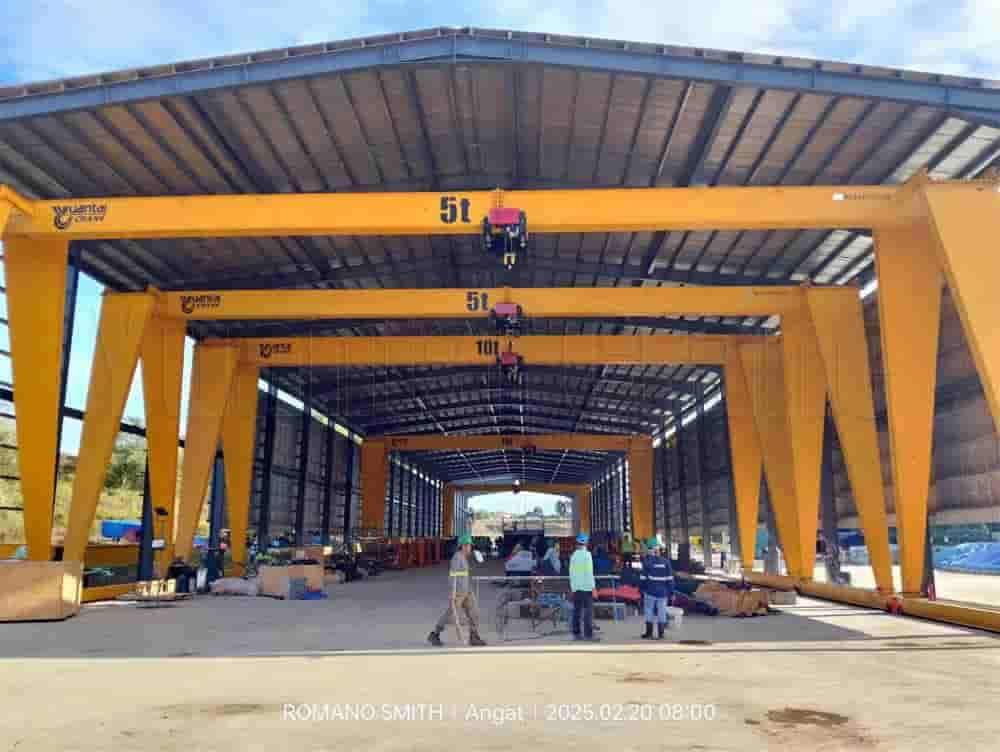
The double girder gantry crane is a variant of the overhead bridge crane, also known as a gantry hoist. Its characteristic feature is two tall legs at both ends of the main girder, which run on ground rails. Compared to the single girder structure, the double girder design offers higher stability and greater lifting capacity, with rated lifting capacities ranging from 10 tons to over 3800 tons.
Based on the overhang of the main girder, double girder gantry cranes can be classified into:
Full Gantry Crane: The main girder has no overhang, and the trolley runs only within the main span.
Cantilever Gantry Crane: The main girder has one or two extending cantilever arms. The double cantilever gantry crane is the most common, featuring reasonable force distribution and high space utilization.
According to differences in the gantry frame structure, they can also be divided into:
Rigid Leg Design: Both legs are rigidly connected to the main girder.
Rigid-Flexible Mixed Design: One side is a rigid leg, and the other is a flexible leg, which can better adapt to track unevenness and thermal deformation.
II. Main Structural Components
1. Gantry Frame System
The gantry frame is the main load-bearing component of the crane, adopting a double girder, double rail structural form. A typical double girder gantry crane consists of two parallel main girders, a rigid leg, and a flexible leg forming the gantry structure. The main frame includes the first support girder, the second support girder, and the cross beam, creating a stable spatial force-bearing system.
2. Main Girder Structure
The main girder, as the core load-bearing component, is crucial in its design:
Structural Form: Primarily eccentric rail box structure or truss structure.
Analysis and Calculation: Systematic analysis using finite element methods like ANSYS to optimize stress distribution.
Material Treatment: Steel structure undergoes SA2.5 grade shot blasting, with a total coating thickness not less than 120μm to improve corrosion resistance.
Performance Indicators: Maximum stress in metal components can reach 150.8 MPa, and mid-span deflection must be strictly controlled to ensure safety.
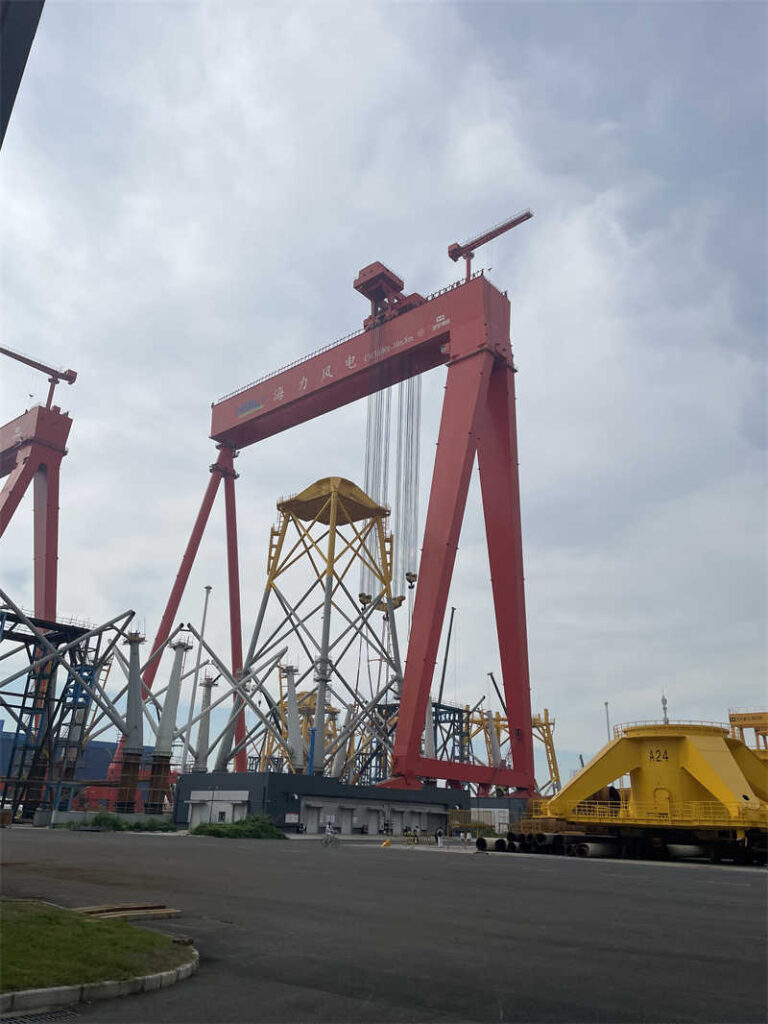
Large double girder gantry cranes, such as the 3600t-106.8m model, use a double main girder, double trolley system. Coordinated operation of the upper and lower trolleys enables heavy components to be turned over in mid-air.
3. Leg Design
The legs support the entire crane structure. Their design features include:
Structural Form: Welded box or truss structure, with a top flange connection.
Configuration: Depending on span and stability requirements, dual rigid legs or a rigid-flexible mixed configuration can be used.
Large Crane Design: For example, a 1600-ton nuclear power gantry crane with a span of 121 meters requires specially reinforced legs.
4. Travel Mechanism
Support Method: Rail-type support, where rails can be installed on a base plate to minimize impact on site traffic.
Drive System: Multi-motor drive ensures smooth operation under high-tonnage loads.
Wind Resistant Design: Large cranes pay special attention to wind resistance capability.
III. Main Technical Parameters
The technical parameters of double girder gantry cranes directly determine their performance and application range:
1. Basic Parameters
Lifting Capacity: Standard models cover 10-100 tons; large specialized equipment can reach 1600 tons, 3600 tons, or even 3800 tons.
Span: Ranges from conventional tens of meters to 121 meters or 107 meters for nuclear power cranes.
Lifting Height: Typically 7-10 meters, with large equipment reaching up to 103 meters or 128 meters.
2. Motion Parameters
Main Hook Speed: 0.5-5 m/min (lower for high-tonnage cranes to ensure safety).
Trolley Travel Speed: 20-40 m/min (varies by model).
Gantry Travel Speed: 30-60 m/min, equipped with variable frequency speed control for smooth starting and stopping.
3. Duty Class
Mechanism Duty Class: A3-A7 (determined based on usage frequency and load conditions).
Overall Duty Class: Typically A5-A6, suitable for medium to heavy-duty usage environments.
Table: Comparison of Technical Parameters for Typical Double Girder Gantry Cranes
Parameter
Standard Model (50t)
Large Model (1600t)
Ultra-Large Model (3600t)
Lifting Capacity
50 tons
1600 tons
3600 tons (dual trolley)
Span
18-35 meters
121 meters
106.8 meters
Lifting Height
7-10 meters
103 meters
128 meters
Main Girder Form
Box Girder
Reinforced Double Girder
Dual Girder Dual Trolley
Application
Freight Yards, Logistics Centers
Nuclear Power Construction
Offshore Wind Power Installation
3600t gantry crane
IV. Safety and Control Systems
Double girder gantry cranes are equipped with multiple safety protection systems to ensure safe and reliable operation:
1. Mechanical Safety Devices
Emergency Braking System: Hydraulic emergency braking device for rapid response.
Buffer Device: Spring buffer device to absorb collision energy.
Overload Protection: Complies with safety technical specifications for overload protection devices of hoisting machinery.
2. Electrical Protection Systems
Limit Switches: Multiple limits set for each direction of motion.
Interlock Devices: Prevent misoperation and dangerous actions.
Emergency Power Off: Quickly cuts off power in emergencies.
3. Advanced Control Technology
Variable Frequency Control: Enables smooth starting/stopping and precise speed regulation.
Synchronization Control: Ensures synchronous operation during coordinated dual trolley work.
Intelligent Monitoring: Real-time monitoring of key parameters like load, stress, and wind speed.
Some models disclose the use of patented technology for a three-tier safety protection system, providing comprehensive protection. Modern large cranes represent the highest global level of safety control technology.
V. Design and Manufacturing Standards
The design and manufacturing of double girder gantry cranes strictly adhere to national and industry standards:
1. Main Standards and Specifications
Design Code: GB3811-2008 “Design Rules for Cranes”.
Safety Regulations: GB6067-85 “Safety Regulations for Cranes”.
Manufacturing and Installation Tolerances: GB10183-88 “Tolerances for the manufacture and track installation of bridge and gantry cranes”.
Test Code: GB5905-86 “Test Code for Cranes”.
2. Quality Control Requirements
Material Selection: High-strength low-alloy structural steel for main load-bearing components.
Welding Process: Full penetration welds, 100% non-destructive testing.
Factory Tests: Include no-load test, static load test (1.25 times rated load), dynamic load test (1.1 times rated load).
Manufacturers must hold a special equipment manufacturing license, and products must pass special equipment supervision inspections. Professional manufacturers have formed serial production capabilities.
VI. Typical Application Fields
Double girder gantry cranes are widely used in various industries due to their advantages:
1. Energy Sector
Nuclear Power Construction: Characterized by strong wind resistance and high operational stability.
Wind Power Installation: Used for lifting large components in offshore wind power projects.
2. Infrastructure Construction
Large-scale Projects: Hoisting heavy prefabricated components, such as in wastewater treatment plant projects.
Ports and Terminals: Loading and unloading containers and bulk cargo.
3. Industrial Manufacturing
Metallurgical Industry: Handling heavy materials in steel plant stockyards and workshops.
Paper Industry: Handling and stacking large paper rolls.
Automobile Manufacturing: Hoisting large stamping parts and molds.
4. Other Fields
Logistics Centers: Loading, unloading, and transferring heavy goods.
Special Operations: Such as mid-air turning of large pieces.
VII. Technological Development Trends
Modern double girder gantry crane technology is developing in the following directions:
1. Ultra-Large Tonnage
Continuous increase in lifting capacity.
Double girder, double trolley systems becoming standard for ultra-large cranes.
2. Intelligent Control
Remote monitoring and fault diagnosis systems.
Automated hoisting path planning.
Anti-sway precise positioning technology.
3. Modular Design
Facilitates transportation and on-site assembly.
Adopted for large cranes used in critical projects.
4. Green and Energy Saving
Energy feedback power systems.
Lightweight design to reduce energy consumption.
Application of environmentally friendly anti-corrosion coatings.
5. Special Environment Adaptation
High wind resistance design.
Anti-corrosion design (e.g., for marine environments).
Special models for low-temperature environments.
VIII. Selection and Usage Considerations
Rational selection and use of double girder gantry cranes require considering the following factors:
1. Key Selection Points
Lifting Capacity: Determine based on the heaviest load, considering future needs and leaving margin.
Span: Determine based on site conditions and operational range.
Duty Class: Match the actual usage frequency and load conditions.
Environmental Conditions: Consider special factors like temperature, humidity, and corrosiveness.
2. Installation Requirements
Track Installation: Must meet tolerance requirements.
Grounding: Proper grounding to prevent electrical faults.
Safety Distance: Maintain sufficient space from surrounding facilities.
3. Operating Regulations
Personnel Qualification: Operators must obtain the “Special Equipment Operator Certificate”.
Daily Inspection: Includes key components like structural members, wire ropes, and brakes.
Maintenance: Regular lubrication, anti-corrosion treatment, and electrical system checks.
4. Safety Precautions
Strictly No Overloading: Use overload protection devices and inspect them regularly.
Wind Protection Measures: Large cranes require special attention to wind speed alarms.
Emergency Preparedness: Familiarize with emergency braking and power-off procedures.
IX. Typical Case Studies
1. 3600t Gantry Crane
Capacity: 3600 tons (dual trolley).
Span: 106.8 meters.
Lifting Height: 128 meters.
Features: Capable of turning 1800-ton components in mid-air.
Application: Lifting large foundations for offshore wind power.
2. 1600t Nuclear Power Gantry Crane
Designation: Noted for its significant capacity in nuclear construction.
Capacity: 1600 tons.
Span: 121 meters.
Lifting Height: 103 meters.
Features: Strong wind resistance and high operational stability.
3. ME Double Girder Crane for Wastewater Plant
Application: Installation of prefabricated bioreactor components.
Advantages: Track installation doesn’t affect site traffic, large lifting capacity, low failure rate.
Comparative Advantage: Lower site requirements compared to mobile cranes.
X. Conclusion
The double girder gantry crane, as key equipment for heavy material handling, has developed into a complete series from small and medium tonnage to ultra-large models through continuous technological innovation. Its double girder structure provides excellent stability and load-bearing capacity. Coupled with advanced control systems and safety protections, it can meet the needs of various large-scale engineering constructions such as nuclear power, wind power, and wastewater treatment plants. In the future, with the deeper application of intelligent and green technologies, double girder gantry cranes will continue to develop towards higher performance, safety, and reliability, providing more efficient material handling solutions for modern industry. When selecting and using them, enterprises should fully consider actual requirements, choose products from qualified manufacturers that comply with national standards, and strictly follow specifications for operation and maintenance to ensure safe and efficient operation.
Contact our crane specialists
Send us a message and we will get back to you as soon as possible.