When a procurement manager or plant engineer begins searching for an overhead crane, the conversation almost always starts the same way: “We need a 10-ton crane.” This single number — the lifting capacity — dominates early-stage thinking and often becomes the only parameter that buyers communicate to crane manufacturers. Yet the harsh reality is that lifting capacity is just one variable in a complex engineering equation, and treating it as the sole selection criterion is the single most common — and most expensive — mistake in industrial crane procurement.
Behind every successful crane installation lies a thorough understanding of the building that must support it. The factory structure — its columns, roof trusses, runway beams, foundations, and available headroom — determines not only which crane configurations are feasible, but also whether the total project cost stays within budget or spirals into unplanned structural reinforcement and extended downtime. Ignoring these building constraints during specification can lead to cranes that cannot be installed without costly modifications, or worse, systems that operate unsafely from day one.
Dongqi Crane, as a Sino-foreign joint venture crane manufacturer with over four decades of engineering experience, has guided hundreds of industrial clients through this exact process. Through our project work across Southeast Asia, the Middle East, Africa, Australia, and the Americas, we have repeatedly observed the same pattern: procurement teams that invest time in understanding their building structure before finalizing crane specifications achieve installations that are safer, more cost-effective, and completed on schedule. Those that skip this step often face structural reinforcement costs, production downtime, and equipment that fails to deliver its expected return on investment.
This article provides a structured, engineering-based framework for matching overhead crane specifications to your factory’s load-bearing characteristics. It is written for procurement professionals, plant engineers, and project managers who need to make informed decisions — not just about crane capacity, but about the full system of building, runway, and crane that must work together for decades.
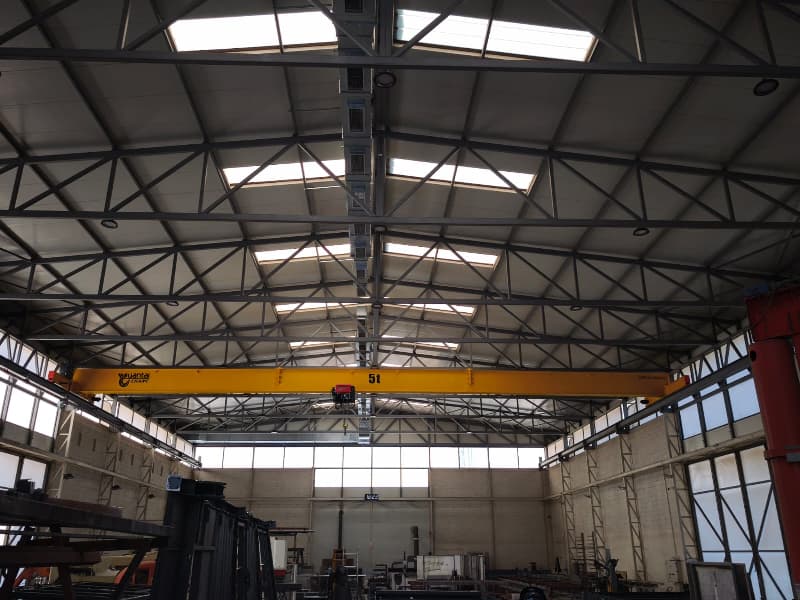
A pervasive misconception in crane procurement is that selecting a larger lifting capacity is automatically safer and more flexible for future needs. In practice, the opposite is often true for overhead crane installations. A higher rated capacity translates directly into heavier crane girders, larger end trucks, increased wheel loads, more powerful motors, and stronger braking systems — every component scales upward. This creates a cost cascade that extends far beyond the crane purchase price.
For a new building, these decisions affect structural design from the very beginning. For an existing factory, they may trigger expensive reinforcement work that was never included in the original crane budget. The hidden costs of oversizing include higher crane self-weight transferring greater loads to runway beams and columns, larger drive and braking systems requiring upgraded electrical infrastructure, and more complex transportation and installation procedures for heavier equipment. One analysis found that the cost of providing support steel structure for even a relatively modest crane can reach approximately $75,000, with interior column upgrades costing $1,000 to $1,200 per column — costs that multiply rapidly as crane capacity and building size increase.
Beyond structural costs, oversized cranes suffer from poor operational matching. A workshop that normally handles 3- to 5-ton loads but installs a 20-ton crane without a clear future need will operate far below the crane’s efficient working range for most of its service life. Operating speed, control sensitivity, and handling feel may be poorly suited to light-load production tasks, and the buyer pays for structural, drive, and power system upgrades without receiving proportional productivity gains.
The opposite error — selecting a crane that only just meets today’s heaviest load — creates a different but equally serious set of problems. A crane operating at or near its rated capacity for a significant portion of its duty cycle will experience accelerated wear on hoist components, bridge structure, and runway systems. The duty classification, which is based on expected usage frequency, load type, and average load weight, becomes critically important here: components designed for a CMAA Class B (light service) application will deteriorate rapidly if the actual usage pattern demands Class D (heavy service) capabilities.
Undersizing also leaves no room for production growth. Factories evolve — new machinery arrives, product mixes change, and lifting requirements that seemed adequate during initial planning may become bottlenecks within a few years. Retrofitting a higher-capacity crane into an existing structure is almost always more expensive than installing the correct capacity from the start, because the building structure, runway beams, and electrical supply that were adequate for the original crane may not support the upgraded system.
Perhaps the most disruptive scenario is the structural mismatch — when a crane is purchased, delivered to site, and only then discovered to be incompatible with the building that must house it. This can manifest as insufficient headroom for the required lifting height, runway beams that cannot handle the crane’s wheel loads, columns that lack the capacity for additional vertical and horizontal forces, or foundations that were never designed for dynamic crane loading.
The consequences are severe: production downtime during structural assessment and modification, unplanned capital expenditure for reinforcement work, extended project timelines, and in some cases, the need to return or replace equipment that simply cannot be accommodated. In existing factory conditions, choosing a crane is not about which configuration is “more advanced” — it is about which is realistic, safer, and cost-effective for a given set of structural constraints.
Before any crane specification is drafted, the procurement team must assemble a complete structural profile of the facility. This is not a task that can be delegated solely to the crane manufacturer — the buyer owns the building data, and accurate information at this stage prevents costly surprises later. The six essential data points are as follows.
Crane columns are the primary load path through which all crane forces — vertical, lateral, and longitudinal — are transmitted to the building foundation. For a top-running bridge crane, building columns must withstand vertical forces from crane self-weight and lifted load, as well as horizontal forces from acceleration, braking, and load swinging. The lateral force on crane runway beams with electrically powered trolleys is typically calculated as 20 percent of the sum of the rated capacity plus the weight of the hoist and trolley, while the longitudinal force is calculated as 10 percent of the maximum wheel loads.
Existing buildings typically have original structural drawings that specify design loads for columns. If these are unavailable — a common situation for older factories — a structural engineer must conduct a condition assessment, which may include visual inspection, material testing, and load analysis. The assessment must determine whether existing columns can accept the additional vertical and horizontal loads that the proposed crane will introduce, or whether column strengthening or replacement is required.
Runway beams support the crane rail and carry the full dynamic loading of the crane bridge as it travels. They are among the most heavily loaded elements in the entire crane-building system, yet runway design frequently receives less attention than crane selection during facility planning — and runway deficiencies are among the leading causes of overhead crane operational problems, including wheel flange wear from misaligned rails, fatigue cracking at beam-to-column connections, and deflection-induced shock loads on the traveling crane.
The runway beam must resist several distinct load types: the vertical dead load of the beam itself, rail, and hardware; the vertical live load from crane wheel loads, which is the dominant load case for most runway beams and is calculated from the crane’s bridge weight, trolley weight, hoist weight, and rated lifted load distributed to individual wheels; impact loads from dynamic effects, typically 10 to 25 percent added to the static lifted load per AISC Design Guide 7; and lateral loads from crane skew and side thrust during bridge travel.
For procurement purposes, the key runway parameters to document are the existing beam section dimensions, the beam material grade, the span between supporting columns, the condition of existing rail and fastening systems, and any known deflection or alignment issues from previous crane operations.
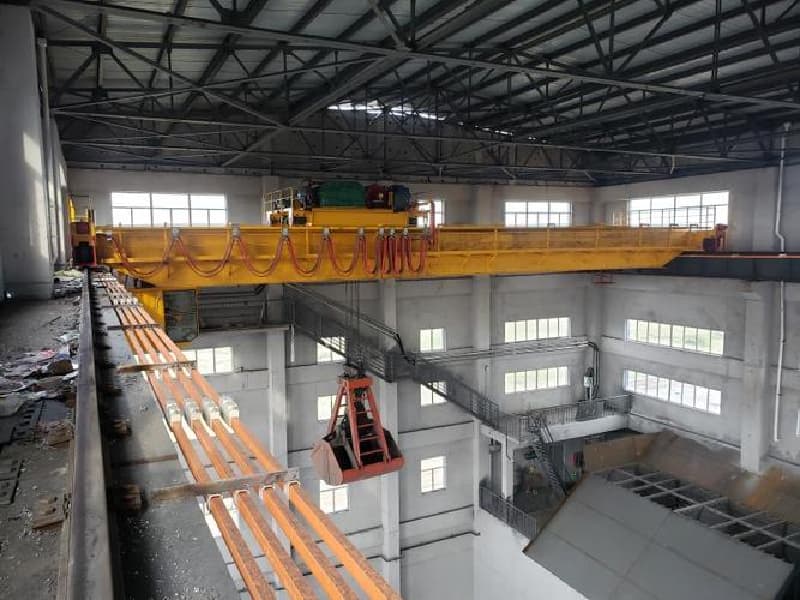
Clear building height — the distance from floor level to the lowest overhead obstruction — directly determines the achievable lifting height and influences whether a standard or low-headroom crane configuration is required. The headroom consumed by a top-running double-girder crane includes the depth of the bridge girders, the hoist and trolley assembly height, the hook approach dimension, and the required safety clearance between the highest hook position and the lowest roof obstruction.
For facilities with limited headroom, low-headroom crane designs can recover valuable centimeters of lifting height. Dongqi’s low-headroom single girder overhead cranes are specifically engineered for factories and plants where the available lifting room is restricted but the required lifting height is substantial. These designs use optimized structural profiles to minimize the distance between the top of the bridge and the roof structure while maximizing hook approach to the walls.
The building frame type — whether structural steel, reinforced concrete, or a hybrid system — determines how crane loads can be introduced into the structure. Steel-framed buildings typically offer more flexibility for adding crane runway support brackets to existing columns, while concrete structures may require more extensive modification. Foundation capacity is equally critical: the concentrated loads from crane columns must be safely transferred to the ground, and inadequate foundations can lead to differential settlement, misalignment, and structural distress over time.
Before approaching any crane manufacturer, procurement teams should collect the following information. The first category is structural data: original building structural drawings, column section dimensions, column spacing along runway lines, existing runway beam specifications and condition, foundation type and geotechnical report availability, and clear building height at runway location. The second category is operational data: the heaviest single load to be lifted, the average working load, the number of lifts per hour and per shift, the required lifting height, the required hook coverage area and span, and any special environmental conditions such as high temperature, dust, or corrosive atmospheres.
With the building’s structural profile established, the next step is determining which crane configuration is compatible. The two primary decisions — bridge crane versus gantry crane, and top-running versus underhung mounting — are fundamentally building-driven choices.
A bridge crane (also called an EOT or overhead travelling crane) is mounted on runway beams fixed to the elevated columns of the factory building. It occupies zero floor space, using the “dead space” near the ceiling to provide full hook coverage while keeping the ground entirely free for operations. This makes it the logical choice for facilities that prioritize high-density floor storage, frequent forklift traffic, or production lines requiring clear, unobstructed floor areas.
A gantry crane, by contrast, is a self-supporting structure with legs that run on rails laid directly on the ground. While this eliminates the need for the building to support the crane, it comes with a significant spatial penalty: the area occupied by the legs and ground rails becomes a no-go zone for storage, forklifts, and personnel traffic, creating logistical dead zones on the shop floor. Gantry cranes are typically only suitable for facilities with exceptionally high ceilings and ground space intentionally dedicated to linear, open-layout processing areas or outdoor storage.
For most indoor industrial applications, the bridge crane offers superior space utilization and operational flexibility. However, if the building structure cannot support the crane loads without extensive and costly reinforcement — and free floor space is available — a gantry crane may represent the more economical overall solution.
Top-running cranes position the bridge structure on top of runway beams mounted to building columns. This configuration places the entire crane weight and load above the runway support system and delivers maximum hook height between the hoist and floor level. Single girder top-running cranes handle loads up to 20 tons, while double girder configurations support 20 to over 500 tons with spans reaching 10 to 45 meters and beyond. The elevated position demands robust building structure to support concentrated loads at column points.
Underhung cranes suspend the bridge from the bottom flange of runway beams, with the entire assembly hanging below the support structure. This configuration typically limits capacity to 3 to 10 tons for standard industrial applications, with spans generally ranging from 3 to 15 meters. The hanging design distributes loads differently across existing building beams, and many installations can use standard roof structure without major reinforcement — making underhung systems attractive for facilities where top-running installation would require prohibitive structural modifications.
The headroom trade-off is critical. A facility with 6 meters of clear height might achieve 5.5 meters of hook height with a top-running configuration but only 4.5 meters with underhung. Underhung installation typically costs 40 to 60 percent below equivalent capacity top-running systems, with savings from simpler runway preparation and faster assembly.
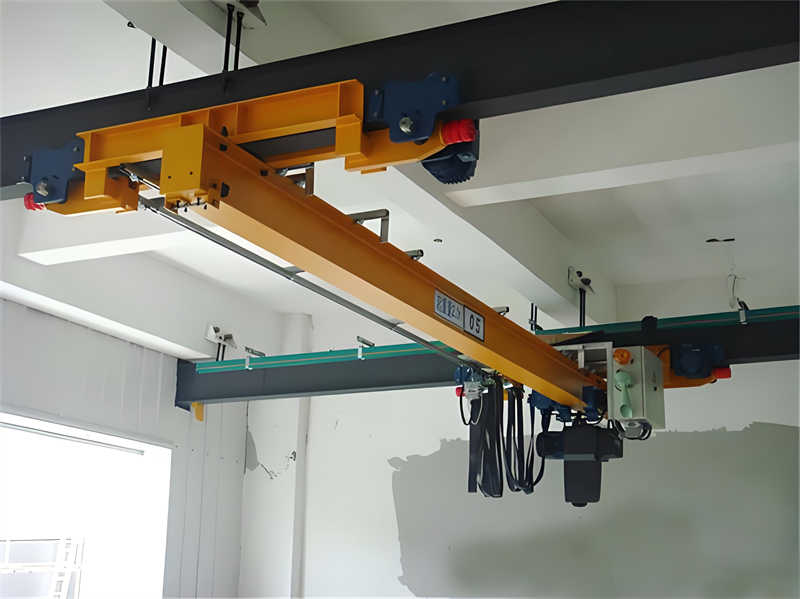
Single girder cranes are generally used on shorter spans and lower capacities. They are best suited for capacities up to 15 to 20 tons and spans up to approximately 20 meters, using an I-beam or welded box-section bridge girder. The economic sweet spot is typically in the 1- to 10-ton range. For workshops with modest lifting requirements and limited budgets, single girder configurations offer an efficient, cost-effective solution.
Double girder cranes use two parallel bridge girders with the hoist trolley riding on top. This configuration extends capacity to 320 tons and beyond, with spans reaching over 40 meters. For a 10-ton overhead crane, a double girder design is often used to enhance rigidity, supporting spans up to 30 meters with a deflection limit of ≤1/750 per CMAA and FEM standards. Double girder cranes also provide greater hook height, as the hoist can be positioned between or above the girders rather than below a single beam. Dongqi’s heavy-duty overhead crane product line covers multiple levels from 15 tons, 16 tons, 20 tons, 32 tons, and 50 tons and above, adopting a double-girder box structure with the characteristics of stable structure, strong carrying capacity, and smooth operation.
Duty classification is one of the most misunderstood parameters in crane procurement, yet it directly determines the service life, reliability, and safety of the equipment. Two cranes with identical 10-ton rated capacity but different duty classifications are fundamentally different machines — the Class F crane is engineered with heavier structural sections, higher-grade components, and more robust drive systems to handle continuous, high-frequency loading that would destroy a Class A crane within months.
Crane duty cycles are standardized under three major systems. CMAA (Crane Manufacturers Association of America) uses experience-based classifications from Class A (standby or infrequent usage) to Class F (continuous severe service). Class A covers standby or infrequent usage such as power utilities or motor rooms, with precise equipment handling at slow speeds and long idle periods. Class B serves light service applications like repair shops or light warehousing, with up to five lifts per hour at maximum rated capacity. Class C handles moderate service in machine shops, with up to ten lifts per hour. Class D covers heavy service in foundries and heavy machining, with up to twenty lifts per hour and loads frequently approaching capacity. Class E serves severe service in steel mills and scrap yards, with continuous operation at or near capacity. Class F is reserved for continuous severe service with the most demanding operating conditions.
FEM classifications, primarily used in Europe, range from 1Dm and 1Cm (standby or infrequent usage) through 1Bm (light service), 1Am (light to medium service), 2m (medium to heavy service), 3m (heavy service), and 4m/5m (severe service). These classifications are the standard for hoist, trolley, and bridge duty motion in European markets. ASME classifications, used in North America, provide duty cycle standards for hoists, while CMAA standards apply to trolley and bridge duty cycles.
Selecting the correct classification requires an honest assessment of how the crane will actually be used: number of lifts per hour and per shift, the percentage of loads that approach maximum capacity, the average load weight relative to rated capacity, the travel distances and speeds involved, and the expected service life. Dongqi Crane’s engineering team works with clients to analyze these operational parameters and specify the appropriate classification, ensuring the crane’s components are developed to meet the actual application rather than an idealized assumption that would lead to premature deterioration and shortened lifespan.
Wheel loads — the concentrated forces transmitted from the crane’s end trucks through the wheels to the runway rail — are perhaps the single most important parameter that procurement teams overlook. The maximum wheel load occurs when the trolley is positioned at the far end of the bridge, concentrating the maximum load on the near-side end truck. This load is calculated from the crane’s bridge weight, trolley weight, hoist weight, and the rated lifted load, distributed to the end trucks and then to individual wheels based on the crane’s wheel spacing and trolley position.
If the calculated wheel loads exceed the runway beam’s capacity, several outcomes are possible — none of them desirable. The runway beam may deflect excessively, causing rail misalignment, increased wheel wear, and degraded crane travel performance. In more severe cases, the beam or its connections may suffer fatigue damage over repeated loading cycles. For heavy-duty cranes, gantry girders must be checked for fatigue loads. Structural reinforcement of existing runway beams is a complex, costly, and disruptive undertaking.
Dongqi Crane provides detailed wheel load data for every crane configuration during the engineering phase, enabling structural engineers to verify runway adequacy before procurement is finalized. This prevents the all-too-common scenario of discovering runway deficiencies during installation — when corrective work is most expensive and most disruptive to production schedules.
Span — the horizontal distance between runway rail centerlines — determines the crane’s lateral coverage. It must be matched to the building’s column spacing and the required hook coverage area. Standard spans range from 7.5 to 31.5 meters for single girder configurations, with double girder designs extending to over 40 meters.
Lift height — the vertical distance the hook can travel from its lowest to highest position — is governed by the clear building height minus the crane’s structural depth and required safety clearances. In facilities where available headroom is tight, low-headroom crane designs can recover significant lifting height by optimizing the bridge girder profile and hoist positioning.
End clearances — the minimum distances from the runway rail centerline to the closest wall obstruction — ensure that the crane can travel the full length of the runway without interference and that the hook can reach all required work areas. These dimensions must be verified against the actual building geometry, accounting for columns, utilities, lighting fixtures, ventilation ducts, and any other obstructions along the crane’s travel path.
Dongqi Crane brings a distinctive engineering philosophy to every project, rooted in European crane technology standards and a commitment to structural optimization that respects the constraints of the building in which the crane will operate. As a Sino-foreign joint venture built on advanced European technology research and development, the company maintains its own R&D laboratories and focuses on the innovation of non-standard crane design to meet diverse material handling requirements.
The European crane design philosophy emphasizes lighter self-weight, optimized structural profiles, and precision manufacturing — all of which directly benefit building compatibility. A lighter crane structure reduces the dead load transmitted to runway beams and columns, potentially eliminating the need for building reinforcement that a heavier crane of equivalent capacity would require. Finite Element Analysis (FEA) is used to optimize structural profiles, minimizing the distance from the top of the bridge to the roof structure while maintaining full structural integrity.
Dongqi’s product range includes European standard bridge cranes, gantry cranes, explosion-proof cranes, metallurgical cranes, and European standard electric hoists, all manufactured to meet international standards including ISO9001, ISO14004, and OHSA18001. The company’s partnerships with leading European component manufacturers — including Siemens, Nord, and Schneider — ensure that every crane meets rigorous quality and performance specifications while maintaining compatibility with global standards.
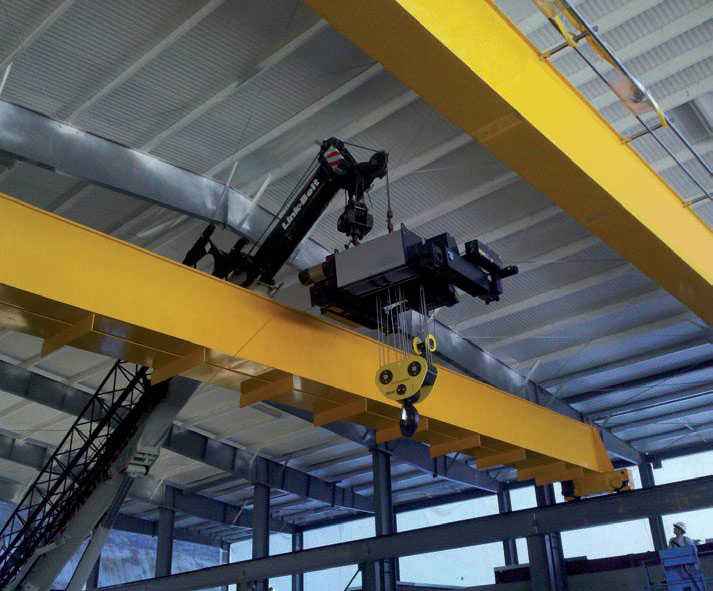
Standardized crane configurations cannot address every building scenario. Facilities with unusual column spacing, restricted headroom, heavy roof loading from equipment, or hybrid structural systems often require customized engineering to achieve safe and efficient crane integration. Dongqi’s in-house design and manufacturing capabilities, covering 240,000 square meters of factory space with over 2,000 sets of manufacturing and detection devices, enable the company to deliver fully customized solutions for demanding applications.
This customization capability extends to every aspect of crane design: bridge girder dimensions and profiles tailored to specific span and deflection requirements, end truck configurations adapted to existing runway beam geometries, low-headroom trolley designs that maximize lift height within restricted building envelopes, control systems and safety features specified to match operational requirements, and corrosion protection and environmental sealing for challenging operating conditions.
In July 2025, Dongqi Crane delivered four sets of 5-ton European standard double girder overhead cranes without main beams to a steel processing plant in Lahore, Pakistan. The project required careful engineering to match the crane kits to the client’s unique plant structure and lifting requirements. The bridge crane kits were customized specifically for the building’s existing runway system and operational needs, demonstrating how close collaboration between crane manufacturer and client during the specification phase leads to equipment that integrates seamlessly with facility constraints.
Following contract finalization, the Pakistani client visited Dongqi’s factory for a critical factory acceptance inspection, reviewing every component and production process. This level of transparency and client involvement is standard practice at Dongqi Crane and reflects the company’s commitment to delivering integrated solutions that address safety, efficiency, and structural compatibility from day one.
Dongqi Crane’s manufacturing facility occupies 240,000 square meters in the Changyuan Crane Industry Park in Henan Province — known as the “cradleland of cranes” in China. With 3,600 employees including 500 technicians and over 70 senior engineers, the factory produces more than 10,000 sets of material handling equipment annually, spanning overhead cranes, gantry cranes, jib cranes, port cranes, and electric hoists.
The manufacturing facility is highly automated to ensure precision, cost-efficiency, and consistent quality levels. Every procedure — from raw material inspection through fabrication, machining, assembly, and final load testing — is strictly performed based on applicable international standards. This manufacturing discipline ensures that the crane delivered to site matches the engineering specifications exactly, with no surprises during installation that might arise from fabrication variations or quality deviations.
Experienced procurement professionals know that a structured approach to site assessment prevents costly rework and schedule delays. Before contacting crane manufacturers, complete the following steps. First, commission a structural survey of the building, including column load ratings, runway beam capacity, and foundation condition. Existing structural drawings are valuable but must be verified against current conditions, as modifications, corrosion, or foundation settlement may have altered the structure’s capacity.
Second, measure and document all critical dimensions: clear building height, column spacing, available headroom, and end clearances. Third, define operational parameters precisely: the heaviest load to be lifted, the average working load, lift frequency, required duty classification, and any special environmental conditions. Dongqi Crane’s structured single-page specification template captures all essential parameters — not just capacity and span, but duty class, environmental conditions, control requirements, and lifecycle expectations — organized into the seven decision dimensions that every overhead crane specification must address.
Several indicators should prompt immediate engineering review before proceeding with crane selection. Existing building columns showing signs of distress — cracking, spalling, visible deflection, or corrosion at column bases — may indicate insufficient capacity for additional crane loading. Runway beams with visible misalignment, excessive deflection under previous crane operation, or inadequate connection details require assessment and possible reinforcement or replacement. Foundation settlement or cracking around column bases suggests that ground conditions may not support concentrated crane loads. A building designed without crane loading in the original structural calculations almost certainly requires structural engineering review before any crane is installed. When these red flags are present, Dongqi Crane recommends engaging a qualified structural engineer to conduct a detailed assessment and develop remediation recommendations before crane specification is finalized.
When a client approaches Dongqi Crane with a project inquiry, the engagement follows a structured path designed to eliminate surprises and ensure building compatibility. The process begins with a comprehensive requirement analysis, during which Dongqi’s engineering team reviews the client’s building data, operational requirements, and any structural constraints to develop an initial crane specification. This is followed by a detailed technical proposal including crane configuration recommendations, wheel load calculations, and interface requirements for the building structure.
Once specifications are agreed, the engineering design phase produces detailed drawings and calculations for client review and structural engineer verification. Manufacturing follows, with strict quality control at every stage and an open invitation for clients to conduct factory acceptance inspections. Delivery, installation, and commissioning are supported by Dongqi’s technical team to ensure the equipment performs as specified from day one. Ongoing after-sales support covers maintenance, spare parts, and technical consultation throughout the equipment lifecycle.
Before finalizing any crane purchase, procurement teams should obtain clear answers to these questions. What are the calculated maximum wheel loads for the proposed crane configuration, and have these been checked against the building’s runway beam capacity? What is the required duty classification for the application, and how does the proposed crane’s classification match? What are the exact headroom requirements for installation, and has the available building clearance been measured and verified? What modifications to the building structure, if any, are required to accommodate the crane — and what is the cost and timeline for these modifications? What international standards (CMAA, FEM, EN, ASME) does the crane comply with? What documentation is provided for structural verification by the client’s engineer? What is the after-sales support commitment, including spare parts availability and technical service?
The most successful crane installations share a common characteristic: the procurement team treated the building structure not as an afterthought, but as a primary design input from the very first conversation. By investing in structural assessment, understanding the implications of duty classification and wheel loads, and partnering with a manufacturer that brings genuine engineering capability to the project, these buyers avoid the costly cycle of specification errors, installation delays, and structural remediation that plagues so many industrial crane projects.
Dongqi Crane brings to every client engagement a deep understanding of how cranes and buildings must work together. With European-standard engineering, ISO-certified manufacturing, and a track record of successful projects across more than 30 countries, Dongqi is positioned to guide procurement teams through every stage — from initial structural compatibility analysis through final commissioning and beyond.
If you are planning a crane procurement, contact Dongqi Crane with your building specifications and operational requirements. Our engineering team will work with you to develop a crane solution that fits your facility structure precisely, delivers the performance your production demands, and protects your investment for decades of reliable service. Visit www.craneyt.com to submit your inquiry and take the first step toward a crane installation that is engineered right from the ground up — starting with the ground beneath your factory.
Contact our crane specialists
Send us a message and we will get back to you as soon as possible.