Every crane buyer faces a version of this question: “Can I buy a standard crane off your catalog, or does my application require something custom-engineered?” The answer has enormous consequences—for your budget, your timeline, and the long-term performance of your material handling system.
Get it wrong in one direction, and you pay for custom engineering you don’t need. The crane arrives overbuilt, over-budget, and late. Get it wrong in the other direction, and you force a standard crane into an operating environment it was never designed to survive. The result is premature fatigue cracking, mechanism failure, safety incidents, and a total cost of ownership that dwarfs whatever you saved on the initial purchase.
At Dongqi Crane, we have supplied more than 10,000 crane sets annually from our 240,000-square-meter manufacturing facility in Changyuan, Henan Province. A significant portion of these—perhaps more than most buyers realize—involve some degree of customization. The question is rarely “standard or custom” in absolute terms. It is “how much customization does my application genuinely require, and where should I draw the line?”
This guide provides the decision framework to answer that question. It explains the spectrum from fully standard to fully custom, identifies the four categories of operating conditions that make customization a necessity rather than a preference, and offers a structured procurement checklist to guide your evaluation. Throughout, we draw on Dongqi Crane’s experience delivering customized lifting solutions to clients in 96 countries, from Pakistani steel plants to Indonesian waste-to-fuel facilities to US manufacturing plants.
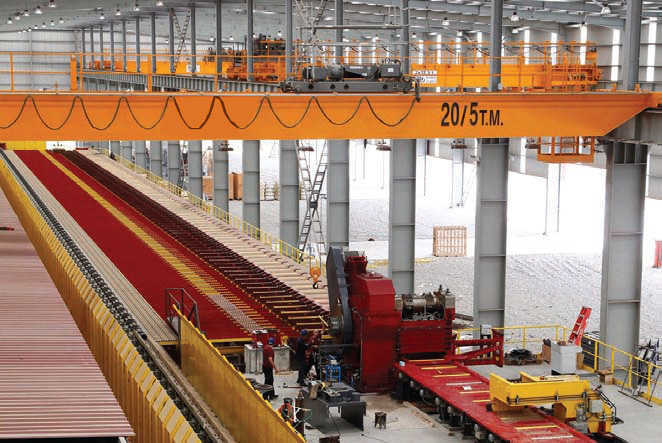
Who We Are: Dongqi Crane is a Sino-New Zealand joint venture with over 3,600 employees, including 500 technicians and more than 70 senior engineers. We design and manufacture to FEM, ISO, and CE standards, with products spanning single-girder and double-girder overhead cranes, gantry cranes, jib cranes, electric hoists, and specialized equipment for steel, petrochemical, cleanroom, and explosive-environment applications. Our engineering team routinely develops tailored solutions while maintaining the cost and lead-time advantages of a high-volume manufacturer.
A “standard” crane is not a single, fixed design. It is a product built within a defined catalog range—with pre-engineered structural modules, mechanisms, and controls that have been validated through repeated production and testing. Standard cranes offer several advantages:
However, “standard” has limits. Every manufacturer’s catalog defines boundaries—maximum capacity, span range, lift height, duty classification, operating speed, and environmental tolerance. Push beyond any of these boundaries, and the crane moves into custom territory.
Customization exists on a spectrum. At one end is parametric customization: adjusting variables within an existing design framework—a slightly longer span, a non-standard lift height, a different voltage or control interface. This type of customization is routine for experienced manufacturers like Dongqi Crane and typically adds minimal cost or lead time.
At the other end is full custom engineering: designing a crane from first principles for an application that falls entirely outside any standard product envelope. This might involve a unique structural configuration, specialized materials, integration with unusual building geometry, or extreme environmental hardening. Full custom engineering is far more resource-intensive and should be reserved for cases where no standard alternative exists.
Between these extremes lies modular customization: assembling a crane from standard, pre-engineered subsystems (hoists, end carriages, controls, electrification) but configuring them in a unique combination to meet specific project requirements. This approach—which Dongqi Crane employs extensively—captures much of the cost and lead-time benefit of standardization while addressing genuine application-specific needs. As demonstrated in our Indonesian waste-to-fuel plant project, where we supplied complete component kits for six bridge cranes designed to integrate with locally fabricated main girders, modular customization allows clients to optimize costs while receiving precisely the lifting performance they require .
Before evaluating specific operating conditions, every procurement team should answer four threshold questions. If the answer to any is “yes,” the project will require some degree of customization:
| Question | If “Yes,” Customization Required Because… |
|---|---|
| Does the operating environment contain hazards (explosive gas, combustible dust, corrosive chemicals, extreme heat, or cleanroom requirements)? | Standard electrical and mechanical components are not rated for these conditions. Safety and regulatory compliance mandate specialized design. |
| Do the dimensional requirements exceed standard catalog ranges? | Span, lift height, or building interface dimensions outside standard limits require structural re-engineering. |
| Does the duty classification exceed what standard products in your capacity range offer? | The fatigue life of standard structures and mechanisms is inadequate for continuous heavy-duty cycling. |
| Does the lifting application involve non-standard load handling (grab buckets, magnets, coils, ladles, or specialized below-the-hook devices)? | The hoist, reeving, and control systems must be designed around the specific load-handling attachment and its operational dynamics. |
If your facility requires answering “yes” to any of these, read on. The sections that follow detail exactly what customization entails for each scenario and how Dongqi Crane approaches the engineering.
Through hundreds of international projects, Dongqi Crane has identified four categories of operating conditions where customization shifts from optional to essential.
The most common trigger for crane customization is not the load itself—it is the building that houses it. Existing facilities, in particular, present fixed geometric constraints that no standard catalog crane can accommodate without modification.
Low Headroom: When ceiling clearance is limited, every millimeter of vertical space matters. European-standard low-headroom designs minimize the distance between the hook and the runway beam, but in extremely constrained buildings—older factories, basement-level workshops, facilities built before modern material handling was contemplated—even optimized standard designs may not fit.
The Pakistan Steel Plant Example: In July 2025, Dongqi Crane delivered four sets of 5-ton European-standard double-girder overhead crane kits to a steel processing plant in Lahore, Pakistan. The client’s existing building presented significant challenges: low ceiling clearance and limited installation space that ruled out a standard full-crane delivery. To meet these constraints, Dongqi Crane supplied complete crane kits without main beams—the client fabricated the main beams locally to our engineering drawings. Each kit included FEM-standard double girder hoist trolleys, end carriages with drive mechanisms, advanced control systems, and all electrical components. The European low-headroom design maximized lifting height within the constrained building envelope, while the kit approach reduced shipping costs by 30–50%. Dongqi provided all fabrication drawings, electrical diagrams, installation manuals, and remote commissioning support .
Non-Standard Column Spacing: When building columns are spaced irregularly or at intervals that do not align with standard crane spans, the runway beam and end carriage configuration must be customized. This is common in renovated industrial buildings, historic structures converted for manufacturing, and facilities that have been expanded in phases.
Unusual Building Geometry: Curved runways, intersecting crane bays, transfer bridges between buildings, or cranes that must operate on multiple levels all require custom engineering. These geometric complexities fall well outside any standard product definition.
Dongqi Crane’s Approach: For every project involving an existing building, our engineering team conducts a structural review of the facility before finalizing the crane specification. We model the crane-building interaction to ensure the equipment fits precisely and imposes acceptable loads on the supporting structure. When building constraints demand it, we customize the end carriage height, wheelbase, rail interface, or overall crane geometry while preserving as many standard subsystems as possible.
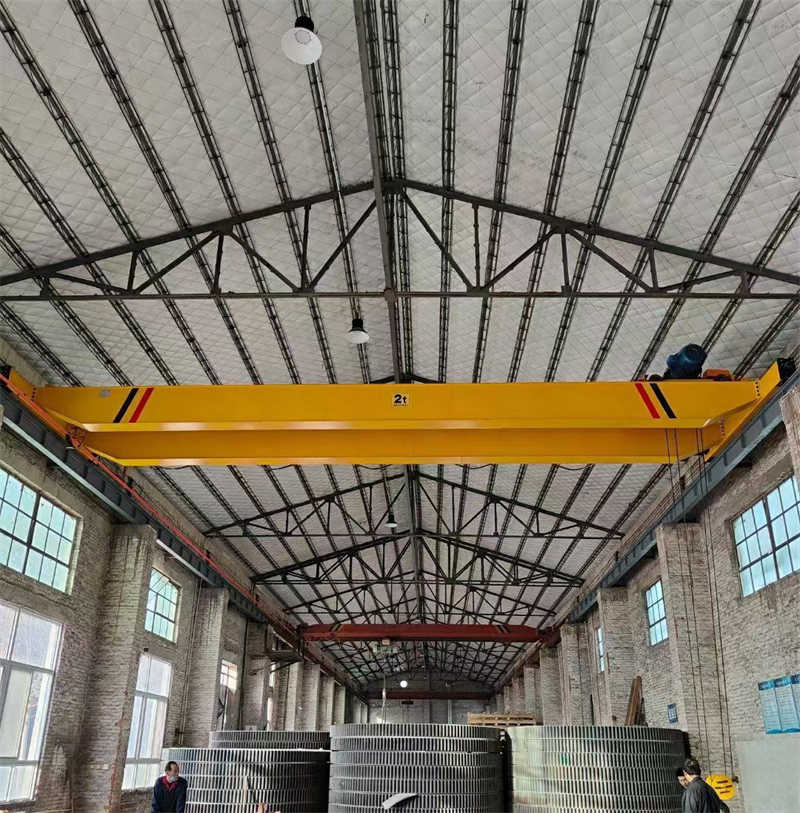
When a crane must operate in an environment that poses risks to personnel, equipment, or product, standard commercial designs are categorically inadequate. Regulatory compliance alone mandates specialized engineering.
Explosive Atmospheres (ATEX/IECEx): Petrochemical plants, oil and gas facilities, paint shops, grain silos, and certain pharmaceutical lines present explosion risks from flammable gases, vapors, or combustible dust. In these environments, a single spark from a motor, brake, or electrical contact can trigger catastrophe. Compliance with ATEX (European) or IECEx (international) standards is non-negotiable.
Customization for explosive environments includes:
Extreme Heat: Steel mills, foundries, and smelters expose cranes to ambient temperatures that degrade standard materials, lubricants, and electrical insulation. Customization for high-temperature applications includes heat shields below the main girder, high-temperature-rated cables and components (up to 180°C in insulated areas), specialized bearing lubricants that maintain viscosity at elevated temperatures, and solid forged wheels without pressed-on tires that could loosen under thermal cycling.
Corrosive Environments: Chemical plants, coastal installations, wastewater treatment facilities, and fertilizer factories subject cranes to accelerated corrosion. Customization may involve stainless steel or coated hardware, multi-layer epoxy paint systems with SA 2.5 blast preparation capable of 15+ years of service in C4/C5 environments per ISO 12944, and sealed electrical enclosures rated IP65 or higher.
Cleanroom and Contamination-Controlled Environments: Semiconductor fabrication, pharmaceutical manufacturing, and precision optics require cranes that generate minimal particulate and do not drip lubricants or shed materials. Customization includes sealed drive systems, food-grade or dry lubricants, stainless steel construction, enclosed cable management, and specialized surface finishes that resist particle adhesion.
Dongqi Crane’s Capability: We manufacture explosion-proof cranes certified to ATEX directives for Zones 1, 2, 21, and 22, with brass-coated hooks, spark-resistant trolleys, enclosed electrical panels, and anti-static belts. Each hazardous-environment project receives dedicated engineering review to ensure full regulatory compliance.
A standard hook crane is designed for general lifting—picking up loads with slings, chains, or spreader beams. But many industrial processes require specialized below-the-hook devices that fundamentally change the crane’s operational dynamics.
Grab Buckets and Bulk Material Handling: Cranes equipped with grabs for scrap metal, coal, aggregates, or waste materials experience shock loads when the grab bites into material piles. The crane structure, hoist mechanism, and controls must be engineered for these impact forces. Dongqi Crane’s QZ grab bridge cranes, as supplied in our Indonesian waste-to-fuel plant project, are specifically designed for this duty—with reinforced structures, high-torque hoist mechanisms, and control systems that manage the grab’s open/close functions in coordination with hoisting and travel .
Magnetic Lifters: Electromagnetic lifting of steel plates, billets, or scrap imposes unique requirements: reliable DC power supply to the magnet (with battery backup to prevent load drop during power interruption), cable management that accommodates the magnet’s vertical movement without tangling, and control logic that prevents hoist movement unless the magnet is energized.
Coil Handling (C-Hooks and Tong Systems): Steel coil handling requires specialized lifting attachments and often demands precision positioning to insert the C-hook into the coil eye without damaging the material. The crane’s hoist and trolley drives may need enhanced slow-speed control and anti-sway features.
Ladle Cranes for Molten Metal: Among the most safety-critical crane applications, ladle cranes require redundant hoist mechanisms, dual independent brakes on each hoist, heat shielding, and structural fatigue design for millions of high-stress cycles. These are never standard products.
Custom Fixtures and Tooling Interfaces: Some applications require the crane to interface with custom lifting fixtures—vacuum lifters for glass panels, expanding mandrels for pipe handling, or specialized spreader beams with multiple pick points. The crane’s control system, hoist configuration, and sometimes the trolley design must accommodate the specific mechanical, electrical, and operational requirements of these devices.
The Indonesian Waste-to-Fuel Example: For an innovative waste processing plant in Indonesia converting municipal and industrial waste into alternative fuel, Dongqi Crane supplied a combination of customized crane types within a single project. Three QZ grab bridge cranes (6.3-ton, 24-meter span, 17-meter lifting height) were provided for handling raw waste materials using grabs, while three HD European-style single girder cranes (7.5-ton, 24-meter span, 12.5-meter lifting height) were supplied for general maintenance and handling processed fuel bales. All components were engineered for seamless integration with locally fabricated main girders and designed to withstand the abrasive and corrosive environment of the waste processing operation .
Some applications demand performance characteristics that exceed what any standard crane in a given capacity class can deliver.
Ultra-High Duty Cycles (A7/A8): A steel mill charging crane making 20–30 full-capacity lifts per hour, 24 hours per day, accumulates stress cycles at a rate that would fatigue a standard A5 crane within two to three years. As Dongqi Crane’s procurement guidelines emphasize, the duty classification directly determines structural fatigue life—selecting a crane with inadequate classification for the actual usage pattern is among the most costly mistakes in crane procurement. Heavy-duty applications demand structures with enhanced fatigue detailing (full-penetration welds at critical joints, post-weld treatment, optimized stiffener placement), mechanisms rated for continuous operation (M6/M7/M8 per FEM), and often dual redundant systems for safety-critical functions.
Precision Positioning: Semiconductor equipment handling, aircraft component assembly, and precision machining load/unload operations may require positioning accuracy measured in millimeters. Achieving this consistently requires high-stiffness structures (deflection ≤ L/1000), VFD-controlled drives with programmable creeping speeds, closed-loop position feedback, and electronic anti-sway systems.
Very High Speeds with Heavy Loads: Some production lines demand crane travel or hoisting speeds well above standard ranges to maintain throughput. Higher speeds increase dynamic loads, require more powerful drives, and place greater demands on brakes and control systems—all of which cascade into structural design requirements.
Multi-Crane Synchronization: When two or more cranes must lift a single oversized load in tandem, the control system must synchronize their movements precisely to prevent load skew and unequal load distribution. This requires master-slave control architecture, high-speed communication between crane controllers, and sophisticated safety interlocks.
The US Manufacturing Example: In 2025, a US manufacturing plant required a crane with a span of exactly 31.394 meters and a lifting height of 6.438 meters—neither of which matched any standard catalog size. Dongqi Crane engineered a tailored HD-type European-style bridge crane precisely configured to these dimensions, with an NR-type European electric hoist providing smooth, precise load control for delicate positioning tasks. The custom dimensions ensured a perfect fit within the client’s existing infrastructure, eliminating wasted space while maximizing bay coverage .
Customization adds cost and time. But forcing a standard crane into an application it was not designed for adds far greater costs over the equipment’s lifecycle. The decision framework below helps procurement teams weigh these trade-offs systematically:
| Operating Condition | Standard Crane Risk | Customization Required | Typical Cost Impact |
|---|---|---|---|
| Standard factory environment, moderate duty (A4–A5), no hazards | None | None | Baseline |
| Slightly non-standard span or lift height within design envelope | Minimal—parametric adjustment | Minor parametric change | +5–10% |
| Low-headroom building requiring compact European design | Moderate—standard low-headroom may not fit | Custom end carriage height, optimized trolley | +10–20% |
| Explosive atmosphere (ATEX Zone 1 or 2) | Catastrophic—safety failure | Full electrical and mechanical ATEX compliance | +40–80% |
| Continuous A7/A8 duty with high load spectrum | Fatigue failure within 2–5 years | Enhanced structural fatigue design, upgraded mechanisms | +30–60% |
| Specialized load handling (grab, magnet, ladle) | Inoperable or unsafe | Custom hoist, controls, and structural interface | +25–50% |
| Corrosive environment + high duty + specialized handling | Compounding failures | Multi-factor custom engineering | +50–100% |
Follow this decision sequence when evaluating any crane requirement:
Between fully standard and fully custom lies the approach Dongqi Crane recommends for most projects: modular customization. This means selecting standard, proven subsystems—FEM/ISO hoists, VFD drive packages, certified control modules, standardized end carriages—and assembling them in a project-specific configuration.
The benefits are substantial:
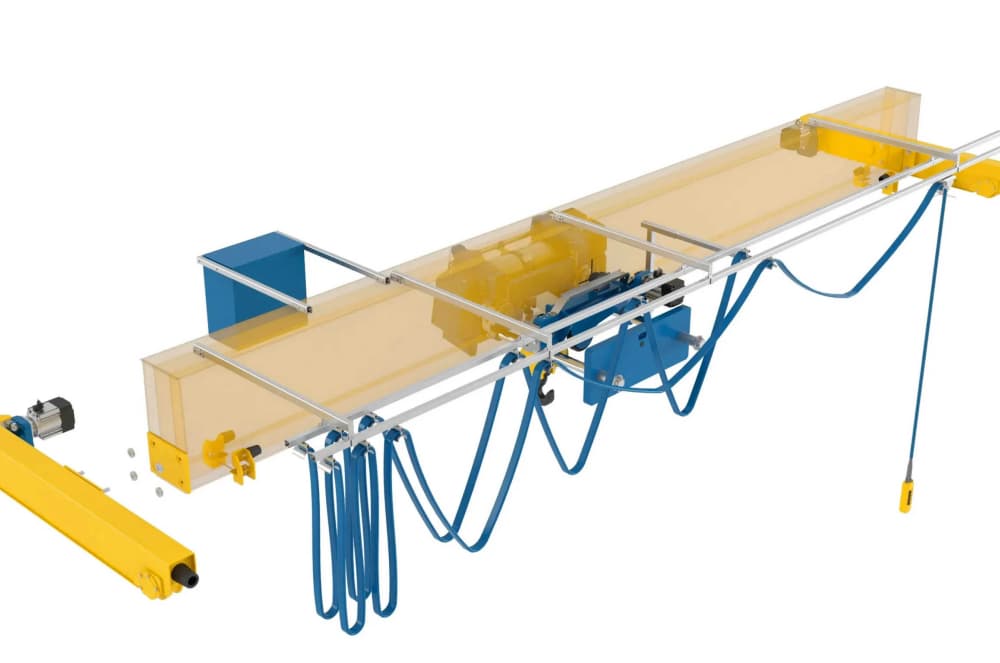
This modular approach enabled Dongqi Crane to deliver a customized crane kit to Pakistan in just 45 days from order to shipment , and to supply six bridge cranes to Indonesia with all components designed for seamless integration with locally fabricated main girders . In both cases, the client received a solution tailored to their specific operational needs without paying for unnecessary custom engineering.
At Dongqi Crane, customization decisions are never made by sales alone. Every project begins with an engineering assessment that evaluates operating conditions, building constraints, load-handling requirements, and duty cycles. This assessment determines exactly where customization is required and where standard approaches can be preserved.
Dongqi Crane’s proven expertise in custom projects, combined with our ability to deliver exactly what the client needs—not just a standard product—has been cited by international clients as a decisive factor in their supplier selection .
With over 70 senior engineers and 500 technicians, Dongqi Crane maintains the engineering depth to handle complex custom projects without relying on external design consultants. Our engineering capabilities include:
Every Dongqi crane—standard or custom—undergoes factory assembly and testing before disassembly for shipment. Static load testing is performed at 125% of rated capacity, and dynamic testing at 110% of rated capacity. For custom designs, these tests are particularly important as they verify that the engineering assumptions hold true under real load conditions. We actively encourage prospective clients to visit and inspect our factory for these reasons—witnessing your crane under test provides assurance that no catalog photograph can match.
Custom cranes require ongoing support that generic spare parts catalogs cannot provide. Dongqi Crane maintains comprehensive documentation for every custom project, including as-built drawings, material certificates, component specifications, and maintenance schedules. Our 36-person multilingual overseas service team, operating in English, Arabic, Spanish, Russian, and Korean, provides responsive support to international clients, backed by a permanent office in Pakistan and distribution to 96 countries.
Customization is neither a virtue nor a vice in crane procurement. It is a tool—one that should be applied precisely where the operating conditions demand it and avoided where they do not. The procurement team’s task is to understand their application with sufficient clarity to know the difference.
The four conditions described in this guide—extreme building constraints, hazardous environments, specialized load handling, and extreme performance requirements—represent the situations where customization is genuinely necessary. In most other cases, a well-selected standard crane or a modular configuration from a reputable manufacturer will serve reliably and economically.
If your facility faces any of the conditions described here, we invite you to engage Dongqi Crane’s engineering team. We will evaluate your operating environment, identify precisely which aspects of the crane require customization, and develop a solution that balances performance, compliance, and cost.
Contact Dongqi Crane Today:
With Dongqi Crane, you gain more than lifting equipment. You gain a partner with the engineering depth to handle your most demanding applications and the manufacturing scale to deliver custom solutions efficiently.
© 2026 Dongqi Crane. All rights reserved. This guide presents genera
Contact our crane specialists
Send us a message and we will get back to you as soon as possible.