In 2025, a cement plant in Punjab, Pakistan, took delivery of a 20-ton double-girder overhead crane. The specifications looked right on paper—sufficient capacity, adequate span, reasonable price. Six months later, the crane’s gearbox failed. The wire ropes showed accelerated wear. The motor burned out during a peak production week. The root cause? The procurement team had specified the right capacity for the crane but had never asked about duty classification. The crane was designed for intermittent maintenance work—not the 16-hour, high-cycle production environment it was thrown into. Total cost of the mistake: $47,000 in repairs and lost production, not counting the reputational damage with downstream customers.
Multiply this scenario across the thousands of factories, warehouses, and infrastructure sites that purchase lifting equipment each year, and the scale of the problem becomes clear. Crane selection is not difficult because the technology is mysterious. It is difficult because the consequences of getting one parameter wrong cascade through years of operation, and most procurement teams lack a structured method to capture all decision-critical information before they approach suppliers.
At Dongqi Crane, we have supplied overhead cranes, gantry cranes, jib cranes, and electric hoists to customers in 96 countries, with projects ranging from single 2-ton workshop hoists to integrated metallurgical crane systems serving foundries in Pakistan’s Dhabeji Special Economic Zone. Over 40 years of manufacturing experience has taught us one consistent lesson: the quality of the crane you receive depends entirely on the quality of the requirements you define before the first quote is generated. A structured, one-page template that captures all essential parameters—not just capacity and span, but duty class, environmental conditions, control requirements, and lifecycle expectations—is the single most powerful tool a procurement professional can wield.
This article provides that template. We will walk through every parameter on the sheet, explain what it means, why skipping it can be costly, and how to fill it in correctly for your specific facility. By the end, you will have a practical, immediately usable tool for your next crane inquiry—and a deeper understanding of what separates a crane that merely “works” from one that delivers reliable production throughput for a decade or more.
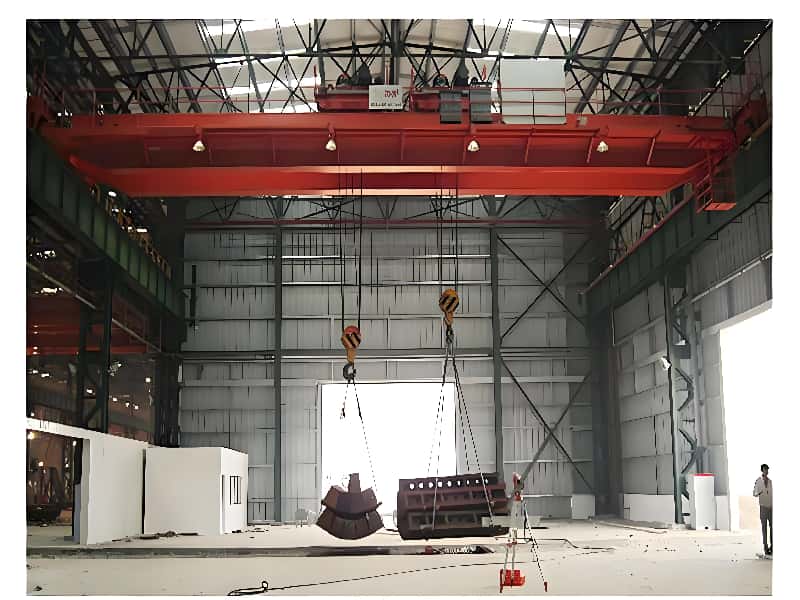
The most common inquiry Dongqi Crane receives from first-time buyers goes something like this:
“We need a 10-ton overhead crane. Can you send us a quote?”
This request is the equivalent of walking into a car dealership and saying, “I need a vehicle that seats five people.” The salesperson could offer you a compact hatchback, a luxury sedan, or a heavy-duty pickup truck—all technically seat five people, but only one is right for your actual needs.
Capacity alone tells a manufacturer almost nothing useful. A 10-ton crane used three times a day for maintenance work is engineered completely differently from a 10-ton crane making 200 lifts per shift in a steel service center. The structural beams, gearbox sizing, motor insulation class, bearing specifications, and electrical control architecture all differ—sometimes by a factor of three in component cost. Two 10-ton cranes with different duty classifications can differ in price by 50 to 90%, even when everything else appears identical on the surface. Understanding this distinction is the single most important factor in making a sound crane procurement decision.
A second common failure mode occurs when procurement teams copy the specification sheet from a previous project and submit it to new suppliers. This approach might work if the new factory is identical to the old one—same products, same production rhythm, same building dimensions, same environmental conditions—but in practice, it rarely is. Even seemingly minor differences—a hotter workshop, a corrosive atmosphere, a higher cycle frequency, a different power supply—can render a copied specification inadequate or over-specified, both of which waste money.
Some buyers assume that because they have described their application verbally, the supplier will automatically specify the right equipment. While reputable manufacturers like Dongqi Crane do provide expert guidance, the supplier can only work with the information provided. If the buyer does not mention that the workshop floor is uneven, that operations run three shifts continuously, that the electrical supply fluctuates by ±10%, or that the load includes fragile components requiring precise positioning, the supplier may select a standard configuration that underperforms in those conditions.
The solution to all three of these problems is a standardized, one-page parameter template that forces systematic thinking before any supplier conversation begins.
Our template organizes all crane selection parameters into seven logical groups, reflecting the seven decision dimensions that every overhead crane specification must address:
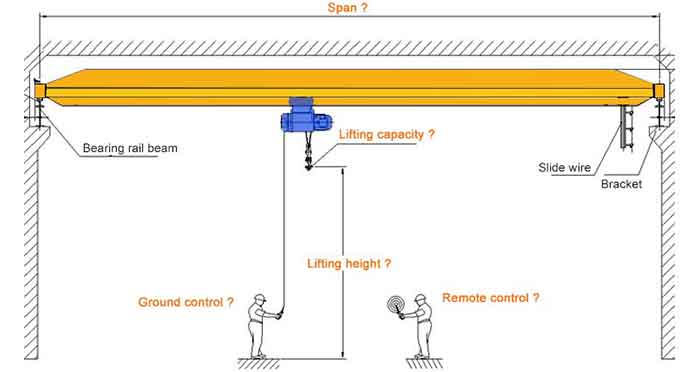
Below, we examine each group in detail, explain the engineering rationale behind each parameter, and provide guidance on filling it in correctly.
This is the parameter everyone thinks they know—and the one most commonly mis-specified. The maximum load weight is not simply “the heaviest thing we lift.” It must account for:
How to fill it in: State the maximum load inclusive of all rigging and lifting attachments. Then state the typical or routine load (often 60–80% of maximum), because duty classification depends more on routine loading than on occasional peak loads. Do not spec the entire system only for a rare peak load.
Dongqi Crane example: A Pakistani steel coil mill required a 15-ton SWL crane, but the actual coil weight plus C-hook attachment totaled approximately 14.2 tons. We specified a 15-ton crane with 20% temporary overload capability to handle the combined static load plus dynamic factors during acceleration, ensuring no routine operation approached the structural limit.
Weight is only one dimension of the load. The load’s physical characteristics drive critical decisions:
| Load Characteristic | Parameter Affected |
|---|---|
| Load dimensions (length × width × height) | Hook coverage area, lifting height, lifting beam design |
| Load shape (regular, irregular, long, flat) | Need for spreader beams, C-hooks, or specialized grabs |
| Load fragility / surface finish | Speed control precision, anti-sway requirements |
| Load surface condition (dry, wet, oily, dusty) | Hoist and brake selection, enclosure ratings |
| Load temperature (ambient, hot, molten) | Heat shielding, motor insulation class, brake lining material |
| Multiple load types in the same facility | Dual-hook configurations, interchangeable below-the-hook attachments |
Procurement teams should provide detailed information about load requirements—including what they plan to lift, the load’s size, weights, shape, material, and fragility—before manufacturers can start recommending the right crane and hoist setup.
Dongqi Crane example: For a metallurgical workshop application, we supplied a dual-hook configuration with 16/3.2-ton and 20/5-ton main/auxiliary hook combinations. The main hook handles ladles or heavy castings at slower, controlled speeds, while the faster auxiliary hook manages molds, risers, and scrap, ensuring that quick auxiliary tasks do not slow down the main production process.
Every crane operates within a defined material flow path that connects pick-up points, processing stations, and destination areas. Mapping this workflow precisely helps define the required travel coverage envelope and identifies potential obstacles such as building columns, overhead conveyors, or mezzanine structures. Understanding the path loads will follow also ensures that the crane coverage aligns with actual operational touch-points rather than theoretical coverage of the entire building footprint.
Hook coverage defines the spatial envelope the crane hook must reach. This is distinct from the building dimensions—a crane installed in a 60-meter-long building may only need to serve a 45-meter section if operations are concentrated in one zone. Mapping the workflow precisely can reduce span requirements and crane cost.
Key hook coverage dimensions to document:
Span is the horizontal center-to-center distance between runway rails—not the building width. This specification directly determines the structural steel weight and cost of the crane bridge. Standard spans follow incremental jumps (typically 3-meter increments such as 10.5m, 13.5m, 16.5m, 19.5m, 22.5m, 25.5m, 28.5m, 31.5m), and longer spans require heavier structural sections, making cost rise with span.
For single-girder cranes, practical span limits are generally shorter than for double-girder configurations. When spans exceed approximately 22 meters, a double-girder crane often becomes structurally more efficient due to reduced deflection under load.
Dongqi Crane example: Our QDX 15-ton double-girder bridge crane for a Pakistani steel coil factory required a 35-meter span to provide full workshop coverage. To ensure stability at this extended span, a box girder structure with deflection control of ≤1/800 of span was adopted, with calculations performed to FEM standards for long-term heavy-load stability.
Lifting height is the vertical distance the hook travels from its lowest to its highest position—and this is far more nuanced than “how tall is our building.” The correct lifting height must account for:
Standard lifting heights range from 6 to 26 meters, with common increments at 12m, 16m, 18m, 22m, and 26m. For dual-hook configurations, both main and auxiliary hook lifting heights must be specified separately.
Headroom is the vertical clearance from the runway rail top elevation to the lowest building obstruction. It determines whether a top-running or under-running configuration is optimal. In facilities with tight headroom, double-girder cranes can actually gain extra hook height because the hoist travels between or on top of the girders rather than hanging below a single girder. Headroom constraints often make the difference between a single-girder and double-girder specification, independent of capacity.
The crane runway beam is the structural track on which the crane bridge travels. Procurement teams must know whether the runway will be building-supported (the building columns bear the crane loads directly) or freestanding (separate columns support dedicated runway beams). Building-supported runways eliminate floor columns but add load to the building frame and foundations; freestanding runways require additional columns, footings, and slab work. The choice significantly affects project budget and construction coordination, and cost can vary dramatically depending on the support method selected.
Other critical runway parameters include rail type and size, column spacing, wheel load limits, and confirmation that the building structure has been verified for the additional crane dead load plus live load. For existing buildings, a structural assessment by a qualified engineer is mandatory before ordering a crane—older buildings may require reinforcement or load redistribution to accommodate the new equipment.
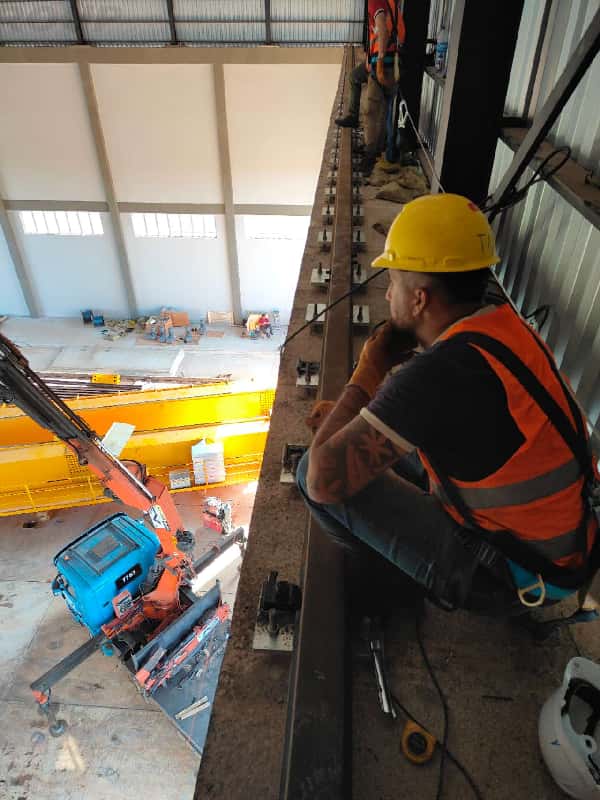
This is the most misunderstood parameter in crane procurement—and arguably the most consequential. Work duty classification is the engineering parameter that defines the operational intensity a crane is designed to withstand over its entire service life. It is determined by two fundamental variables.
The first variable is the load spectrum: what percentage of the crane’s rated capacity does it lift, on average, across all lifting cycles? A crane that routinely lifts 80% of its rated capacity experiences far greater cumulative stress than one that typically lifts 30%. The second is usage frequency: how many lifting cycles does the crane perform per hour, per shift, per day? A crane making 200 lifts daily accumulates fatigue loading twenty times faster than one making 10 lifts daily.
These two variables combine to define the crane’s total fatigue exposure. Every structural member, weld, gear tooth, bearing, brake, and electrical component must survive this cumulative loading. A crane designed for high frequency and high load percentage requires heavier structural sections, higher-grade components, and more robust electrical systems than one designed for low frequency and light loads—even if both carry the identical rated capacity.
Multiple international standards define work duty classification, and while the naming conventions differ, the underlying engineering logic is consistent.
Quick Reference: Work Duty Classification Mapping
| FEM | ISO | CMAA | Typical Application | Lifts/Hour (approx.) |
|---|---|---|---|---|
| A1–A2 | M1–M2 | Class A | Standby/infrequent maintenance, machine house cranes | <2 |
| A3 | M3 | Class B | Light workshop, assembly, occasional handling | 2–5 |
| A4 | M4 | Class C | Moderate production, general machine shop | 5–10 |
| A5 | M5 | Class D | Regular production, fabrication, warehousing | 10–20 |
| A6 | M6 | Class E | Heavy production, foundry, continuous 2-shift | 20–40 |
| A7 | M7 | Class F | Severe continuous duty, steel mill, scrap handling | 40+ |
The implication for procurement is direct. If your facility runs two or three shifts with frequent starts and stops, do not underspec the duty class. Choosing the correct duty class reduces unplanned downtime and long-term maintenance costs. A crane’s expected service life—typically around 10 years under defined operating conditions—is achievable only when the classification is correctly matched to actual usage patterns.
Complementing the formal duty class, you must define the crane’s operational rhythm:
Cranes are long-term capital assets. Therefore, specifying the expected design life upfront—15 years, 20 years, or more—allows the manufacturer to calculate the cumulative number of load cycles the crane must survive and to size structural members and components accordingly. ISO 4301 and FEM standards explicitly factor design life into their classification models, so this parameter ties directly into duty class determination.
Hoisting speed is the vertical lifting velocity of the main hook, typically expressed in meters per minute (m/min). It must balance two competing priorities: speed for productivity, and control for safety and precision. High hoisting speeds (8–12 m/min and above) improve cycle times, while lower speeds (0.5–2 m/min) enable precise inching for assembly, die setting, and mold positioning.
Modern dual-speed hoists with variable frequency drives (VFDs) provide the best of both worlds: rapid lifting for long vertical travel and micro-speed for final positioning. Dongqi Crane typically offers two-speed or VFD-controlled hoist motors that provide both a fast lifting mode and a precision creep speed—for example, 8 m/min for main lifting and 0.5 m/min for precise positioning. Dual-speed capability significantly reduces load swing while improving placement accuracy.
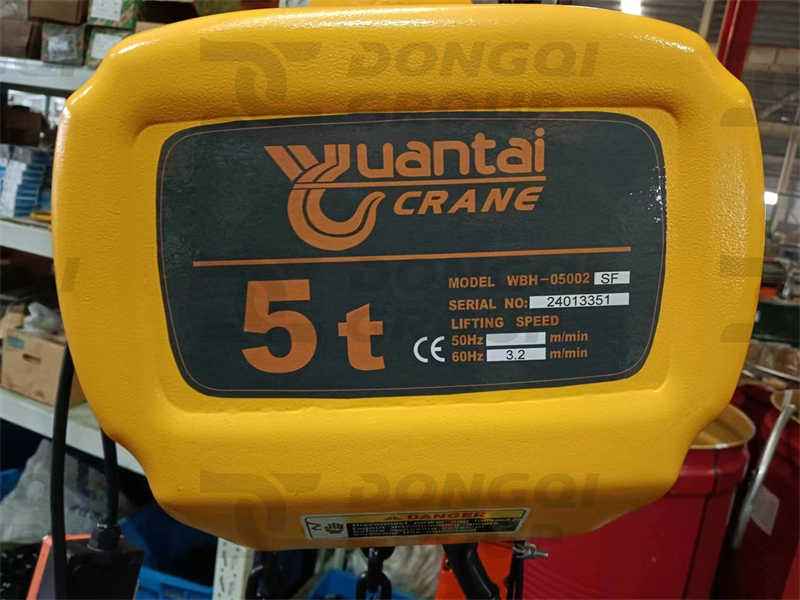
Cross-travel speed refers to the trolley movement along the bridge beam, and long-travel speed refers to the entire crane moving along the runway. These speeds determine how quickly loads traverse the workshop horizontally. Typical values:
| Crane Type | Cross-Travel Speed | Long-Travel Speed |
|---|---|---|
| Light-duty single-girder | 10–20 m/min | 20–40 m/min |
| Medium-duty double-girder | 15–25 m/min | 30–60 m/min |
| Heavy-duty double-girder | 20–30 m/min | 40–80 m/min |
Higher speeds require larger motors, heavier duty brakes, and often stiffer structures to manage dynamic forces. VFDs provide soft starts and stops that improve positioning accuracy, reduce wear on mechanical components, and lower energy consumption.
For certain applications—assembly operations, mold changes, fixture moves—the crane must position loads with millimeter-level accuracy rather than merely placing a load “in the general vicinity.” Precision requirements drive the need for creep speeds, anti-sway controls, and in some cases laser positioning systems. Dongqi Crane has deployed anti-sway controls and positioning systems that allow faster, more accurate load placement while reducing cycle times and improving safety for operators working near the load path.
Environmental conditions are not peripheral—they directly determine whether a crane can operate safely and durably in your facility. Different environmental factors will impact the performance, safety, and durability of the crane and hoist, and accounting for these conditions upfront is essential to optimizing durability and maintaining peak performance over the crane’s service life.
High ambient temperatures—common in foundries, steel mills, glass plants, and outdoor installations in hot climates—degrade standard motor insulation, accelerate lubricant breakdown, and can reduce the structural strength of materials. For high-temperature environments, specialized component specifications become mandatory. In facilities where extreme temperatures are present, specialized components are required to prevent overheating, brittleness, or freezing. Dongqi Crane recommends H-class insulated motors (withstand up to 180°C ambient), heat-resistant brake linings, and forced cooling systems for electrical cabinets when workshop temperatures regularly exceed 45°C.
Conversely, cold environments (refrigerated warehouses, outdoor winter operations) require low-temperature rated steel grades, special lubricants that remain fluid at sub-zero temperatures, and heated electrical enclosures to prevent condensation.
Facilities with heavy dust, metal particles, humidity, or chemical exposure require Ingress Protection (IP) rated enclosures. For general industrial use, IP54 provides dust and splash-proof protection. For wash-down environments (food processing, pharmaceutical), IP65 or higher may be necessary. In corrosive environments—chemical plants, marine applications, fertilizer production—galvanized structural components, stainless steel electrical enclosures, and corrosion-resistant coatings are essential. Exposure to chemicals or moisture calls for protective coatings and corrosion-resistant materials to maintain equipment integrity over the long term.
If the crane will operate in an area with flammable gases, vapors, or combustible dust, explosion-proof (ATEX or equivalent) certification is required. This affects every component on the crane: motors, brakes, electrical enclosures, limit switches, and even pendant control stations must be rated for the specific hazardous zone classification. Dongqi Crane offers explosion-proof configurations for petrochemical and chemical processing environments, with all electrical components meeting the relevant international hazardous location standards.
Crane motors and controls must match the facility’s actual power supply. Specifying the power supply incorrectly—or not specifying it at all—can mean that a correctly designed crane cannot operate because the motors are wound for a different voltage, phase configuration, or frequency. Dongqi Crane has extensive experience supplying cranes configured for diverse global electrical standards, including 415V/50Hz/3P for Pakistan industrial installations, 380V/50Hz/3P for various international markets, and 480V/60Hz/3P for North American specifications. Other factors to capture include voltage stability (acceptable fluctuation range) and whether a dedicated power feeder or transformer is available.
For existing buildings, the physical path for delivering and installing crane components must be assessed. Tight doorways, limited overhead clearance, and confined access points can prevent large pre-assembled crane sections from entering the facility. In such cases, the crane must be designed in smaller sub-assemblies or fabricated on-site—adding cost and installation time. Dongqi Crane’s engineering team routinely assesses site access conditions before finalizing crane designs for export projects, ensuring a safe, feasible, and efficient installation sequence.
Overhead crane control methods range from simple to sophisticated, and the choice affects both capital cost and operator safety:
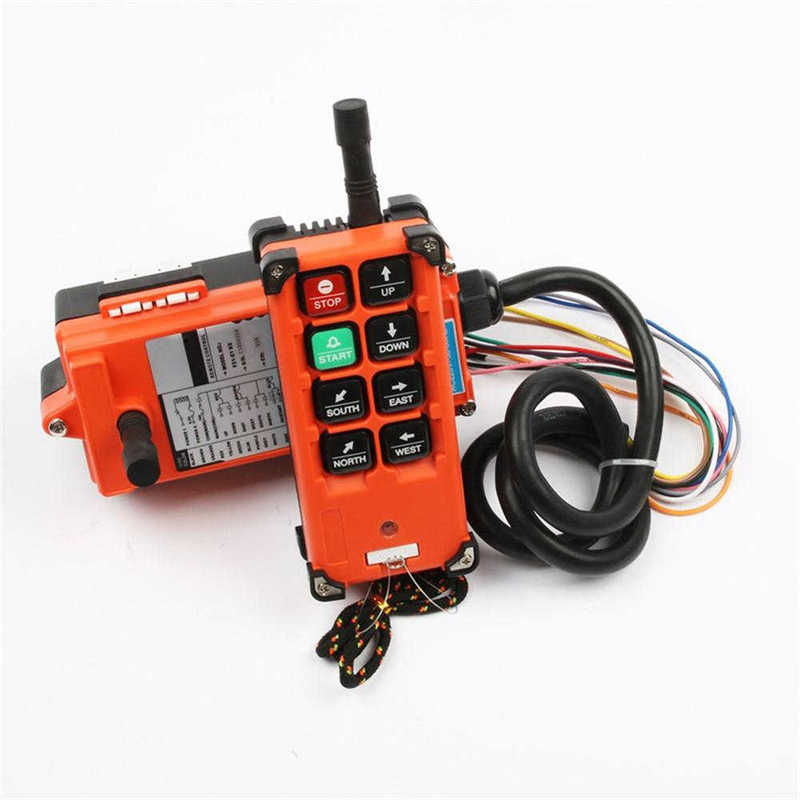
The choice between single-speed, two-speed, and VFD (variable frequency drive) control directly affects positioning accuracy, mechanical wear, energy consumption, and operator experience. VFDs provide soft starts and stops that eliminate mechanical shock loading, reduce load swing (pendulum effect), cut energy consumption, and extend the service life of motors, gearboxes, and brakes through gentler acceleration and deceleration profiles. For cranes that will operate more than a few lifts per day, the modest additional cost of VFD controls delivers substantial savings in maintenance and downtime over the crane’s life.
Every crane must incorporate fundamental safety equipment. The following should be considered mandatory for any production crane:
Dongqi Crane includes multiple safety system integrations as standard on all production-grade lifting equipment, including overload protection, end-stop limits, collision avoidance that reduces operational risk, and zone control (no-go areas) that helps protect equipment and personnel.
For facilities pursuing Industry 4.0 integration, several intelligent options are available:
Cranes are regulated equipment in most countries, and the standards that govern their design, manufacture, testing, and inspection vary by region. Buyers must know which standards their facility requires, especially for export-oriented installations or projects funded by international bodies.
Globally, three systems dominate.
Dongqi Crane manufactures cranes compliant with all three standards, as well as specific regional certifications including CE (European conformity), SGS third-party inspection, and Pakistan-specific electrical and structural requirements. When supplying a 15-ton double-girder bridge crane to a Pakistani steel coil factory, we designed and calculated the crane structure to FEM (German standard) requirements and configured the power supply for 415V/50Hz/3P to match Pakistani industrial electrical standards.
Procurement does not end at installation. To avoid the scenario described in this article’s introduction, buyers must define their service expectations from the start:
Below is the complete template, condensed into a single-page format. Procurement teams can fill this out and submit it to Dongqi Crane to receive a technically accurate, application-matched quotation within 12–24 hours.
Project Information
| Field | Entry |
|---|---|
| Company Name | |
| Project / Facility Name | |
| Contact Person & Title | |
| Email / Phone | |
| Country / Region | |
| Target Installation Date |
1. Load & Lifting Parameters
| Parameter | Your Specification |
|---|---|
| Maximum load weight (including rigging) | _ tons |
| Typical/routine load weight | _ tons |
| Load type (coils, containers, machinery, bulk, molten) | |
| Load dimensions (L × W × H) | |
| Special handling requirements (fragile, hot, hazardous) |
2. Dimensional Parameters
| Parameter | Your Specification |
|---|---|
| Required hook coverage area (L × W) | _ m × _ m |
| Building span (center-to-center runway rails) | _ m |
| Required lifting height (hook travel) | _ m |
| Available headroom (rail top to ceiling obstruction) | _ m |
| Runway type (existing / new, building-supported / freestanding) |
3. Duty & Usage Parameters
| Parameter | Your Specification |
|---|---|
| Industry type (manufacturing, steel, foundry, warehousing, etc.) | |
| Shifts per day | _ shifts |
| Operating days per year | _ days |
| Average lifts per hour | _ lifts/hr |
| Typical load as % of SWL | _ % |
| Expected equipment service life | _ years |
4. Motion & Speed Parameters
| Parameter | Your Specification |
|---|---|
| Required hoisting speed (m/min) | |
| Required cross-travel speed (m/min) | |
| Required long-travel speed (m/min) | |
| Positioning precision requirement | Normal / High / Precision |
5. Environmental & Site Conditions
| Parameter | Your Specification |
|---|---|
| Ambient temperature range (min–max) | _ °C to _ °C |
| Dust / moisture / chemical exposure | |
| Hazardous area classification (if any) | |
| Indoor or outdoor installation | |
| Power supply (voltage / phase / frequency) | _ V / Ph / __ Hz |
6. Control & Safety Requirements
| Parameter | Your Specification |
|---|---|
| Preferred control method | Pendant / Radio Remote / Cabin / Automated |
| Speed control technology | Single-speed / Two-speed / VFD |
| Special safety requirements | |
| Smart features required |
7. Standards & Support
| Parameter | Your Specification |
|---|---|
| Required certifications (CE, ISO, FEM, CMAA, SGS) | |
| Warranty expectations | |
| Service response time requirement | |
| Operator training required (Yes / No) |
Additional Notes / Special Requirements
|
|
Submit completed template to Dongqi Crane: sales010@cranesdq.com
Mistake 1: Specifying maximum capacity without stating typical usage. A crane that occasionally lifts 20 tons but routinely lifts 5 tons needs a different duty design than one lifting 20 tons every cycle. The template captures both maximum and routine loads separately.
Mistake 2: Using building width as crane span. Building width is not span. Span is runway rail center-to-center distance. The template explicitly asks for building span as a distinct dimensional entry.
Mistake 3: Ignoring headroom constraints. Many buyers specify lifting height and span but forget to measure headroom, only to discover during installation that a top-running crane cannot fit. The template captures headroom as a mandatory parameter.
Mistake 4: Assuming standard duty classification is adequate for any application. A maintenance crane and a production crane may share identical specifications in capacity, span, and lift height—yet their performance requirements and engineering are fundamentally different. The template captures operating schedule, lifts per hour, and expected service life to enable correct duty classification.
Mistake 5: Omitting environmental conditions. Standard industrial cranes are not designed for foundry heat, chemical corrosion, or outdoor exposure. The template includes dedicated environmental parameter fields.
Mistake 6: Forgetting about after-sales support. A crane discounted by 15% but unsupported with local spare parts can result in weeks of downtime costing far more than any initial savings. The template captures support expectations upfront.
Dongqi Crane’s ability to deliver precisely specified, application-matched lifting solutions is built on four complementary strengths:
Engineering Depth. With a dedicated R&D center employing over 70 senior engineers and specialized design departments covering gantry cranes, bridge cranes, hoists, and electrical control systems, Dongqi Crane provides in-house engineering for every major crane system and sub-assembly.
Manufacturing Scale and Quality. Our 240,000-square-meter facility in Changyuan, Henan—the “Cradleland of Cranes” in China—houses 2,000 sets of manufacturing and detection devices, capable of producing 10,000 crane sets per year. Advanced fabrication equipment includes automated welding systems, digital control machining centers, and multi-stage spray-paint finishing lines that ensure consistent quality across every unit produced.
Global Project Experience. Dongqi Crane products operate in 96 countries across diverse industries including steel, foundry, cement, automotive, power generation, food and beverage, electronics, and pharmaceutical manufacturing. We have delivered successful projects to manufacturing facilities in Pakistan’s Dhabeji Special Economic Zone, steel plants in Southeast Asia, glass manufacturing facilities in the Philippines, and heavy equipment factories across South Asia, each tailored to local operating conditions and regulatory requirements.
One-Stop Partnership Model. From initial consultation through design, manufacturing, logistics, installation, commissioning, operator training, and lifetime technical support, Dongqi Crane serves as a single point of accountability for the entire crane procurement lifecycle.
Filling in the one-page template above takes approximately 30 minutes of focused work—gathering load data, measuring dimensions, interviewing production supervisors about actual usage patterns, and checking environmental conditions. Those 30 minutes are the highest-return investment a procurement team can make in the entire crane acquisition process.
With a completed template, your inquiry transforms from a vague “We need a 10-ton crane” to a comprehensive engineering brief that any reputable manufacturer can use to propose the right equipment for your actual operating conditions. The quotation you receive will be technically accurate, commercially comparable across suppliers, and aligned with your real-world production requirements—not a generic specification that might or might not fit your facility.
At Dongqi Crane, we review every completed template within 12–24 hours and return a customized proposal that addresses every parameter on the sheet. Our engineers do not just quote a crane—they design a lifting solution matched to your workflow, your building, your production rhythm, and your budget.
Complete the template. Send it to sales010@cranesdq.com. Twenty-four hours later, you will be looking at a crane that is designed for your factory—not someone else’s.
© 2026 Dongqi Crane. All rights reserved. Dongqi Crane is a Sino-New Zealand joint venture crane manufacturer with over 40 years of industry experience, supplying overhead cranes, gantry cranes, jib cranes, and electric hoists to customers in 96 countries.
Contact our crane specialists
Send us a message and we will get back to you as soon as possible.