Gantry cranes are indispensable heavy-duty handling equipment in modern industrial production, and their structural performance is directly related to production safety and operational efficiency. As the core load-bearing component of a gantry crane, the design and control of its no-load camber is crucial for ensuring the long-term, stable operation of the equipment. This article systematically explores the engineering significance, standards, measurement techniques, failure analysis, and maintenance strategies of no-load camber. It also proposes a comprehensive solution for camber management based on practical application scenarios. By deeply analyzing the relationship between camber and the static stiffness and dynamic performance of cranes, examining the similarities and differences between relevant domestic and international standards, and introducing advanced camber detection and adjustment techniques, this article aims to provide a comprehensive technical reference for crane designers, manufacturers, installers, and maintenance personnel, extending equipment service life and preventing structural failures.
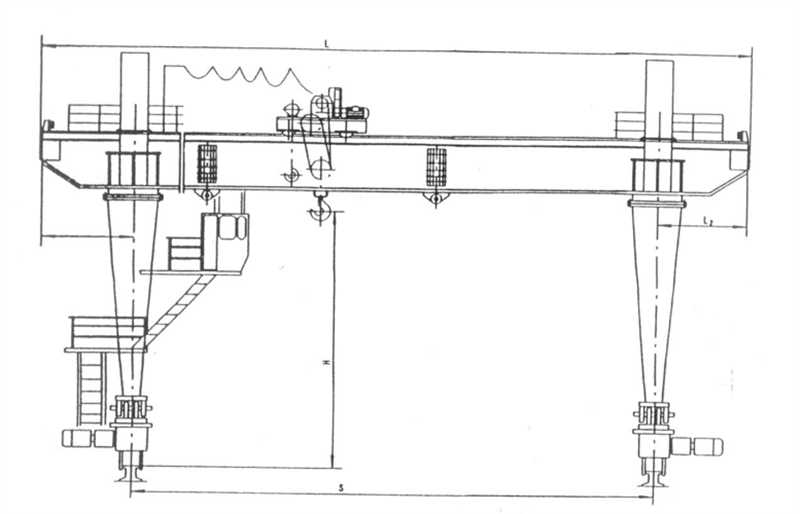
No-load camber, a core geometric parameter of a gantry crane’s main girder, refers to the predetermined vertical camber deformation of the main girder when the crane is unloaded. This design feature is by no means accidental; it is a pre-deformation measure implemented by engineers to offset the inevitable downward deflection that occurs when the crane is loaded. From the perspective of material mechanics, unloaded camber essentially improves the stress distribution of the main beam under load by pre-applying reverse deformation, thereby optimizing structural performance.
The mechanical nature of camber can be explained through beam bending theory. According to Bernoulli-Euler beam theory, the maximum deflection of a simply supported beam under a uniformly distributed load is proportional to the fourth power of the span and inversely proportional to the section moment of inertia and elastic modulus. While the design of gantry crane main beams is not a completely simply supported beam model, this basic principle still applies. Excessive downward deflection of the main beam under load will directly affect the smooth operation of the trolley and may even cause “hilling” and lead to safety accidents.
By pre-setting the unloaded camber, the net deflection can be effectively reduced, ensuring that the actual deformation of the main beam under rated load is within the allowable range. From a structural performance perspective, proper no-load camber design offers three core advantages: First, it optimizes the distribution of internal forces in the main beam, reduces maximum stress, and delays the initiation and propagation of fatigue cracks. Second, it improves the rigidity of the main beam, reduces vibration amplitude during dynamic operation, and ensures positioning accuracy. Third, it compensates for permanent deformation caused by long-term use, extending the serviceability of the equipment throughout its lifecycle. Especially for large-span cranes, proper camber design can also reduce sag caused by deadweight, maintain the straightness of the main beam, and avoid additional stress caused by excessive deformation.
It is worth noting that there have been differing views within the engineering community regarding the relationship between camber and crane performance. Some researchers believe that main beam camber is only related to the operating performance of the trolley and has no direct correlation with the main beam strength, and advocate controlling camber by adjusting the trolley track rather than the main beam itself. However, modern crane design theory has confirmed that proper camber distribution not only affects the smoothness of the operating mechanism but is also a key factor influencing the overall stress state, local stability, and dynamic characteristics of the main beam. Especially for cranes with higher operating levels, optimized camber design plays a significant role in preventing premature failure.
The coupling relationship between camber and static stiffness is also a key focus of engineering design. Static stiffness reflects the main beam’s ability to resist deformation, while camber is a pre-set initial geometric characteristic. Together, they determine the crane’s actual deflection under load. National standards typically set requirements for both camber and static stiffness. For example, GB6067, “Safety Regulations for Hoisting Machinery,” stipulates that the deflection of a crane under rated load generally should not exceed 1/700-1/1000 of the span, while the unloaded camber is 1/1000-1.4/1000 of the span. This matching relationship ensures that the crane maintains excellent structural performance across the entire operating range.
Standardized management of no-load camber of gantry cranes is crucial for ensuring safe operation of these equipment. Detailed technical specifications have been developed by national standards organizations. my country’s current standards system primarily regulates crane camber across the design, manufacturing, and inspection stages, forming a comprehensive quality control chain. A thorough understanding of the content and applicable conditions of these standards is crucial for the proper use and maintenance of cranes.
The basic range of camber standards is highly consistent across various technical specifications. The girder camber of general-purpose gantry cranes is typically specified as 1/1000 to 1.4/1000 of the span. This range applies to conventional cranes with spans between 10 and 165 meters. For a 20-meter span crane, for example, the girder camber should be controlled between 20 and 28 millimeters. This parameter represents an optimized range validated through extensive experimentation and engineering practice, ensuring the crane maintains optimal operating conditions under various operating conditions. For cranes with larger spans, such as extra-large equipment with spans between 165 and 225 meters, camber standards need to be adjusted appropriately based on their specific designs. Due to structural differences, camber standards for gantry cranes differ slightly from those for bridge cranes, but remain generally within the same order of magnitude.
The technical basis for determining camber compliance not only considers static geometric dimensions but also the crane’s operating history and current condition. The “Safety Regulations for Hoisting Machinery” (GB6067), the core standard for crane safety management in my country, clearly stipulates the minimum allowable no-load camber for in-use cranes. Generally speaking, when the no-load camber of the main beam falls below 0.7L/1000, the crane should be repaired or downgraded; when the camber falls below 0.4L/1000, it must be taken out of service and undergo a comprehensive overhaul. This tiered management strategy ensures equipment safety while providing a reasonable maintenance window. It is important to note that the impact of ambient temperature during measurement should also be considered when determining camber compliance, as the thermal expansion and contraction of steel structures can cause significant fluctuations in measured values. Ideally, camber measurements should be conducted at a temperature of approximately 20°C; appropriate adjustments should be made for other temperature conditions.
Regional standards and special requirements reflect the specific performance requirements for cranes in different operating environments. For example, in Kunming, due to the plateau environment, crane camber standards must consider the changes in material properties under low air pressure and strong ultraviolet light, as well as the effects of large temperature differences commonly found in the workplace on steel structure deformation. Similarly, camber calculations for double-girder bridge cranes in Yinchuan typically use elasticity theory, specifically designed based on factors such as the main girder’s material properties, cross-sectional shape, and length. The calculation formula is f=(5qL⁴)/(384EI), which comprehensively considers key parameters such as distributed load (q), span (L), elastic modulus (E), and section moment of inertia (I). These regional adjustments demonstrate the flexibility and adaptability of standards in practical application.
A comparative analysis of international standards reveals differences in crane safety management concepts across countries. The EU standard (EN 15011) has relatively loose requirements for crane camber, focusing primarily on overall performance under load. The US standard (CMAA), on the other hand, places stricter manufacturing tolerances on camber, particularly for the central flat zone of long-span cranes. my country’s standards were formulated by drawing on advanced international experience while incorporating the actual conditions of domestic manufacturing to achieve relatively balanced technical requirements. In the context of globalization, understanding these differences is crucial for the manufacture and acceptance of exported equipment.
Table: Comparison of no-load camber standards for gantry cranes
| Crane type | Span range(m) | Standard value of camber | Boundaries to be repaired | Scrap limit | Standard basis |
| General bridge crane | 10-165 | (1/1000-1.4/1000)L | <0.7L/1000 | <0.4L/1000 | |
| Large gantry crane | 165-225 | Special design | <0.6L/1000 | <0.35L/1000 |
The future development of camber standards presents two distinct characteristics: first, a shift from single-geometric control to full-lifecycle performance management. This involves focusing not only on initial camber values but also on how camber changes over time and its relationship to structural health. Second, a transition from empirical standards to scientific standards based on reliability analysis. This involves establishing more accurate camber-safety-life correlation models through probabilistic statistical methods and damage tolerance design. These developments will propel crane safety management into an era of intelligent and precise control.
Accurately measuring the unloaded camber of gantry cranes is fundamental to ensuring safe equipment operation and a core component of regular crane inspections. With advances in measurement technology, camber detection methods have evolved from traditional mechanical measurement to modern photoelectric measurement, significantly improving both accuracy and efficiency. Scientifically selecting measurement methods, standardizing operating procedures, and correctly processing measurement data are key to obtaining reliable camber values.
The most commonly used traditional measurement methods are the leveling method and the wire method. The leveling method utilizes the high-precision height measurement capabilities of an optical level to calculate the camber distribution by measuring the heights of several pre-marked points on the main beam. This method offers high accuracy, achieving within ±1mm, but is subject to significant limitations in the on-site environment and requires specialized personnel. The wire method is an economical and practical, simple measurement method. It involves fixing a wire with a diameter of approximately 0.5mm at each end of the main beam, applying a certain tension to maintain a straight line, and then measuring the vertical distance between the wire and the beam’s midpoint to determine the camber value. While the wire-pulling method is simple to use, it requires a correction calculation for wire sag due to its own weight. The correction factor, k = PL²/8F (where P is the wire weight per unit length, L is the span, and F is the tension), results in a certain amount of calculation error. Furthermore, wires are susceptible to wind vibrations, causing unstable measurements. Therefore, this method is often used in on-site testing under restricted conditions.
Modern photoelectric measurement technology offers a more efficient solution for camber detection. The laser linearity measurement method uses a reference beam emitted by a laser linearity gauge as a measurement reference. A mobile receiver mounted on the main beam measures the height deviation at each point, enabling continuous scanning measurement and significantly improving detection efficiency. This method is particularly suitable for camber detection of long-span cranes, enabling the acquisition of a complete camber distribution curve in a short period of time. Laser rangefinders are another widely used technology. They utilize the laser time-of-flight principle to directly measure the distance between each point on the main beam and a fixed reference point. Camber values are calculated through differential calculation, avoiding the correction issues inherent in the wire-pulling method. Photoelectric measurement technology typically achieves an accuracy of ±0.5mm and is less susceptible to environmental interference. However, the equipment is relatively expensive and requires specialized data processing software.
The selection of measurement points has a direct impact on the camber assessment results. National standards stipulate that camber measurements should be based on the center of the main beam span and extend symmetrically to both sides, with the spacing between measurement points generally not exceeding 1/10 of the span. For cranes with extra-long spans (spans > 30m), the density of measurement points should be increased, especially near the mid-span, as camber variations in this area have the most significant impact on crane performance. During actual measurements, care should be taken to avoid local structures such as main beam reinforcement plates and connecting welds to prevent them from affecting measurement accuracy. Before measurement, debris, dust, and accumulated water should be removed from the main beam to ensure a clean measurement reference surface. The crane should also be checked to ensure it is truly unloaded, including confirming that the effects of the overhanging weight of the hoisting wire rope have been eliminated.
Measurement data processing and analysis are the core steps in camber assessment. The raw measurement data must be temperature-corrected. The temperature deformation coefficient of steel structures is approximately 1.2×10⁻⁵/°C, meaning that a 10°C temperature change on a 10m-long main beam will result in a 1.2mm length change. The correction formula is Fₜ=Fₘ/[1+α(T-20)], where Fₜ is the camber value at a standard temperature of 20°C, Fₘ is the measured value, α is the linear expansion coefficient, and T is the ambient temperature. For cranes with asymmetric girders or those with localized deformation, a fitting analysis of the camber curve is also required. Common fitting methods include least squares and spline interpolation, which can identify areas of abnormal girder deformation. The measurement report should include a description of the measurement conditions, original data records, the correction calculation process, and conclusion evaluation, forming a complete chain of evidence.
Table: Comparison of main measurement methods for no-load camber of gantry cranes
| Measurement method | Accuracy range | Applicable occasions | Advantage | Limitation | Standard basis |
| Wire drawing method | ±2mm | Small and medium spans and sites with limited conditions | Simple equipment and low cost | Needs correction, affected by wind | |
| Level method | ±1mm | Precision measurement, laboratory environment | High precision and reliable data | Complex operation and low efficiency | |
| Laser linear measuring instrument | ±0.5mm | Large span, production site | High efficiency and continuous measurement | Expensive equipment | |
| Laser rangefinder | ±0.3mm | High precision requirements, special research | Non-contact, fast response | Need a stable platform |
Measurement cycles and quality control are long-term tasks in camber management. Camber measurements should be performed regularly, depending on the frequency of crane use and the working environment. It is generally recommended to measure once a year in normal working environments and once every six months in corrosive environments or heavy-load conditions. The same environmental conditions and operating methods should be maintained as much as possible for each measurement to ensure data comparability. Establishing a crane camber file to record previous measurement results and change trends will help to detect abnormal deformation of the main beam structure at an early stage and predict the remaining service life. For cranes that are close to the limit of repair, the measurement cycle should be shortened, monitoring should be strengthened, and non-destructive testing methods should be used to evaluate the internal damage condition of the main beam to provide a comprehensive basis for maintenance decisions.
Abnormal changes in the no-load camber of gantry cranes are often early signs of structural damage or performance degradation in the main girder. Systematically analyzing the causes of abnormal camber and accurately assessing its impact is fundamental to developing a sound maintenance strategy. Abnormal camber manifests primarily in two forms: insufficient camber and distorted camber distribution. Each corresponds to a different failure mechanism and potential risk. A thorough understanding of the causes and consequences of these abnormalities facilitates preventative maintenance and crane lifespan prediction.
Material degradation is an inherent factor contributing to the gradual loss of camber. Long-term exposure to alternating loads in crane main girders causes steel fatigue, manifesting as a decrease in elastic modulus and yield strength. These changes directly weaken the main girder’s stiffness and reduce its ability to maintain the desired camber. In corrosive environments, the thickness of the main girder web and upper flange plates gradually decreases due to rust, resulting in a decrease in the section moment of inertia and accelerating the degradation of camber. The high humidity found in areas like Kunming significantly exacerbates the corrosion rate of steel, exacerbating the problem of abnormal camber. Material creep is another long-term factor, particularly for high-performance cranes. Sustained stress can cause the main beam to slowly plastically deform, leading to an irreversible reduction in camber. This creep effect is more pronounced in high-temperature environments, typically manifesting as an exponential decrease in camber with age.
Overloading is a common human factor that can cause sudden changes in camber. When a crane is frequently overloaded, the tensile stress in the lower flange of the main beam can exceed the material’s yield point, resulting in permanent tensile deformation. The upper flange, in turn, experiences compressive deformation, resulting in a decrease in camber or even a shift to deflection. More seriously, chronic overloading can cause unstable wrinkling in the main beam web, leading to localized buckling. This damage not only affects camber but also significantly reduces the load-bearing capacity and fatigue life of the main beam. Camber abnormalities caused by overloading are often asymmetrical, with the point of maximum deformation offset from the mid-span, a significant difference from the symmetrical deformation pattern under design loads. Analysis of the camber curve’s shape often reveals the approximate location and history of overloading.
Accumulated structural damage is the primary cause of camber distribution distortion. Cracks or open welds in main beam welds, especially butt welds at mid-span, significantly reduce the bending stiffness of that area, resulting in a noticeable depression in the camber curve at that point. Similarly, loosening of end beam connecting bolts or loss of preload in high-strength bolts can degrade the interoperability between the main and end beams, manifesting as an overall decrease in camber values with more pronounced variations at the ends. For double-girder cranes, localized damage to a single main beam can cause camber asynchrony between the two beams, further increasing trolley resistance and the “three-legged” phenomenon (where one wheel hangs in the air). Initial defects such as delamination and slag inclusions in the steel plate at key locations of the main beam (such as the mid-span and quarter-span regions) can expand into macrocracks under alternating loads, causing abnormal camber variations.
Manufacturing and installation defects are potential causes of early camber anomalies. Inaccurate camber prefabrication during main beam web blanking or excessive welding deformation caused by improper welding techniques can cause initial camber to deviate from the design value. During installation, factors such as uneven foundation settlement and improper track adjustment can cause the main beam to be in a suboptimal support state, generating additional stress and leading to a redistribution of camber. These inherent deficiencies are often discovered during the initial inspection of the crane after commissioning, manifesting as a camber distribution that does not conform to the typical quadratic parabola or a significant asymmetry in the camber between the left and right main beams. It is worth noting that the traditional manufacturing method of achieving camber through baking to generate internal stress has been proven to be limited in effectiveness and potentially harmful. Modern processes prefer to achieve ideal camber distribution through precise material cutting control and optimized welding sequences.
The impact of abnormal camber requires a comprehensive analysis from the perspectives of safety, performance, and economy. Regarding safety, insufficient camber can significantly increase the actual deflection of the main beam under rated load. When the deflection exceeds 1/500 of the span, it can cause trolley mechanism failures, such as gear misalignment and motor overload. In extreme cases, it can lead to trolley derailment. Regarding performance, abnormal camber distribution can alter the slope of the trolley track, increase operating resistance, and reduce positioning accuracy, directly impacting crane productivity. According to field data, when the camber deviation exceeds 30% of the standard value, the trolley motor current can increase by 15%-20%. Long-term operation can lead to premature failure of the motor and reducer. Economically, the cost of camber repair increases exponentially with the severity of the anomaly. When the camber loss reaches 50%, the repair cost can reach 20%-30% of the price of a new machine. In this case, a comprehensive assessment of the economic viability of repair and replacement is necessary.
The correlation between camber and static stiffness is a key challenge in this assessment. Camber abnormalities are often accompanied by a decrease in static stiffness, but the relationship between the two is not a simple linear one. A case study at Beijing North Railway Station under the Beijing Railway Administration found that when camber drops to 70% of the standard value, static stiffness may only decrease by 10%-15%. However, when camber further drops to 50%, stiffness plummets by 30%-40%, exhibiting a distinct nonlinear characteristic. This relationship demonstrates that camber monitoring can serve as an early warning indicator of static stiffness changes, but it cannot completely replace direct stiffness measurement. A comprehensive structural assessment should include both camber and static stiffness indicators and analyze their coordinated changes.
Contact our crane specialists
Send us a message and we will get back to you as soon as possible.