A Dongqi Crane application engineer receives a request for quotation. The client, a fabrication workshop manager, has written a clear specification: “10-ton double-girder overhead crane, 16-meter span, 6-meter lift.” The engineer reviews the workshop’s operational data—attached helpfully in our Working Condition Analysis Worksheet—and notices something that stops the review cold. The heaviest single object the workshop handles weighs 2.8 tons. The average load is 1.5 tons. The workshop operates eight hours per day, five days a week, with approximately twenty lifts per hour. The requested 10-ton capacity is three times the maximum load ever experienced and more than six times the average load.
The engineer calls the client. “Can you help me understand the 10-ton capacity requirement?”
The client’s response: “Our old crane was 10 tons. We want the same. Besides, bigger is better, right? It gives us room to grow.”
This conversation, or a variation of it, occurs with remarkable frequency across the global crane industry. It reflects a deeply held but fundamentally flawed assumption: that over-specification is harmless—merely a margin of safety purchased at a modest price premium. The reality is more complex, more costly, and more dangerous than this assumption allows. A crane whose capacity is radically mismatched to its actual duty is not a safer crane; it is a more expensive crane to buy, a more expensive crane to operate, a more expensive crane to maintain, and, in some configurations, a crane that actually underperforms in the precise lifting tasks it is meant to accomplish.
This article examines the logic of crane component matching—the engineering principles that determine why a 3-ton hoist belongs to a 3-ton bridge, why a 10-ton bridge carrying a 3-ton hoist is a mismatch with real financial consequences, and how procurement professionals can avoid the most common specification errors that introduce unnecessary cost and complexity into their lifting operations.
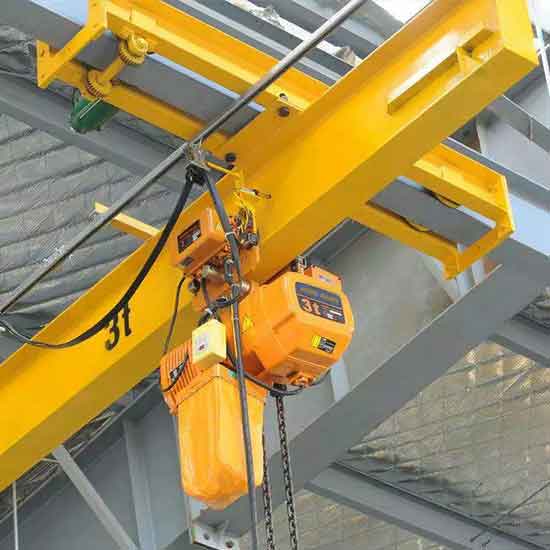
To understand why this matching error matters, we must first understand what the specification components represent. An overhead crane is not a monolithic device. It is an integrated system of sub-systems, each designed and rated for specific load conditions. The principal sub-systems are:
When we speak of a “3-ton hoist on a 10-ton bridge,” we describe a configuration where the hoist is physically capable of lifting a maximum of 3 tons (plus the weight of any below-the-hook attachment), but the bridge structure—the girders, the end carriages, the bridge drive—is sized for a 10-ton rated load. The bridge is structurally capable of carrying 10 tons, but the hoist will never ask it to carry more than 3 tons (plus hoist self-weight).
At first glance, this seems merely inefficient—a bridge designed for a heavier load than it will ever see. But the mismatch introduces a cascade of hidden costs and operational compromises.
The “3-ton hoist on 10-ton bridge” scenario typically arises through one of four decision-making pathways:
Pathway One: “Future-proofing” or “Room to grow.” The client’s current production requires a 3-ton capacity, but the client anticipates—or imagines—a future need for heavier lifting. By specifying a 10-ton bridge now and a 3-ton hoist, the client believes they are buying flexibility: when the heavier lifting need materializes, only the hoist needs to be upgraded. The bridge is already in place.
Pathway Two: “Copying the old specification.” A facility replacing an existing crane simply matches the old specification, which may have been based on a different production requirement, a different building layout, or—most commonly—a different era’s approach to engineering margins. No one questions whether the 10-ton rating is still appropriate because no one wants to be responsible for specifying something “smaller.”
Pathway Three: “The used equipment solution.” A buyer locates a second-hand 10-ton bridge at an attractive price and pairs it with a new or used 3-ton hoist, creating a hybrid crane that “should work” because the bridge rating exceeds the hoist rating.
Pathway Four: “The distributor’s stock compromise.” A crane distributor with a 10-ton bridge in inventory, needing to close a sale to a client who only needs 3 tons, proposes the combination as a “good deal”—the bridge is already built, the lead time is short, and the client gets “more crane” for a competitive price.
Each pathway has its own logic, but all four lead to the same set of engineering and financial consequences, which the following sections will detail.
The most immediate and measurable consequence of an over-specified bridge is excessive structural dead weight. A crane bridge designed for a 10-ton rated load must satisfy deflection limits, stress limits, and fatigue requirements under that load. The girders must be deeper. The flanges must be thicker. The stiffeners must be more closely spaced. The end carriages must be stronger and heavier to transfer the increased wheel loads to the runway. A 10-ton double-girder bridge typically weighs 40% to 60% more than a properly designed 3.2-ton or 5-ton bridge for the same span.
This additional steel mass is not passive. It must be accelerated and decelerated every time the bridge travels—loaded or empty. Every empty-hook return trip, which in many manufacturing operations constitutes 30% to 50% of total travel distance, consumes energy proportional to the moving mass. The bridge travel motors on a 10-ton crane are larger than those required for a 3-ton duty, drawing higher current even when moving unloaded. Over 20 years of operation, the cumulative energy penalty of unnecessarily heavy bridge steel represents a real and unnecessary operating cost.
A heavier crane imposes higher wheel loads on the runway beams and, ultimately, on the building columns and foundations. For an existing building, these higher loads may still be within the original structural design margin—or they may not. If the building was originally designed for a 5-ton crane and a 10-ton crane replacement is installed without structural verification, the runway beams may be overloaded. Deflection limits may be exceeded. Fatigue damage may accumulate in runway connections.
Even for a new building designed to accommodate a 10-ton crane, the heavier wheel loads drive up the required runway beam section, increasing the building’s structural steel cost. This cost is not captured in the crane quotation but is a direct consequence of the crane specification. A 3-ton crane with a properly sized bridge would allow lighter, less expensive runway beams. In a new construction project, the savings on building steel can significantly offset any perceived advantage of “buying capacity for the future.”
A 10-ton bridge fitted with a 3-ton hoist exhibits operational characteristics that are subtly but meaningfully inferior to a properly matched 3-ton crane:
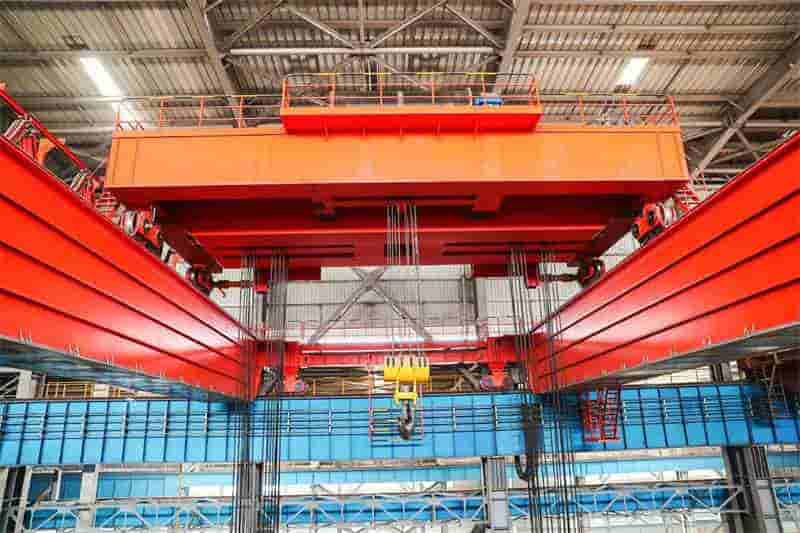
A larger crane typically requires more extensive maintenance. The electrical system—motors, contactors, VFDs, resistors, wiring—is sized for the bridge rating. More components mean more potential failure points, more spare parts to inventory, and more inspection time per cycle. A maintenance budget based on a 3-ton crane’s simplicity will be inadequate for a 10-ton crane’s complexity, even though the actual lifting work performed is no greater.
The previous section established why an over-specified bridge imposes real costs. But the logic of proper matching runs deeper. The relationship between the hoist and the bridge is governed by engineering principles that extend beyond mere capacity numbers.
When a crane lifts a load, the load follows a path through multiple components, each of which must be adequately rated:
Load → Hook → Wire Rope / Chain → Drum / Sprocket → Gearbox → Brake → Motor → Trolley Frame → Bridge Girder(s) → End Carriages → Wheels → Runway Rails → Runway Beams → Building Columns → Foundation
Each interface in this chain represents a design decision. In an optimally designed crane, all components in the path are proportioned for the same maximum load condition. No component is grossly overdesigned or underdesigned relative to the others. This proportional design minimizes total system cost, weight, and complexity while maintaining appropriate safety margins.
The “3-ton hoist on a 10-ton bridge” configuration creates an intentional weak link—the hoist—that protects an overdesigned bridge structure. But it does so at the cost of all the penalties described above while providing no operational benefit. The bridge’s excess capacity cannot be accessed until the hoist is also upgraded, which in turn may require upgrading the electrical supply, the runway, and possibly the building structure. The “room to grow” argument presumes that a simple hoist swap will unlock the bridge’s unused capacity, but in practice, the entire load path must be verified for the new capacity.
Capacity is only one dimension of crane specification. Duty class—the classification that defines how intensively the crane will operate—is equally critical and must be consistent across sub-systems.
Consider a scenario where a 3-ton hoist is selected at FEM 2m (ISO M5) duty for a moderate-intensity production operation, but paired with a 10-ton bridge designed and manufactured for FEM 1Am (ISO M3) light-duty warehouse service. The hoist is built for 20 lifts per hour, 8 hours per day; the bridge structure and end carriages are built for occasional use. In this case, the bridge—despite having higher capacity—will fatigue and fail long before the hoist because its duty class is mismatched to the actual intensity of use.
Conversely, if a 3-ton FEM 1Am hoist is paired with a 10-ton FEM 4m (ISO M7) bridge designed for steel mill continuous service, the bridge is massively overdutyed for the application, representing an even larger waste of capital and lifetime operating cost than a simple capacity mismatch.
Proper matching requires alignment of both capacity and duty class. The Dongqi Crane application engineering process evaluates both parameters simultaneously to ensure that the hoist, bridge, and end carriages are not only rated for the correct loads but also designed for the correct service intensity.
When a crane system has a deliberate weak link—in this case, a 3-ton hoist on a 10-ton bridge—the overall system capacity defaults to the weakest link. The bridge’s extra capacity is entirely inaccessible in operational terms. The crane cannot lift 10 tons because the hoist will not allow it.
In safety terms, this configuration is not hazardous—the hoist’s overload protection will prevent lifting beyond 3.2 tons (or 125% of rated capacity during test). But consider the psychological dimension: operators working under a crane bridge conspicuously rated at 10 tons may, over years of operation, come to believe that the crane is “strong enough for anything.” When an unusual lift presents itself—a 4-ton machine component requiring emergency maintenance, for example—the operator might be tempted to test the crane’s limits, overriding safety devices or using unapproved lifting arrangements, precisely because the bridge “looks like it can handle it.” A crane whose structural capacity is clearly and visibly aligned with its hoist capacity communicates an unambiguous message about its limits.
The “3-ton hoist on 10-ton bridge” is only one manifestation of a broader category of specification errors rooted in misunderstandings about how crane components interact. The following logical errors recur across procurement specifications globally. Each represents an opportunity for procurement professionals to add value through informed questioning.
The assumption: A crane with capacity far exceeding the maximum load provides a larger safety margin and is therefore inherently safer.
The reality: Safety in crane design is achieved through engineered safety factors applied to correctly specified components, not through arbitrary over-specification. A properly specified 3.2-ton crane operating at its rated capacity has the same structural safety factor (typically 4:1 or 5:1 based on ultimate tensile strength for steel structures, and higher for wire rope) as a properly specified 10-ton crane operating at its rated capacity. The safety margin is in the engineering, not in the unused capacity.
Moreover, an oversized crane may introduce new safety hazards. Heavier bridge structures have higher inertia, complicating precise positioning and increasing collision consequences in the event of control failure. Oversized motors may accelerate loads more abruptly than operators expect. Safety is achieved through correct specification, not over-specification.
The assumption: The hoist, bridge, and end carriages are independent components that can be mixed and matched freely as long as each is individually rated for the intended load.
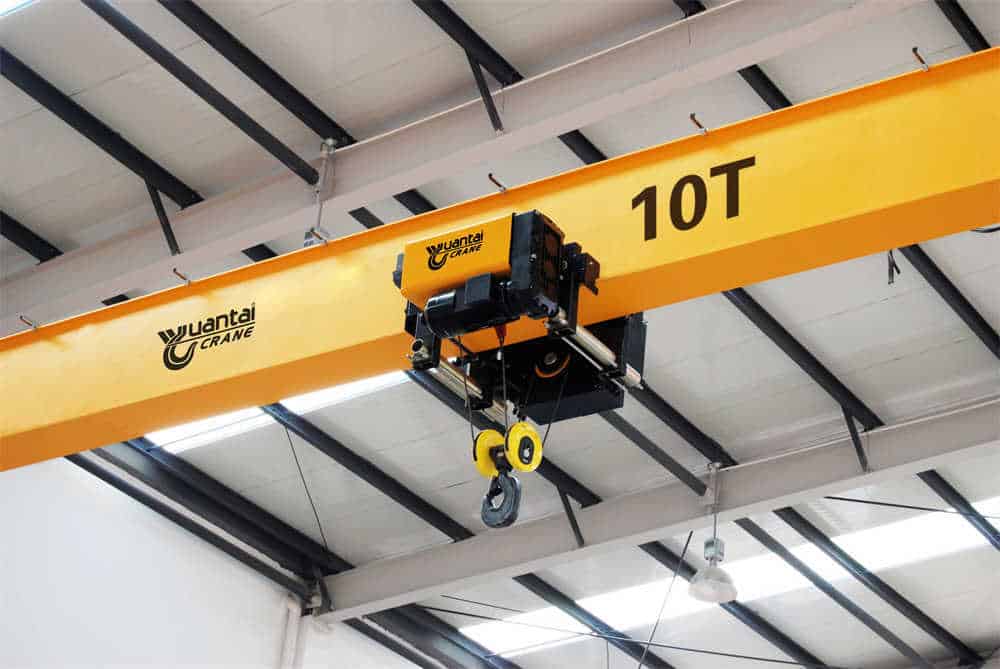
The reality: While modularity is a feature of modern crane design—Dongqi Crane’s product platform is built on standardized, interchangeable modules—the engineering integration of these modules into a specific crane configuration is not arbitrary. The interface between the hoist trolley and the bridge girder must accommodate the trolley’s wheelbase, flange width, and clearance requirements. A 3-ton hoist may have a different trolley gauge and wheel configuration than a 10-ton hoist, and the bridge girder flange designed for a 10-ton trolley may not physically accommodate the 3-ton hoist without modification. The bolted connections between the bridge girder and end carriages must be verified for the actual loads, including the specific hoist weight and wheel arrangement. The electrical supply must be rated for the actual connected load, not the bridge capacity.
The integration of components requires engineering verification. While a 3-ton hoist can physically be mounted on a bridge designed for 10 tons—it has been done, and it will lift loads—the integration is sub-optimal unless the bridge design explicitly accounted for the lighter hoist from the beginning.
The assumption: Installing a 10-ton bridge with a 3-ton hoist today allows future capacity expansion by simply replacing the 3-ton hoist with a 10-ton hoist when needed.
The reality: Upgrading the hoist from 3 tons to 10 tons involves far more than a hoist swap. The bridge girders must be verified for the increased combined load (10-ton payload plus the heavier 10-ton hoist versus 3-ton payload plus lighter 3-ton hoist). The end carriages must be adequate for the increased wheel loads. The runway beams must be adequate. The electrical supply to the crane—including the main disconnect, festoon cable or conductor bar, and power distribution panel—must be adequate for the increased connected load of the larger hoist motor. The building power supply may require an upgrade.
If any of these elements are inadequate, the “simple hoist swap” becomes a comprehensive crane replacement project. The money saved by deferring the 10-ton hoist purchase is consumed many times over by the cost and disruption of re-engineering the installation.
Dongqi Crane’s recommendation for clients with genuine, near-term (2–5 year) capacity expansion plans is to design the entire crane for the future capacity—hoist, bridge, end carriages, runway, and electrical—and accept the upfront premium as rational planning. For clients with vague, uncertain “room to grow” aspirations, we recommend specifying for current needs with a bridge design that provides a moderate capacity buffer (e.g., specifying a 5-ton bridge for a current 3.2-ton requirement) and clearly documenting the maximum upgrade potential. This approach captures genuine flexibility without the full cost of a grossly over-specified bridge.
The assumption: The hoist determines the duty class; the bridge simply needs to be strong enough.
The reality: Duty class (FEM, ISO, or CMAA classification) applies to the entire crane, not just the hoist. The bridge structure experiences cyclic loading from the combination of the hoist dead weight, the payload, and the dynamic effects of acceleration, braking, and load swing. A bridge designed for light, infrequent loading (FEM 1Am, ISO M3) will accumulate fatigue damage rapidly if subjected to heavy, frequent loading (FEM 2m/M5 or higher), regardless of whether the payload is below the rated capacity. The number of load cycles, not just the magnitude, determines fatigue life.
Matching duty class across all components is essential for consistent service life. A properly matched crane will see the hoist, bridge, and end carriages approach their design life limits at roughly the same point in time, allowing planned modernization rather than premature failure of individual components.
The assumption: The crane manufacturer’s standard configuration for a given capacity is suitable for any application at that capacity.
The reality: Standard configurations are designed for the most common applications at each capacity point, but the standard may not address specific environmental, operational, or regulatory requirements. A standard 10-ton crane may be designed with a bridge optimized for general manufacturing duty (FEM 2m, M5). Installing it in a steel mill environment without the thermal protection, dust sealing, and continuous-duty components of a metallurgical crane is a specification error that will lead to premature failure.
Similarly, a standard 3-ton crane designed for indoor industrial use will fail rapidly if installed outdoors in a coastal environment without upgrade to the corrosion protection specification.
The procurement professional’s responsibility is to ensure that the crane specification reflects the actual operating environment and duty intensity, not just the load weight. Dongqi Crane’s Working Condition Analysis Worksheet is designed to capture these variables systematically.
The assumption: A 3-ton electric wire rope hoist from any reputable manufacturer is functionally identical to any other.
The reality: Even within the same capacity rating, hoists differ significantly in parameters that determine long-term performance:
Two 3-ton hoists at similar purchase prices may have vastly different lifecycle costs if one uses a low D/d ratio drum (accelerating rope fatigue), a minimum-service-factor gearbox (requiring earlier overhaul), or a motor with inadequate thermal capacity for the actual duty cycle.
Having diagnosed the common errors, we now outline the correct approach to crane specification—one that avoids the hidden costs of gross over-specification while ensuring that the crane is properly engineered for its actual duty.
The maximum load the crane will lift is only one data point in the specification. Equally important is the load spectrum—the frequency distribution of loads the crane will handle. Dongqi Crane’s application engineering process captures this by asking clients to estimate the percentage of lifts at various load ranges:
A crane that will operate most of its life at 60% to 80% of its rated capacity is experiencing a different fatigue spectrum than one that operates at 95% continuously. The former may be satisfactorily served by a mid-range duty classification; the latter requires a higher duty class, even if both cranes have the same rated capacity.
The hoist capacity is the maximum combined weight of:
If the maximum product weight is 2.8 tons, and the permanent spreader beam weighs 0.3 tons, and a 15% dynamic factor is applied, the required hoist capacity is (2.8 + 0.3) × 1.15 = 3.57 tons. The nearest standard hoist capacity is 5 tons, not 3.2 tons and certainly not 3 tons. This simple calculation, consistently applied, prevents the common error of sizing the hoist to the product weight alone.
The bridge capacity is the sum of:
A 5-ton hoist with a trolley weighing approximately 0.8 tons requires a bridge rated for a minimum of 5.8 tons. The standard bridge rating that accommodates this is 6.3 tons or 8 tons, depending on the manufacturer’s standard increments. There is no engineering justification for a 10-ton bridge in this scenario.
The duty class is selected based on:
A workshop operating 8 hours per day, 5 days per week, with 20 lifts per hour and a moderate load spectrum will typically require FEM 2m (ISO M5) classification. An identical crane with the same capacity operating 24 hours per day in a continuous process with heavy load spectrum requires FEM 4m (ISO M7). The bridge structure, hoist, and end carriages must all be specified to the same duty class.
The following table provides a simplified reference for matching hoist and bridge specifications in typical industrial applications:
| Actual Maximum Payload (incl. attachment) | Required Hoist Capacity (with dynamic factor) | Standard Hoist Rating | Recommended Bridge Rating | Typical Duty Class (8 hrs/day, mod. spectrum) |
|---|---|---|---|---|
| Up to 0.8 tons | 1.0 tons | 1 ton | 1.6 tons | M4/FEM 1Am |
| 0.8–1.6 tons | 2.0 tons | 2 tons | 3.2 tons | M4–M5/FEM 1Am–2m |
| 1.6–2.5 tons | 3.1 tons | 3.2 tons | 5 tons | M5/FEM 2m |
| 2.5–4.0 tons | 5.0 tons | 5 tons | 6.3 or 8 tons | M5/FEM 2m |
| 4.0–6.3 tons | 7.9 tons | 8 tons | 10 tons | M5–M6/FEM 2m–3m |
| 6.3–8.0 tons | 10.0 tons | 10 tons | 12.5 or 16 tons | M5–M6/FEM 2m–3m |
Note: These are generalized starting points. Every application should be verified by an application engineer using the specific operational data. Dongqi Crane provides this verification as a standard part of our quotation process.
Engineering principles should not become dogma. There are legitimate scenarios where some degree of over-specification is justified. The key is to recognize these scenarios explicitly and document the reasoning, rather than defaulting to “bigger is better” as an unexamined assumption.
If a facility has a board-approved, budgeted expansion plan that will introduce heavier lifting requirements within 2 to 3 years, designing the crane for the future capacity may be more economical than buying a smaller crane now and replacing or extensively modifying it later. In this case, the entire crane—hoist, bridge, end carriages, runway, and electrical supply—should be specified for the future capacity from day one. The 3-ton hoist is not installed with a 10-ton bridge; rather, the full 10-ton crane is installed, and it operates under-loaded until the expansion materializes.
Research laboratories, prototype workshops, and job shops with constantly changing work may genuinely not know what loads will be lifted over the crane’s lifetime. In such environments, a moderate capacity buffer (e.g., specifying a 5-ton crane when the current maximum known load is 3.2 tons) may be prudent. However, the buffer should be modest—one or two standard capacity increments, not a factor of three—and the duty class should match the known operating intensity.
If a high-quality used 10-ton bridge is available at a genuinely compelling price for a 3-ton application, it may be economically viable—provided a qualified structural engineer verifies the bridge’s condition, fatigue status, and compatibility with the intended 3-ton hoist and the existing runway. The cost of this verification, plus the building structural review, plus the lifetime energy and maintenance penalties, must be included in the economic comparison against a new, properly sized crane. In many cases, the true cost of the used-oversized solution exceeds the new-right-sized solution.
Large organizations with multiple similar facilities may standardize on a single crane specification for fleet commonality—reducing spare parts complexity, operator training requirements, and maintenance variability. If the standard is a 10-ton crane, then all facilities get 10-ton cranes regardless of individual maximum loads. This is a legitimate operational strategy, but it must be acknowledged as a deliberate trade-off: accepting higher per-unit capital and operating costs for lower fleet management complexity. The decision should be documented as a conscious choice, not an unexamined assumption.
A recent Dongqi Crane project illustrates the value of specification scrutiny.
The initial inquiry: A South Asian structural steel fabricator requested a 10-ton double-girder overhead crane, 18-meter span, 9-meter lift. The stated reason was that their previous crane was 10 tons, and the new crane should match it.
The Dongqi investigation: Our application engineer requested the client complete our Working Condition Analysis Worksheet. The completed worksheet revealed:
Engineering analysis:
Comparison of options:
| Parameter | Client-Requested 10-ton Crane | Dongqi Recommended 5-ton on 6.3-ton Bridge |
|---|---|---|
| Hoist rating | 10 tons | 5 tons |
| Bridge rating | 10 tons | 6.3 tons |
| Duty class | FEM 2m (M5) | FEM 2m (M5) |
| Bridge dead weight (est.) | 16 tons | 11 tons |
| Bridge motor size (each) | 0.75 kW | 0.55 kW |
| Energy consumption (20-yr NPV) | $42,000 | $31,000 |
| Wheel load per end carriage | 120 kN | 82 kN |
| Runway beam section required | HE 300B or equivalent | HE 260A or equivalent |
| Estimated crane acquisition cost | $48,000 | $36,500 |
| Estimated runway structural steel saving | — | $5,200 (new build) |
| Total 20-year lifecycle cost (NPV) | $118,600 | $84,300 |
Outcome: The client accepted the Dongqi recommendation. The $34,300 lifecycle saving (net present value) was redeployed to additional production equipment. The smaller crane proved entirely adequate for the production requirement and has operated without a single overload alarm or capacity-related incident in the years since installation. The building runway beams were designed for the lighter load, contributing to a measurable reduction in building structural steel cost that the client tracked separately.
The “3-ton hoist on a 10-ton bridge” is more than a physical object. It is a monument to unexamined assumptions—the belief that bigger is naturally safer, that future capacity can be purchased cheaply by overbuilding the bridge, that crane components are interchangeable commodities rather than integrated engineering systems.
The clients who get the most value from their crane investment are not those who order the largest crane their budget permits. They are those who invest the time to specify correctly—to understand their actual loads and duty, to match the hoist and the bridge and the duty class, and to verify that the entire load path is engineered for the service it will see.
Dongqi Crane’s application engineering service exists precisely to assist with this specification process. We do not simply quote what the client requests; we review the underlying requirements and, when we identify a potential mismatch, we present the analysis and the alternatives. In the case of the structural steel fabricator described above, this review saved the client over $34,000 in net present value. In other cases, the recommendation has gone the other direction—identifying that a client’s requested 5-ton crane was dangerously undersized for the actual 6.8-ton maximum payload, and recommending an upgrade to an 8-ton or 10-ton configuration.
The engineering principle is symmetric: the crane should be neither over-specified nor under-specified. It should be correctly specified. Achieving this requires data, analysis, and a manufacturer whose commercial interest is aligned with the client’s long-term operational interest. At Dongqi Crane, that alignment is the foundation of our client relationships.
To request a specification review for your upcoming crane project, contact Dongqi Crane’s application engineering team with your operational data. Our engineers will perform a no-obligation analysis and provide a written recommendation for the crane configuration that matches your actual requirements. If a smaller, less expensive crane is the right answer, we will recommend it. If a larger, more robust crane is required, we will explain exactly why. Engineering integrity does not serve one direction exclusively; it serves the truth of the data.
Dongqi Crane—Henan Dongqi Machinery Co., Ltd.—is a Sino-New Zealand joint venture with a 240,000-square-meter manufacturing facility and an installed base in over 96 countries. Our application engineering team comprises 70+ senior engineers supported by 500+ technical staff, delivering crane configurations from 1 ton to over 500 tons across all FEM, ISO, and CMAA duty classifications. Certifications include CE, ISO 9001, ISO 14001, ISO 45001, ISO 50001, and GJB9001C.
Contact our crane specialists
Send us a message and we will get back to you as soon as possible.